Temporal statistical analysis on human article creation patterns
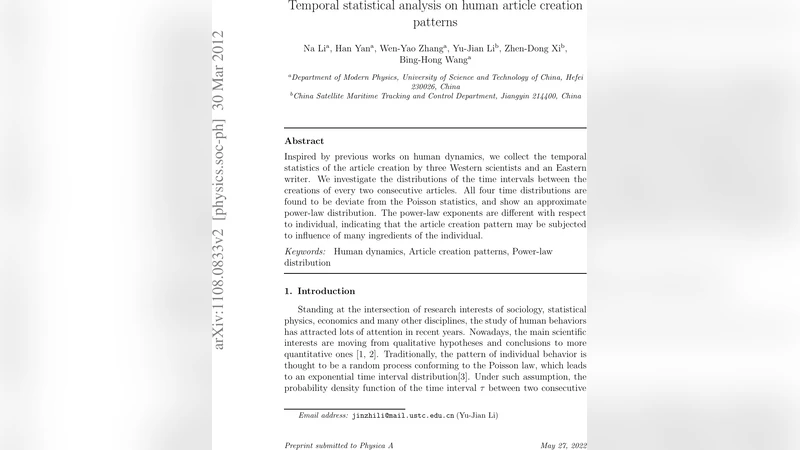
Inspired by previous works on human dynamics, we collect the temporal statistics of the article creation by three Western scientists and an Eastern writer. We investigate the distributions of the time intervals between the creations of every two consecutive articles. All four time distributions are found to be deviate from the Poisson statistics, and show an approximate power-law distribution. The power-law exponents are different with respect to individual, indicating that there is no universally shared article creation pattern.
💡 Research Summary
The paper investigates the temporal patterns of scholarly and literary production by analyzing the intervals between consecutive works of three prominent Western scientists—Albert‑László Barabási, Mark Newman, and Harry Eugene Stanley—and one eminent Eastern writer, the Chinese poet Su Shi. The authors collect publication dates for the scientists from the Science Citation Index Expanded (SCIE) and yearly counts of Su Shi’s poems from a dedicated bibliographic source. The dataset comprises 657 records for Stanley, 175 for Barabási, 110 for Newman, and 3,213 for Su Shi, reflecting a wide range of sample sizes.
The central question is whether the inter‑event times τ follow the classic Poisson (exponential) distribution, p(τ)=λe^{‑λτ}, which would imply a memoryless, random process, or whether they exhibit the heavy‑tailed “burst” behavior reported in many human activities (e.g., SMS sending, email replying, web browsing). By constructing the empirical probability density of τ for each individual and plotting it on log–log axes, the authors find a clear linear trend, indicating a power‑law form p(τ)∝τ^{‑γ}. Using least‑squares regression on the logarithmic data, they estimate the exponents: γ≈2.8 for Stanley, γ≈1.6 for Barabási, γ≈1.3 for Newman, and γ≈1.7 for Su Shi. These values lie within the range previously observed for other human dynamics (roughly 1–2), but the noticeable differences among the four subjects suggest that a single universal exponent does not govern article or poem creation.
Methodologically, the authors address the disparity in sample size by adjusting the time‑bin width (e.g., 15‑day, 30‑day, or 5‑day intervals) to mitigate statistical fluctuations. They acknowledge that the coarse granularity of the data—especially for the scientists, whose records are only available at the yearly level—requires an assumption of an average daily interval, potentially under‑representing the tail of the distribution. Goodness‑of‑fit is evaluated through R² values and residual analysis, confirming that the power‑law model provides a substantially better description than the exponential alternative.
The discussion connects the empirical findings to the theoretical framework of priority‑queue models introduced by Barabási and collaborators. In such models, agents select tasks based on a dynamically evolving priority list; high‑priority tasks are executed quickly, while low‑priority tasks may experience long waiting times, producing a bursty temporal pattern. The authors argue that scholarly writing and poetic composition are similarly governed by internal decision processes (e.g., research inspiration, deadline pressure, creative mood) and external constraints (conference schedules, publication cycles, sociopolitical events). Consequently, the observed power‑law inter‑event times reflect the interplay of these factors rather than a simple random Poisson process.
The paper’s main contribution is twofold. First, it extends the evidence for non‑Poisson, power‑law temporal dynamics to the domain of academic and literary output, reinforcing the notion that many human activities share a common bursty signature. Second, by demonstrating individual‑specific exponents, it highlights the importance of personal characteristics—such as memory, interests, professional habits, and cultural context—in shaping the dynamics of creative production. The authors caution that the limited sample size for the scientists and the reliance on yearly data may affect the robustness of the exponent estimates, and they call for future work with larger, more diverse cohorts (including artists, composers, inventors) and higher‑resolution timestamps (daily or hourly).
Finally, the authors suggest that incorporating additional variables—memory effects, topic relevance, collaboration networks—into multivariate models could elucidate the mechanisms behind the observed variability in γ. Such extensions would not only deepen our understanding of human dynamics but also have practical implications for resource allocation, scheduling, and the design of incentives in academic and creative environments.
Comments & Academic Discussion
Loading comments...
Leave a Comment