Trusted Network Selection using SAW and TOPSIS Algorithms for Heterogeneous Wireless Networks
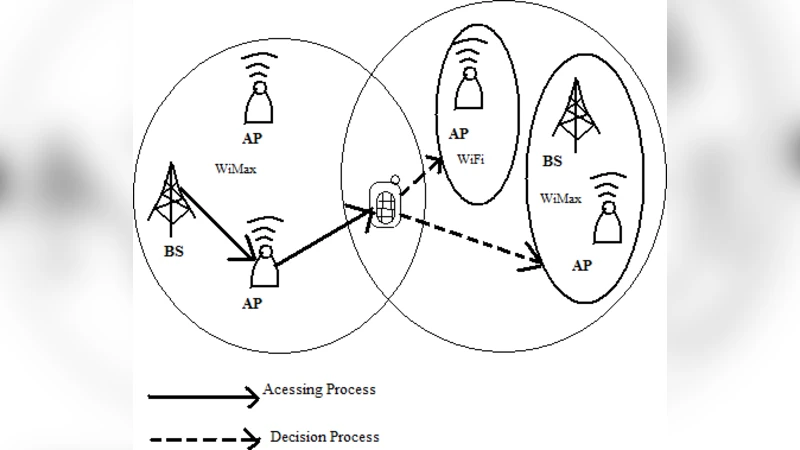
Seamless continuity is the main goal in fourth generation Wireless networks (FGWNs), to achieve this “HANDOVER” technique is used, when a mobile terminal(MT) is in overlapping area for service continuity, Handover mechanism are mainly used. In Heterogeneous wireless networks main challenge is continual connection among the different networks like WiFi, WiMax, WLAN, WPAN etc. In this paper, Vertical handover decision schemes are compared and Multi Attribute Decision Making (MADM) is used to choose the best network from the available Visitor networks (VTs) for the continuous connection by the mobile terminal. In our work we mainly concentrated to the handover decision phase and to reduce the processing delay in the period of handover. MADM algorithms SAW and TOPSIS where compared to reduce the processing delay by using NS2 to evaluate the parameters for processing delay.
💡 Research Summary
The paper addresses the problem of vertical handover (VHO) decision making in heterogeneous wireless environments, where a mobile terminal (MT) must switch among multiple access technologies (e.g., Wi‑Fi, Wi‑Max, WLAN, WPAN) to maintain seamless service continuity. The authors focus on the handover decision phase, which is critical because it determines the target network and directly influences processing delay, end‑to‑end latency, and overall throughput.
Three handover decision architectures are examined: Centralized VHO Decision (C‑VHD), Distributed VHO Decision (D‑VHD), and Trusted Distributed VHO Decision (T‑DVHD). In the centralized scheme the MT exchanges all QoS information with neighboring networks, leading to high signaling overhead and processing delay. The distributed scheme offloads the decision computation to each candidate Visitor Network (TVN); each TVN evaluates its own Network Quality Value (NQV) based on a set of criteria and returns this scalar to the MT, which then selects the TVN with the highest NQV. The trusted variant adds a “Level of Trust” (LOT) test: a TVN is considered only if its LOT exceeds a predefined threshold; otherwise the MT either looks for another TVN or aborts the handover. This mechanism aims to avoid unnecessary handovers and to improve security.
The decision problem is formulated as a Multi‑Attribute Decision Making (MADM) problem. Four attributes are considered: bandwidth (B), delay (D), cost (C), and jitter (J). Each attribute is assigned a weight according to the user’s service profile (e.g., voice, video). The authors compare two well‑known MADM techniques: Simple Additive Weighting (SAW) and Technique for Order Preference by Similarity to Ideal Solution (TOPSIS).
SAW normalizes each attribute, multiplies by the corresponding weight, and sums the results to obtain a score for each TVN. TOPSIS first normalizes and weights the decision matrix, then identifies the positive ideal solution (best values for all attributes) and the negative ideal solution (worst values). Euclidean distances from each TVN to both ideal points are computed, and a closeness coefficient (Ci*) is derived as Si‑/(Si*+Si‑). The TVN with the highest Ci* is selected.
A numerical example is presented where a MT currently attached to a Wi‑Fi cell must choose among six candidate networks (A1‑A6), two of which are Wi‑Fi and the rest Wi‑Max. The user runs a voice application, and the weight vector is set to Wv =
Comments & Academic Discussion
Loading comments...
Leave a Comment