Epidemics on Interconnected Networks
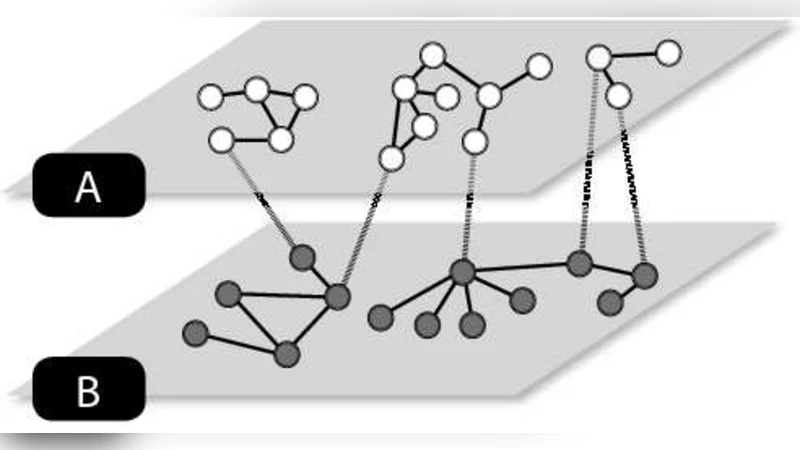
Populations are seldom completely isolated from their environment. Individuals in a particular geographic or social region may be considered a distinct network due to strong local ties, but will also interact with individuals in other networks. We study the susceptible-infected-recovered (SIR) process on interconnected network systems, and find two distinct regimes. In strongly-coupled network systems, epidemics occur simultaneously across the entire system at a critical infection strength $\beta_c$, below which the disease does not spread. In contrast, in weakly-coupled network systems, a mixed phase exists below $\beta_c$ of the coupled network system, where an epidemic occurs in one network but does not spread to the coupled network. We derive an expression for the network and disease parameters that allow this mixed phase and verify it numerically. Public health implications of communities comprising these two classes of network systems are also mentioned.
💡 Research Summary
The paper investigates how infectious diseases spread when populations are represented as multiple, interconnected networks rather than isolated groups. Using the classic susceptible‑infected‑recovered (SIR) framework, the authors model each community as a network characterized by an internal link probability (p_in) and an external link probability (p_out) that connects it to other communities. They focus on two limiting regimes of inter‑network coupling.
In the strongly‑coupled regime, p_out is comparable to or larger than p_in, creating many cross‑community edges. Under these conditions the collection of networks behaves like a single large graph. The authors derive a system‑wide critical infection strength β_c that is lower than the critical value for any individual network. When the transmission probability β exceeds β_c, an epidemic erupts simultaneously across all coupled networks; below β_c the disease dies out. This regime models highly mobile societies, major transportation hubs, or densely linked urban regions where a pathogen can quickly traverse community boundaries.
In contrast, the weakly‑coupled regime features a much smaller p_out relative to p_in, so only a few bridges exist between communities. Here the authors identify a “mixed phase.” If β lies between the critical value for a single network (β_c^A) and the system‑wide critical value (β_c^total), an epidemic can take off in one network (A) while failing to spread to the other (B). They formalize this condition with an inequality that incorporates p_in, p_out, network sizes, and the recovery probability γ. The mixed phase exists only when the inter‑network connectivity is sufficiently low to keep the effective reproduction number across the bridge below one, even though it remains above one within the originating network.
The theoretical predictions are validated through extensive Monte‑Carlo simulations on Erdős–Rényi random graphs and Barabási–Albert scale‑free graphs. The numerical results confirm the analytically derived β_c values and the boundaries of the mixed phase. Additional experiments explore how the number of initial infections and disparities in network size affect the width of the mixed region; larger size differences and smaller seed numbers tend to enlarge the mixed phase.
From a public‑health perspective, the findings suggest that communities with weak inter‑network ties can act as natural buffers, allowing targeted containment measures within a single region without immediate risk of spillover. Conversely, strongly‑coupled regions require coordinated, system‑wide interventions such as travel restrictions, mass testing, or temporary reduction of cross‑community links to prevent simultaneous outbreaks. The authors argue that real‑time measurement of inter‑community connectivity and adaptive re‑configuration of network links should be integral to modern epidemic response strategies. By quantifying how coupling strength reshapes epidemic thresholds, the study provides a rigorous foundation for designing differentiated, network‑aware control policies in an increasingly interconnected world.
Comments & Academic Discussion
Loading comments...
Leave a Comment