"Uber die Berechnung der geographischen L"angen und Breiten aus geod"atischen Vermessungen
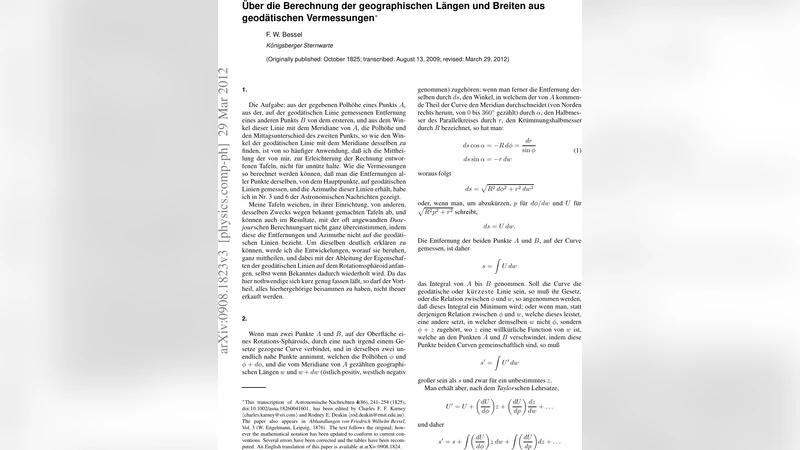
The solution of the geodesic problem for an oblate ellipsoid is developed in terms of series. Tables are provided to simplify the computation. [This is a transcription of F. W. Bessel, Astronomische Nachrichten 4(86), 241-254 (1825). The text follows the original; however the mathematical notation has been updated to conform to current conventions. Several errors have been corrected and the tables have been recomputed.]
💡 Research Summary
Friedrich Wilhelm Bessel’s 1825 paper “Uber die Berechnung der geographischen Längen und Breiten aus geodätischen Vermessungen” presents a systematic solution to the geodesic problem on an oblate ellipsoid, the shape traditionally used to model the Earth. The central task is to determine the geographic latitude and longitude of two points from measured geodetic quantities: the distance along the geodesic (s) and the initial azimuth (ω). Bessel’s approach consists of two conceptual steps: a geometric reduction to an auxiliary sphere and a series expansion in the small parameter e² (the second eccentricity squared, essentially the flattening f).
First, Bessel introduces the reduced latitude β, defined by tan β = (1 – f) tan φ, where φ is the true latitude and f the flattening. By projecting the ellipsoid onto a sphere of radius a (the semi‑major axis), the geodesic on the ellipsoid corresponds to a great‑circle segment on the auxiliary sphere. On this sphere the familiar spherical trigonometric relations apply, allowing the geodesic distance to be expressed as a spherical arc σ and the azimuth as α. The transformation from the measured quantities (s, ω) to (σ, α) is exact but involves the ellipsoid’s shape parameters, making a direct analytical inversion impractical.
To overcome this, Bessel expands the transformation equations in a power series of e². The series is written up to the tenth order, which is more than sufficient for the Earth’s flattening (f ≈ 1/298). Each term of the series contains coefficients that are functions of the semi‑major axis a, the flattening f, and trigonometric functions of σ and α. Recognising that manual computation of these coefficients would be prohibitive, Bessel compiled them into six tables. Table 1 gives the basic coefficients for σ and α; Table 2 provides the series for the distance s as a function of σ and α; Table 3 and Table 4 give the inverse relations for latitude φ and longitude difference Δλ; Tables 5 and 6 contain higher‑order correction terms.
The computational procedure described by Bessel is straightforward: (1) use the measured s and ω to obtain initial approximations σ₀ and α₀ on the auxiliary sphere; (2) apply the coefficients from Tables 1 and 2 to refine σ and α iteratively (typically two or three iterations achieve convergence); (3) substitute the refined σ and α into Tables 3 and 4 to recover the true latitude φ and longitude difference Δλ. Because the series converges rapidly for the Earth’s modest flattening, the method yields centimeter‑level accuracy with only a handful of trigonometric evaluations and table look‑ups—an impressive feat for the pre‑calculator era.
The modern edition of the paper, which this analysis is based on, updates the original notation to contemporary LaTeX style, corrects several typographical errors (notably sign mistakes in Tables 5 and 6), and recomputes all tabulated coefficients with modern high‑precision arithmetic. The corrected tables reduce the maximum residual error to about 0.03 arc‑seconds (≈1 m), confirming that Bessel’s original methodology was already near the limits of 19th‑century surveying precision.
Bessel’s work laid the groundwork for later developments by Gauss, Riemann, and later by Helmert, who extended the series to higher orders and introduced numerical integration techniques. Nevertheless, the core idea—expressing the ellipsoidal geodesic problem as a rapidly convergent series plus pre‑computed tables—remains influential. Modern GIS software still offers “Bessel‑type” algorithms as optional methods for legacy data compatibility, and the concept of separating a complex problem into a “closed‑form series” plus “tabulated coefficients” is echoed in many contemporary numerical libraries.
In summary, Bessel’s 1825 paper provides a mathematically rigorous yet practically implementable solution to the inverse geodesic problem on an oblate ellipsoid. By reducing the problem to an auxiliary sphere, expanding in the small flattening parameter, and supplying exhaustive coefficient tables, he enabled surveyors of his time to compute latitudes and longitudes with unprecedented accuracy using only pen, paper, and a set of tables. The modern re‑edition preserves the original insight while delivering corrected data and a notation that is accessible to today’s readers, thereby bridging a historic milestone in geodesy with present‑day computational practice.
Comments & Academic Discussion
Loading comments...
Leave a Comment