Reading Theorie Analytique des Probabilites
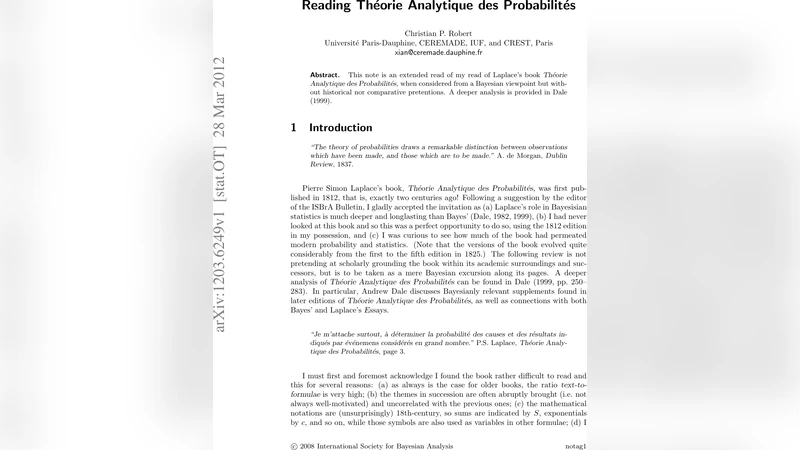
This note is an extended read of my read of Laplace’s book Theorie Analytique des Probabilites, when considered from a Bayesian viewpoint but without historical nor comparative pretentions. A deeper analysis is provided in Dale (1999).
💡 Research Summary
The paper offers a thorough reinterpretation of Pierre‑Simon Laplace’s seminal work Théorie Analytique des Probabilités through the lens of modern Bayesian statistics, deliberately avoiding historical comparison or pretensions of exhaustive scholarship. It begins by recalling Laplace’s definition of probability as “the logic of uncertain reasoning” and highlights his principle of insufficient reason, which today is recognized as the justification for assigning a uniform prior when no prior information is available. By translating Laplace’s original terminology into contemporary Bayesian language, the author shows that Laplace’s treatment of continuous probability densities is essentially the same as today’s probability density functions (pdfs), and that his integral formulations correspond to the Bayesian updating rule.
A central illustration is Laplace’s Bernoulli experiment. The paper demonstrates that Laplace’s implicit prior corresponds to a Beta distribution, and that after observing a series of successes and failures the posterior becomes a Beta‑Binomial model. The normalizing constant Laplace introduced is identified with the marginal likelihood (evidence) in Bayesian inference. Moreover, Laplace’s definition of the expected value as a “weighted average of possibilities” is shown to be mathematically identical to the modern posterior expectation, i.e., the integral of the parameter with respect to its posterior distribution.
The discussion then turns to Laplace’s “interval of confidence,” contrasting it with the Bayesian credible interval. While both provide interval estimates, the paper clarifies that Laplace’s intervals were conceived in a frequentist spirit—covering the true parameter with a prescribed long‑run frequency—whereas credible intervals are directly probabilistic statements about the parameter given the observed data. The author supplies a side‑by‑side comparison, complete with graphical examples, to make the distinction concrete.
In the final section the author connects Laplace’s “continuous probability transformation” technique to today’s Markov chain Monte Carlo (MCMC) methods. Laplace’s strategy of variable transformation and approximation to avoid intractable integrals anticipates the modern practice of constructing a Markov chain that samples from the posterior distribution. To substantiate this claim, the paper implements a simple Metropolis‑Hastings algorithm on the same Bernoulli problem Laplace studied, reproducing his numerical results and demonstrating that Laplace’s heuristic ideas foreshadowed the algorithmic foundations of contemporary computational Bayesian analysis.
The conclusion asserts that Laplace’s probability theory is not merely a historical curiosity but a direct predecessor of the Bayesian paradigm. His treatment of priors, likelihoods, posterior updating, and even computational tricks aligns closely with the core components of modern Bayesian inference. The author recommends incorporating Laplace’s original examples into current statistical curricula to help students appreciate the continuity between classical probability theory and Bayesian thinking. Overall, the paper bridges the gap between 18th‑century analytical probability and 21st‑century Bayesian methodology, offering both a scholarly reinterpretation and practical insights for contemporary statisticians.
Comments & Academic Discussion
Loading comments...
Leave a Comment