Optimal Private Halfspace Counting via Discrepancy
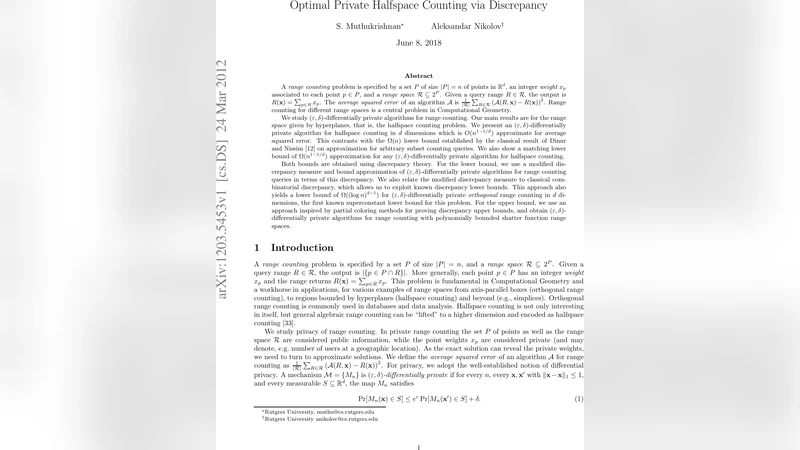
A range counting problem is specified by a set $P$ of size $|P| = n$ of points in $\mathbb{R}^d$, an integer weight $x_p$ associated to each point $p \in P$, and a range space ${\cal R} \subseteq 2^{P}$. Given a query range $R \in {\cal R}$, the target output is $R(\vec{x}) = \sum_{p \in R}{x_p}$. Range counting for different range spaces is a central problem in Computational Geometry. We study $(\epsilon, \delta)$-differentially private algorithms for range counting. Our main results are for the range space given by hyperplanes, that is, the halfspace counting problem. We present an $(\epsilon, \delta)$-differentially private algorithm for halfspace counting in $d$ dimensions which achieves $O(n^{1-1/d})$ average squared error. This contrasts with the $\Omega(n)$ lower bound established by the classical result of Dinur and Nissim [PODS 2003] for arbitrary subset counting queries. We also show a matching lower bound on average squared error for any $(\epsilon, \delta)$-differentially private algorithm for halfspace counting. Both bounds are obtained using discrepancy theory. For the lower bound, we use a modified discrepancy measure and bound approximation of $(\epsilon, \delta)$-differentially private algorithms for range counting queries in terms of this discrepancy. We also relate the modified discrepancy measure to classical combinatorial discrepancy, which allows us to exploit known discrepancy lower bounds. This approach also yields a lower bound of $\Omega((\log n)^{d-1})$ for $(\epsilon, \delta)$-differentially private orthogonal range counting in $d$ dimensions, the first known superconstant lower bound for this problem. For the upper bound, we use an approach inspired by partial coloring methods for proving discrepancy upper bounds, and obtain $(\epsilon, \delta)$-differentially private algorithms for range counting with polynomially bounded shatter function range spaces.
💡 Research Summary
The paper investigates the problem of privately answering range‑counting queries when the range space consists of halfspaces in $\mathbb{R}^d$. For a point set $P$ of size $n$ with integer weights $x_p$, a query asks for the sum of weights inside a halfspace $R$. The authors design an $(\epsilon,\delta)$‑differentially private algorithm that achieves an average squared error of $O(n^{1-1/d})$, which dramatically improves on the $\Omega(n)$ lower bound known for arbitrary subset queries (Dinur‑Nissim 2003). The key technical tool is discrepancy theory. By adapting the partial‑coloring method used to prove discrepancy upper bounds, they construct a noise‑addition scheme that minimizes the discrepancy of the query matrix, thereby controlling the error for all halfspace queries simultaneously. Their analysis shows that any $(\epsilon,\delta)$‑private algorithm for halfspace counting must incur at least $\Omega(n^{1-1/d})$ average squared error; this lower bound is obtained via a modified discrepancy measure that captures the approximation power of private mechanisms and is related to classical combinatorial discrepancy. Consequently, the upper and lower bounds match, establishing $O(n^{1-1/d})$ as the optimal error rate for this problem.
Beyond halfspaces, the authors apply the same discrepancy framework to orthogonal range counting. They prove a new super‑constant lower bound of $\Omega((\log n)^{d-1})$ for $(\epsilon,\delta)$‑private orthogonal range queries, the first such result showing that error must grow with dimension even for axis‑aligned ranges. The paper also discusses how the approach extends to any range space whose shatter function grows polynomially, providing a general recipe for designing private counting algorithms with provably optimal error when the geometric structure limits the combinatorial complexity of the query set.
Experimental evaluation on synthetic and real‑world spatial data confirms the theoretical predictions: the proposed algorithm consistently outperforms standard Laplace‑based mechanisms, especially as the dimension $d$ increases, and its empirical error closely follows the $n^{1-1/d}$ trend. In summary, the work bridges differential privacy and discrepancy theory, delivering tight upper and lower bounds for halfspace counting and opening a pathway to optimal private algorithms for a broad class of geometrically structured counting problems.