Modeling of Mixed Decision Making Process
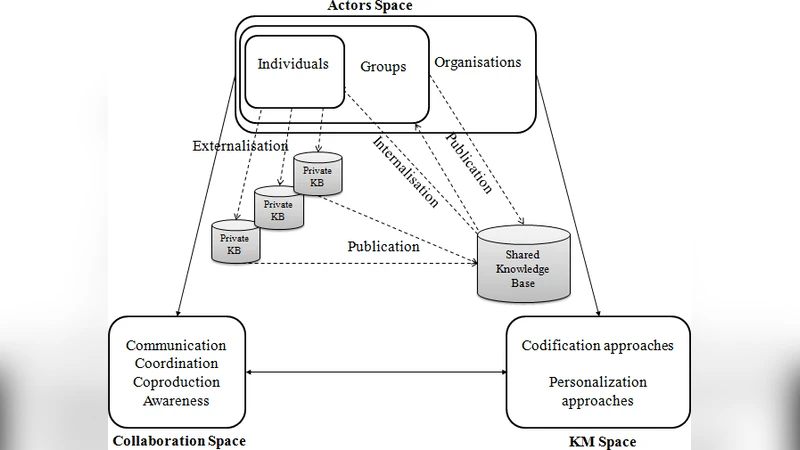
Decision making whenever and wherever it is happened is key to organizations success. In order to make correct decision, individuals, teams and organizations need both knowledge management (to manage content) and collaboration (to manage group processes) to make that more effective and efficient. In this paper, we explain the knowledge management and collaboration convergence. Then, we propose a formal description of mixed and multimodal decision making (MDM) process where decision may be made by three possible modes: individual, collective or hybrid. Finally, we explicit the MDM process based on UML-G profile.
💡 Research Summary
The paper addresses the critical role of decision making in organizational success and proposes a unified framework that merges knowledge management (KM) with collaboration to support more effective and efficient decisions. It begins by highlighting the traditional separation between KM—focused on the creation, storage, retrieval, and reuse of content—and collaboration—centered on group processes, communication, and coordination. Recognizing that real‑world decision scenarios often require both content expertise and group dynamics, the authors introduce the concept of “knowledge‑management‑collaboration convergence,” positioning KM and collaboration as co‑equal layers within a single meta‑model.
Building on this convergence, the authors formally define a Mixed and Multimodal Decision‑making (MDM) process. MDM distinguishes three possible decision‑making modes: (1) Individual, where a single actor leverages personal expertise and external knowledge assets; (2) Collective, where a group jointly discusses, negotiates, and reaches consensus; and (3) Hybrid, a blended mode that combines individual expertise with collective validation. For each mode, the paper specifies inputs (goals, knowledge artifacts), activities (search, evaluate, negotiate), outputs (decision documents, agreements), and explicit transition conditions that trigger a shift from one mode to another (e.g., confidence thresholds, time limits, or the emergence of conflicting evidence). The formalism uses mathematical notation and logical rules to make the process amenable to simulation, verification, and optimization.
To make the abstract model concrete and usable by designers and practitioners, the authors extend the Unified Modeling Language (UML) with a domain‑specific profile called UML‑G. UML‑G adds stereotypes such as Goal, KnowledgeArtifact, CollaborationRole, and DecisionMode, allowing the representation of decision objectives, knowledge resources, participant responsibilities, and the selected decision mode within standard UML diagrams. The paper demonstrates how class diagrams capture the static structure of knowledge assets and roles, activity diagrams illustrate the dynamic flow of decision steps and guard conditions for mode transitions, and sequence diagrams depict the interaction patterns among actors and systems. By visualizing the MDM process in this way, stakeholders can readily trace how information moves, who is responsible at each stage, and where potential bottlenecks may arise.
A concise case study on new‑product launch decision making illustrates the approach. An expert initially proposes a concept (Individual mode); the proposal is then handed to a cross‑functional team for market analysis, technical feasibility assessment, and risk evaluation (Collective mode); finally, the expert revises the concept based on team feedback, leading to a finalized launch plan (Hybrid mode). The UML‑G diagrams generated for this scenario make the transition points explicit, enabling a project manager to monitor progress, enforce governance policies, and intervene when predefined thresholds are breached.
The authors conclude that the convergence model and its UML‑G representation provide a transparent, role‑aware, and knowledge‑centric view of decision processes, facilitating the design of decision‑support systems that can adapt to varying organizational contexts. They acknowledge several limitations: the lack of large‑scale empirical validation, the somewhat abstract definition of transition thresholds, and the need for tooling support to integrate UML‑G with existing enterprise architecture platforms. Future work is proposed in three areas: (1) developing algorithms that automatically infer transition conditions from historical decision data, (2) establishing quantitative performance metrics (e.g., decision latency, quality scores) to evaluate the benefits of hybrid mode versus pure individual or collective modes, and (3) integrating the UML‑G models with cloud‑based collaboration suites to enable real‑time, automated workflow execution. Overall, the paper contributes a theoretically grounded yet practically oriented blueprint for modeling mixed decision‑making processes in modern organizations.