Driven polymer translocation through a cylindrical nanochannel: Interplay between the channel length and the chain length
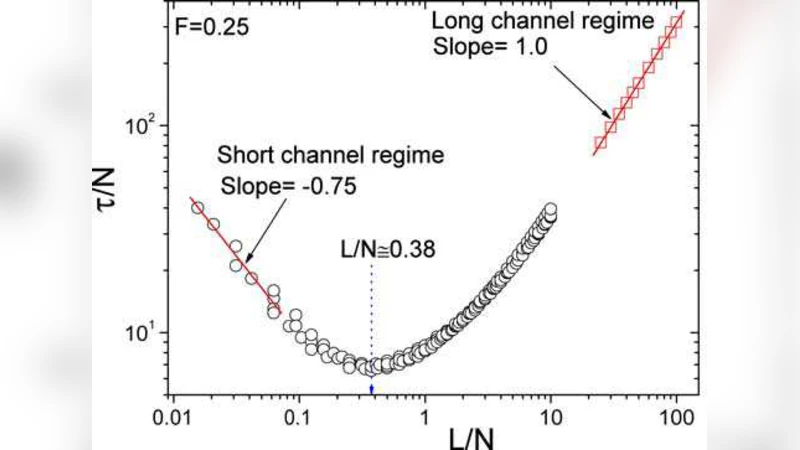
Using analytical techniques and Langevin dynamics simulations, we investigate the dynamics of polymer translocation through a nanochannel embedded in two dimensions under an applied external field. We examine the translocation time for various ratio of the channel length $L$ to the polymer length $N$. For short channels $L\ll N$, the translocation time $\tau \sim N^{1+\nu}$ under weak driving force $F$, while $\tau\sim F^{-1}L$ for long channels $L\gg N$, independent of the chain length $N$. Moreover, we observe a minimum of translocation time as a function of $L/N$ for different driving forces and channel widths. These results are interpreted by the waiting time of a single segment.
💡 Research Summary
This study investigates the dynamics of a polymer chain driven through a cylindrical nanochannel by an external electric field, using both analytical scaling arguments and Langevin dynamics simulations in two dimensions. The authors focus on how the translocation time τ depends on the ratio of the channel length L to the polymer length N, as well as on the driving force F and the channel width. Two distinct regimes emerge. In the short‑channel regime (L ≪ N) and under weak driving, the translocation time scales as τ ∝ N^{1+ν}, where ν≈0.75 is the Flory exponent in 2D. Here the process can be viewed as an initial “integrated” stage, where the whole chain enters the pore, followed by a “stretching” stage as the chain is pulled through. In the long‑channel regime (L ≫ N), the chain quickly fills the channel and then moves at a constant velocity set by the balance of driving force and friction; consequently τ ∝ F^{-1} L, independent of N. The simulations confirm these scaling laws across a wide range of L/N, F, and channel widths.
A particularly noteworthy finding is the existence of a minimum in τ as a function of L/N. By analyzing the waiting time of individual monomers at the pore entrance, the authors show that the entrance waiting time dominates the total translocation time for short channels, while for long channels the bulk motion dominates. As L increases, the entrance waiting time first decreases (because the chain can be pulled more efficiently) and then rises again once the channel becomes sufficiently long that the chain spends a large fraction of the time moving inside the channel. This competition produces a U‑shaped τ(L/N) curve, whose minimum shifts to smaller L/N for stronger driving forces and to larger L/N for wider channels.
The work extends classic polymer translocation theory by explicitly incorporating the channel length as a tunable parameter, rather than treating the pore as a point‑like constriction. The results provide practical guidance for designing nano‑fluidic devices: selecting an optimal L/N ratio can minimize translocation time, which is crucial for applications such as DNA sequencing, molecular sensing, and polymer filtration. Moreover, the waiting‑time framework offers a microscopic picture that can be generalized to three‑dimensional geometries, heterogeneous pores, or time‑dependent driving fields, opening avenues for future theoretical and experimental investigations.
Comments & Academic Discussion
Loading comments...
Leave a Comment