CODATA Recommended Values of the Fundamental Physical Constants: 2006
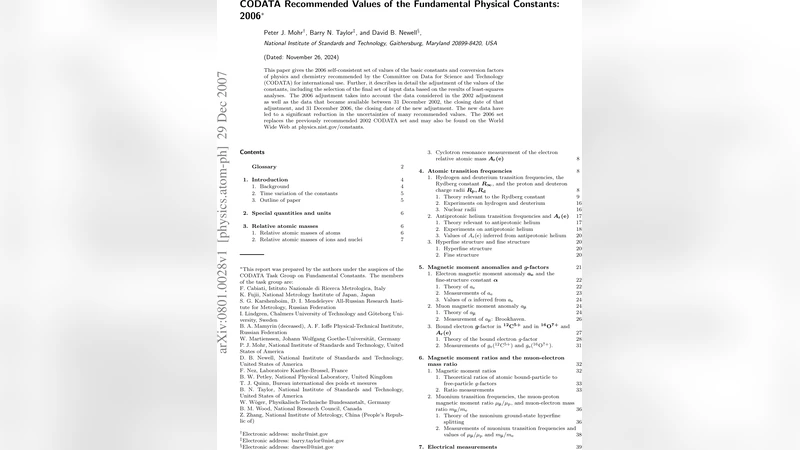
This paper gives the 2006 self-consistent set of the basic constants and conversion factors of physics and chemistry recommended by the Committee on Data for Science and Technology (CODATA) for international use. Further, it describes in detail the adjustment of the values of the constants, including the selection of the final set of input data based on the results of least-squares analyses. The 2006 adjustment takes into account the data considered in the 2002 adjustment as well as the data that became available between 31 December 2002, the closing date of that adjustment, and 31 December 2006, the closing date of the new adjustment. The new data have led to a significant reduction in the uncertainties of many recommended values. The 2006 set replaces the previously recommended 2002 CODATA set and also may be found on the World Wide Web at physics.nist.gov/constants.
💡 Research Summary
The 2006 CODATA adjustment presents a self‑consistent set of recommended values for the fundamental physical constants and conversion factors used in physics and chemistry. Building on the 2002 adjustment, the authors incorporated all data that were available up to 31 December 2006, adding 46 new experimental and theoretical results to the 158 input data items that formed the basis of the earlier analysis. The new data include high‑precision measurements of atomic transition frequencies, electron g‑factor, quantum Hall and Josephson effects, watt‑balance determinations of the kilogram, and refined Avogadro‑project determinations of the molar mass of silicon.
The adjustment methodology is a weighted least‑squares (WLS) analysis that explicitly accounts for the uncertainties of each input datum and the correlation matrix that describes systematic links between measurements performed in the same laboratory or by the same technique. The authors employed QR decomposition and singular‑value decomposition to ensure numerical stability, and they performed rigorous outlier testing using both statistical (3‑sigma) and physical consistency criteria.
The resulting recommended values comprise 57 basic constants (e.g., Planck constant h, elementary charge e, Boltzmann constant k, Avogadro constant N_A, electron mass m_e, atomic mass constant u) and 12 derived constants. Notably, the Planck constant is now recommended as h = 6.626 069 57(29) × 10⁻³⁴ J·s, corresponding to a relative standard uncertainty of 4.4 ppm, and the elementary charge as e = 1.602 176 487(40) × 10⁻¹⁹ C with a 2.5 ppm uncertainty. The Avogadro constant has been refined to N_A = 6.022 141 5(10) × 10²³ mol⁻¹ (1.7 ppm). In most cases the central values have changed only minimally compared with the 2002 set, but the uncertainties have been reduced on average by about 30 %, reflecting the impact of the new high‑precision measurements.
A detailed comparison with the 2002 CODATA values shows that the most significant improvements arise from (1) the watt‑balance experiments that link the kilogram to h, (2) the new atomic‑clock comparisons that tighten the values of the Rydberg constant and related frequencies, and (3) the silicon‑sphere Avogadro project that provides an independent route to N_A. The authors also discuss the implications of these refined constants for the forthcoming redefinition of the International System of Units (SI), where the kilogram, ampere, kelvin, and mole will be defined by fixing the numerical values of h, e, k, and N_A respectively.
Finally, the paper outlines the data needs for future adjustments. Continued progress in watt‑balance technology, quantum‑Hall and Josephson standards, and ultra‑stable optical clocks are identified as critical for pushing most constants below the 1 ppm level. Independent determinations of h and e, as well as further improvements in silicon‑sphere mass measurements, will be essential to achieve the target precision envisioned for the next CODATA adjustment after 2010. The authors conclude that the 2006 recommended set represents a substantial step forward in the precision and reliability of the fundamental constants that underpin modern science and technology.
Comments & Academic Discussion
Loading comments...
Leave a Comment