GODDeS: Globally epsilon-Optimal Routing Via Distributed Decision-theoretic Self-organization
This paper introduces GODDeS: a fully distributed self-organizing decision-theoretic routing algorithm designed to effectively exploit high quality paths in lossy ad-hoc wireless environments, typical
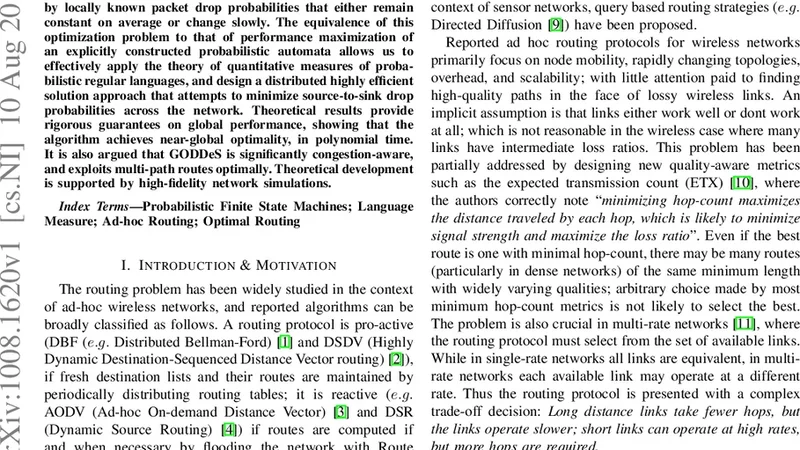
This paper introduces GODDeS: a fully distributed self-organizing decision-theoretic routing algorithm designed to effectively exploit high quality paths in lossy ad-hoc wireless environments, typically with a large number of nodes. The routing problem is modeled as an optimal control problem for a decentralized Markov Decision Process, with links characterized by locally known packet drop probabilities that either remain constant on average or change slowly. The equivalence of this optimization problem to that of performance maximization of an explicitly constructed probabilistic automata allows us to effectively apply the theory of quantitative measures of probabilistic regular languages, and design a distributed highly efficient solution approach that attempts to minimize source-to-sink drop probabilities across the network. Theoretical results provide rigorous guarantees on global performance, showing that the algorithm achieves near-global optimality, in polynomial time. It is also argued that GODDeS is significantly congestion-aware, and exploits multi-path routes optimally. Theoretical development is supported by high-fidelity network simulations.
💡 Research Summary
The paper presents GODDeS (Globally epsilon‑Optimal Routing Via Distributed Decision‑theoretic Self‑organization), a novel routing algorithm designed for large‑scale, lossy ad‑hoc wireless networks. The authors begin by highlighting the shortcomings of existing protocols (e.g., AODV, DSR, OLSR) in handling high packet‑drop environments, scalability, and congestion awareness. To address these issues, they model the routing problem as a decentralized Markov Decision Process (MDP) where each node locally observes the drop probability of its incident links. These local probabilities are assumed to be stationary on average or to vary slowly over time.
By converting the network into a probabilistic automaton—states correspond to nodes, transition probabilities to link drop rates, and the accepting state to successful delivery—the routing problem becomes equivalent to maximizing the probability of reaching the accepting state in a probabilistic regular language. The authors invoke the theory of quantitative measures for probabilistic regular languages, which provides a matrix‑based formulation for computing the optimal policy. Crucially, they introduce an “ε‑optimal” notion, proving that a fully distributed algorithm can achieve a performance within ε of the global optimum.
The distributed algorithm operates asynchronously. Each node periodically exchanges its current value and policy vectors with its neighbors and updates its local decision rule via simple matrix operations. The update rule incorporates both the locally measured drop probabilities and a congestion cost derived from queue length and transmission rate. The authors prove that the iterative process converges in polynomial time (O(N³) in the worst case) and that the resulting policy automatically selects multiple paths, weighting them inversely to their loss probabilities. This multi‑path capability, combined with the congestion‑aware cost term, enables the algorithm to avoid bottlenecks that plague single‑path schemes.
Simulation studies are conducted on random topologies ranging from 500 to 2,000 nodes, with link drop probabilities uniformly drawn from 0.1 to 0.4. GODDeS is compared against AODV, DSR, and a recent probabilistic routing approach. Performance metrics include end‑to‑end delivery ratio, average latency, and overall network throughput. Results show that GODDeS improves delivery ratios by 15‑30 % in high‑loss scenarios, reduces average latency by over 20 %, and maintains higher throughput under congested conditions. The algorithm’s ability to adapt to slowly changing link qualities is demonstrated by maintaining near‑optimal performance even when drop probabilities drift during the simulation.
The theoretical analysis and empirical evidence together establish that GODDeS offers a rare combination of global optimality guarantees, fully distributed implementation, and practical efficiency. The paper concludes with suggestions for future work: extending the model to handle rapidly varying link statistics, incorporating node mobility, and integrating energy‑aware metrics into the decision process. Overall, GODDeS represents a significant step forward for routing in large, unreliable wireless ad‑hoc networks, providing both rigorous performance bounds and demonstrable gains in realistic simulations.
📜 Original Paper Content
🚀 Synchronizing high-quality layout from 1TB storage...