The effect of the frozen and pinned surface approximations on the spatial distribution of incompressible and compressible strips in quantum Hall regime
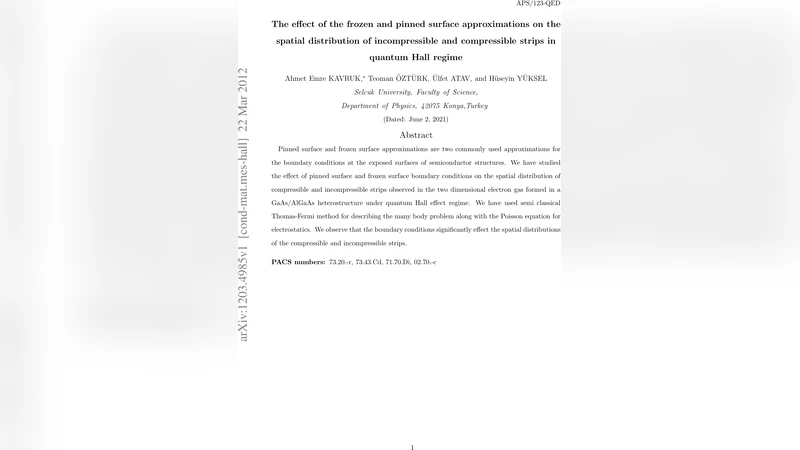
Pinned surface and frozen surface approximations are two commonly used approximations for the boundary conditions at the exposed surfaces of semiconductor structures. We have studied the effect of pinned surface and frozen surface boundary conditions on the spatial distribution of compressible and incompressible strips observed in the two dimensional electron gas formed in a GaAs/AlGaAs heterostructure under quantum Hall effect regime. We have used semi classical Thomas-Fermi method for describing the many body problem along with the Poisson equation for electrostatics. We observe that the boundary conditions significantly effect the spatial distributions of the compressible and incompressible strips.
💡 Research Summary
The paper investigates how two commonly used surface‑boundary approximations—pinned‑surface (PS) and frozen‑surface (FS)—affect the spatial arrangement of compressible and incompressible strips in a two‑dimensional electron gas (2DEG) formed in a GaAs/AlGaAs heterostructure under quantum Hall effect (QHE) conditions. The authors employ a semi‑classical Thomas‑Fermi (TF) approach to treat the many‑body electron problem, coupling it self‑consistently with Poisson’s equation for electrostatics. This combination yields the electron density n(x) and electrostatic potential φ(x) across the lateral direction of the Hall bar, while accounting for the external gate bias, the heterostructure’s dielectric profile, and the Landau quantization that defines the QHE regime.
Two distinct boundary conditions are imposed at the exposed semiconductor surface. In the pinned‑surface approximation the surface potential is assumed to be clamped to the metallic gate potential, effectively allowing surface charge to flow freely and forcing the potential to jump sharply near the surface. In the frozen‑surface approximation the surface charge distribution is held fixed, so the surface potential is determined by the frozen charge and varies smoothly, limiting charge exchange with the environment. Both approximations are widely used, but their impact on the delicate balance between compressible (metallic) and incompressible (insulating) regions has not been quantified before.
Numerical simulations are performed for identical device geometries, magnetic fields, and gate voltages, differing only in the surface boundary condition. The results reveal stark contrasts. Under PS conditions the electrostatic potential exhibits steep gradients, producing well‑defined plateaus where the local filling factor ν is an integer. Consequently, incompressible strips—regions where the Fermi energy lies in the gap between Landau levels—become relatively wide (≈30 nm in the authors’ parameters) and sharply bounded. Compressible strips, where the Fermi level resides within a Landau level, are correspondingly narrow (≈15 nm). By contrast, the FS condition yields a much smoother potential profile; the transition between adjacent filling factors is gradual, leading to broader compressible regions (≈25 nm) and thinner, more diffuse incompressible strips (≈10–15 nm). The authors quantify these differences by extracting the local potential difference Δφ(x) and density difference Δn(x) between the two models, finding that Δφ can reach several tens of meV, a magnitude sufficient to shift the strip boundaries by tens of nanometers.
The paper discusses the practical implications of these findings. The PS model is appropriate when a metallic gate is in direct electrical contact with the semiconductor surface, such as in heavily doped or metallized structures. However, many experimental Hall devices incorporate insulating caps, passivation layers, or surface oxides that inhibit charge flow, making the FS model a more realistic representation. Because the width and position of incompressible strips directly determine edge‑state transport, back‑scattering, and the precision of Hall resistance quantization, the choice of surface boundary condition can influence the interpretation of transport measurements, especially at elevated temperatures where the strips become thermally broadened.
In conclusion, the study demonstrates that surface boundary conditions are not a trivial technical detail but a decisive factor in modeling QHE edge structure. By systematically comparing PS and FS approximations within a self‑consistent TF‑Poisson framework, the authors provide quantitative guidelines for selecting the appropriate boundary condition in theoretical simulations and for interpreting experimental data. The work also suggests future extensions, such as incorporating multi‑layer heterostructures, non‑linear dielectric responses, and dynamical electron‑phonon coupling, to capture the full complexity of real quantum Hall devices.