Investigating the topology of interacting networks - Theory and application to coupled climate subnetworks
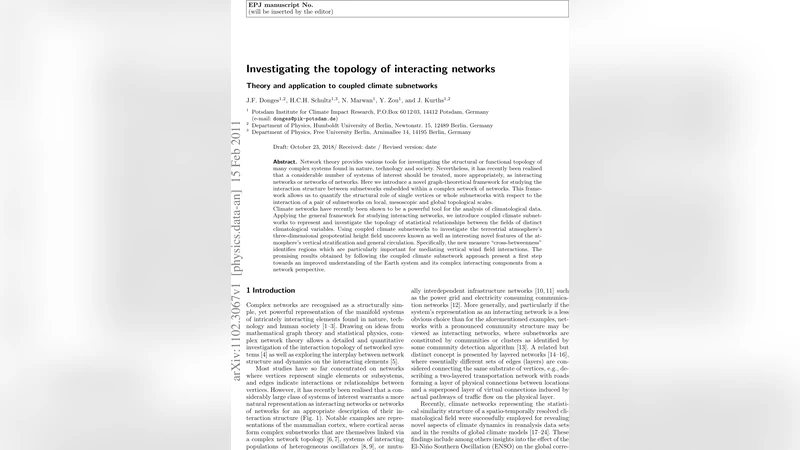
Network theory provides various tools for investigating the structural or functional topology of many complex systems found in nature, technology and society. Nevertheless, it has recently been realised that a considerable number of systems of interest should be treated, more appropriately, as interacting networks or networks of networks. Here we introduce a novel graph-theoretical framework for studying the interaction structure between subnetworks embedded within a complex network of networks. This framework allows us to quantify the structural role of single vertices or whole subnetworks with respect to the interaction of a pair of subnetworks on local, mesoscopic and global topological scales. Climate networks have recently been shown to be a powerful tool for the analysis of climatological data. Applying the general framework for studying interacting networks, we introduce coupled climate subnetworks to represent and investigate the topology of statistical relationships between the fields of distinct climatological variables. Using coupled climate subnetworks to investigate the terrestrial atmosphere’s three-dimensional geopotential height field uncovers known as well as interesting novel features of the atmosphere’s vertical stratification and general circulation. Specifically, the new measure “cross-betweenness” identifies regions which are particularly important for mediating vertical wind field interactions. The promising results obtained by following the coupled climate subnetwork approach present a first step towards an improved understanding of the Earth system and its complex interacting components from a network perspective.
💡 Research Summary
The paper introduces a comprehensive graph‑theoretical framework for analyzing systems that consist of multiple interacting subnetworks, often referred to as “networks of networks” or “interacting networks.” Traditional complex‑network studies usually focus on a single set of nodes and the edges among them, but many real‑world systems—such as the mammalian cortex, interdependent infrastructure, or the Earth system—are naturally decomposed into distinct modules that are themselves linked by cross‑module connections. To capture this structure, the authors formally partition the vertex set (V) of a graph (G=(V,E)) into disjoint subsets (V_i) (the subnetworks) and decompose the edge set into internal edges (E_{ii}) (within a subnetwork) and cross‑edges (E_{ij}) (between different subnetworks). Although the exposition assumes undirected, unweighted graphs for clarity, the authors note that extensions to directed or weighted cases are straightforward.
Four local measures are defined to quantify how a single vertex in one subnetwork relates to another subnetwork:
-
Cross‑degree (k_{ij}^v) – the number of direct neighbours a vertex (v\in V_i) has in subnetwork (G_j). This captures the immediate influence of (v) on the other module.
-
Cross‑clustering coefficient (C_{ij}^v) – the probability that two randomly chosen neighbours of (v) in (G_j) are themselves connected. By comparing (C_{ij}^v) with the internal edge density (\rho_j) of (G_j), one can detect whether cross‑connections are random or reflect specific design or growth principles.
-
Cross‑closeness (c_{ij}^v) – the inverse average shortest‑path length from (v) to all vertices in (G_j). Even if a vertex has few direct cross‑links, a high cross‑closeness indicates that it can quickly reach the other module through indirect routes.
-
Cross‑betweenness (b_{ij}^w) – the fraction of all shortest paths that start in (V_i) and end in (V_j) and pass through a given vertex (w). This measures the control a vertex exerts over information flow between the two subnetworks; a vertex with high cross‑betweenness is a potential bottleneck or critical conduit.
Three global measures are introduced for a pair of subnetworks ((G_i,G_j)):
-
Cross‑edge density (\rho_{ij}) – the proportion of possible inter‑module edges that actually exist. When (\rho_{ij}) is much smaller than the internal densities (\rho_i,\rho_j), the modules are topologically well separated, indicating a strong community structure.
-
Cross‑transitivity – a generalisation of the clustering coefficient that counts triangles spanning both subnetworks, providing insight into higher‑order inter‑module organization.
-
Cross‑average path length – the mean shortest‑path distance between any vertex in (V_i) and any vertex in (V_j), reflecting the efficiency of inter‑module communication.
Having established the theoretical toolkit, the authors apply it to climate data. They construct three subnetworks from reanalysis geopotential height fields at 1000 hPa, 500 hPa, and 200 hPa, representing different atmospheric layers. Edges are placed between grid points whose Pearson correlation exceeds a statistical significance threshold, yielding dense intra‑layer networks and sparser inter‑layer connections. The analysis reveals that internal edge densities are high, while cross‑edge densities are low, confirming the expected vertical stratification of the atmosphere.
The most striking result comes from the cross‑betweenness analysis. Vertices with exceptionally high cross‑betweenness are located in regions that coincide with known dynamical features: the tropical‑midlatitude convection zones, the jet‑stream boundaries, and the strong temperature gradients near the Antarctic front. These locations act as “vertical bridges” that mediate the interaction between low‑ and high‑altitude wind fields. The authors argue that such regions are crucial for the vertical transport of momentum and energy, and that the cross‑betweenness measure uncovers them more effectively than simple cross‑degree or cross‑clustering metrics.
Cross‑closeness further highlights points that, despite having few direct cross‑links, can rapidly influence the opposite layer through indirect paths, suggesting the presence of efficient “vertical corridors” in the atmospheric circulation. The cross‑clustering coefficient identifies non‑random patterns of inter‑layer connectivity, pointing to systematic coupling mechanisms rather than chance correlations.
Beyond the climate example, the paper discusses how the framework can be extended to weighted, directed, or time‑varying networks, and how it could be employed to study vulnerability (e.g., targeted attacks on high cross‑betweenness nodes), tipping points in coupled Earth‑system components, or functional integration in brain networks. The authors emphasize that the decomposition of standard centrality measures into cross‑components provides a nuanced view of node roles that is otherwise hidden in aggregate analyses.
In conclusion, the study delivers a versatile set of graph‑theoretic tools for dissecting the topology of interacting networks across scales. By applying these tools to atmospheric geopotential height data, it validates known circulation patterns, uncovers new vertical coupling structures, and demonstrates the practical utility of cross‑network metrics. The framework promises broad applicability to any complex system where distinct modules interact, offering a quantitative bridge between network science and domain‑specific insights.
Comments & Academic Discussion
Loading comments...
Leave a Comment