A constructive Galois connection between closure and interior
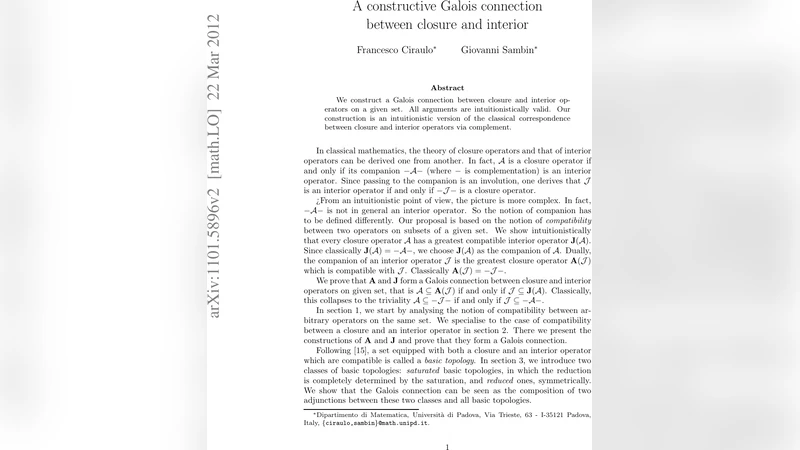
We construct a Galois connection between closure and interior operators on a given set. All arguments are intuitionistically valid. Our construction is an intuitionistic version of the classical correspondence between closure and interior operators via complement.
💡 Research Summary
The paper develops an intuitionistic framework for relating closure and interior operators on an arbitrary set S, avoiding the classical reliance on set‑theoretic complement. The authors introduce the notion of “overlap” (U ≬ V ⇔ ∃a∈S · a∈U∩V) and define compatibility between two operators O and O′ by the condition O U ≬ O′ V ⇒ U ≬ O′ V. This compatibility captures the intuitionistically valid part of the classical relationship between closure (cl) and interior (int), namely cl ≻ int, while the converse direction fails without the law of excluded middle.
For any operator O, they prove the existence of a greatest left‑compatible operator L(O) and a greatest right‑compatible operator R(O). L(O) is characterized pointwise by the formula
a ∈ L(O)U ⇔ ∀V (a ∈ OV ⇒ U ≬ OV),
and R(O) is the constant operator whose value is the largest subset Z⊆S that “splits” O (i.e., OV ≬ Z ⇒ V ≬ Z). These constructions are intuitionistically valid and rely only on the overlap relation.
The paper then restricts attention to monotone, idempotent operators that are either expansive (id ⊆ A) – called saturations – or contractive (J ⊆ id) – called reductions. Classical closure and interior operators are examples, but the authors work in a more general setting where additional topological axioms (e.g., preservation of finite intersections) are not required.
Given a saturation A, the authors define its “best compatible interior” as J(A) := L(A). Dually, for a reduction J they define its “best compatible closure” as A(J) := R(J). The central theorem establishes a Galois connection between these constructions: A ⊆ A(J) iff J ⊆ J(A). Thus (A, J) form a Galois pair, generalizing the classical equalities cl = −int− and int = −cl−. The proof uses the compatibility definition and the maximality of L and R.
Section 3 introduces “basic topologies”: a set equipped with both a saturation and a reduction that are compatible (A ≻ J). Two subclasses are distinguished: saturated basic topologies (where the reduction is completely determined by the saturation) and reduced basic topologies (where the saturation is determined by the reduction). Classically these classes coincide, but the authors exhibit intuitionistic counter‑examples showing they differ. Moreover, they prove that the inclusions between the two classes are each equivalent to the law of excluded middle, highlighting a deep logical dependence.
Section 4 provides explicit counter‑examples: for certain families of subsets P⊆Pow(S) the associated operators A_P and J_P (defined by taking unions and intersections of members of P) are not compatible. By constructing specific inhabited subsets, they demonstrate that the compatibility condition fails without LEM.
Section 5 discusses how the developed theory can be used predicatively in important mathematical contexts. The compatibility relation fits naturally into the framework of overlap algebras (as in Sambin’s work), allowing one to replace impredicative complement‑based arguments with constructive overlap‑based ones. This makes the constructions applicable in settings such as constructive topology, locale theory, and type‑theoretic models where predicativity is essential.
In summary, the paper provides a fully constructive (intuitionistic) counterpart to the classical correspondence between closure and interior operators. By introducing overlap‑based compatibility and constructing maximal compatible operators L and R, it yields a Galois connection that works without complement. The work also clarifies the logical strength required for various identifications (e.g., saturated vs. reduced basic topologies) and opens the way for predicative applications in constructive mathematics.
Comments & Academic Discussion
Loading comments...
Leave a Comment