On Species Persistence-Time Distributions
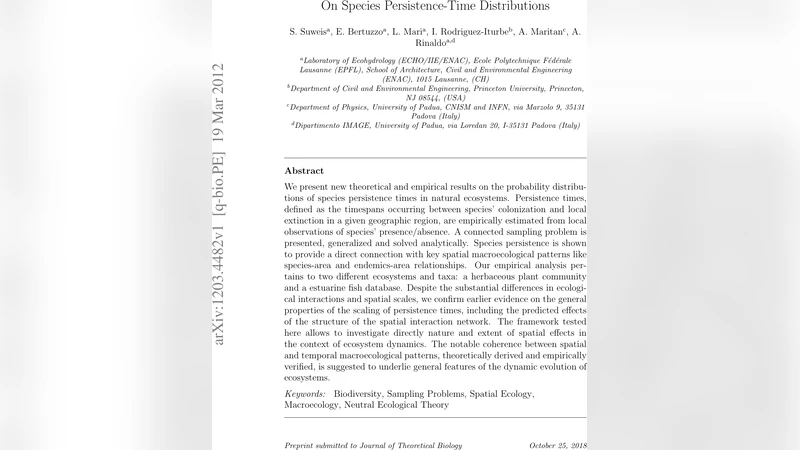
We present new theoretical and empirical results on the probability distributions of species persistence times in natural ecosystems. Persistence times, defined as the timespans occurring between species’ colonization and local extinction in a given geographic region, are empirically estimated from local observations of species’ presence/absence. A connected sampling problem is presented, generalized and solved analytically. Species persistence is shown to provide a direct connection with key spatial macroecological patterns like species-area and endemics-area relationships. Our empirical analysis pertains to two different ecosystems and taxa: a herbaceous plant community and a estuarine fish database. Despite the substantial differences in ecological interactions and spatial scales, we confirm earlier evidence on the general properties of the scaling of persistence times, including the predicted effects of the structure of the spatial interaction network. The framework tested here allows to investigate directly nature and extent of spatial effects in the context of ecosystem dynamics. The notable coherence between spatial and temporal macroecological patterns, theoretically derived and empirically verified, is suggested to underlie general features of the dynamic evolution of ecosystems.
💡 Research Summary
The paper introduces a unified theoretical and empirical framework for describing the probability distribution of species persistence times (PTs) – the interval between a species’ colonization of a given geographic region and its subsequent local extinction. By defining PTs in terms of observable presence/absence time series, the authors address a long‑standing methodological gap: how to estimate PTs from limited field data without resorting to extensive long‑term monitoring or simulation.
A central methodological contribution is the formulation and analytical solution of the “connected sampling” problem. In real surveys, the observed sites constitute a connected subgraph of the larger metacommunity network; naïve sampling therefore introduces bias because the probability of detecting a species depends on the topology of that subgraph. The authors model the metacommunity as a stochastic network characterized by average degree, clustering coefficient, and an effective dimensionality d. Using a combination of Markov‑chain theory and first‑passage‑time analysis, they derive a closed‑form expression for the PT distribution, which exhibits a power‑law tail P(τ > t) ∝ t^{‑α}. The tail exponent α is shown to be a direct function of the network’s effective dimension, linking temporal dynamics to spatial structure.
The theory predicts two key macroecological scaling laws. First, the species‑area relationship (SAR), traditionally expressed as S ∝ A^{z}, emerges naturally because larger areas correspond to larger, more highly connected subgraphs, which in turn generate longer average PTs. The exponent z is mathematically identical to α, implying that the same spatial network properties that shape PT tails also determine how species richness scales with area. Second, the endemics‑area relationship (EAR) is derived from the short‑time behavior of the PT distribution: the probability that a species remains confined to a small area is governed by the frequency of short PTs, again controlled by network topology. Thus, spatial and temporal macroecological patterns are not independent phenomena but two facets of a single underlying stochastic process.
Empirically, the framework is tested on two contrasting data sets. The first consists of a herbaceous plant community in southwestern England, sampled across plots of a few hundred square meters. The second comprises an estuarine fish database from the U.S. Atlantic coast, covering thousands of square kilometers and characterized by strong hydrological connectivity. For both systems, PTs are estimated from yearly presence/absence matrices using the authors’ maximum‑likelihood approach. The resulting PT distributions display clear power‑law tails. In the plant community, the estimated tail exponent α≈1.3 corresponds to an effective network dimension d≈1.3, reflecting limited seed dispersal and relatively low connectivity among plots. In the fish system, α≈1.8 (d≈1.8) indicates a higher‑dimensional interaction network shaped by water flow, which facilitates longer persistence times.
Crucially, the empirically derived α values match the SAR exponents measured independently for each system (z≈1.3 for plants, z≈1.8 for fish), confirming the theoretical prediction that PT scaling and species‑area scaling share a common driver. The authors also demonstrate that variations in network clustering and modularity systematically shift the PT tail, providing a mechanistic explanation for observed differences in SAR slopes across ecosystems.
Beyond validation, the authors discuss the broader implications of linking PTs to spatial network structure. Because PTs encapsulate the temporal dimension of community turnover, the framework offers a direct way to predict how habitat fragmentation, climate‑induced range shifts, or alterations in dispersal pathways will affect both species richness and turnover rates. For instance, reducing connectivity (lower average degree) would steepen the PT tail (larger α), leading to shorter persistence times, a flatter SAR, and a higher proportion of endemic species confined to small patches. Conversely, restoration actions that increase connectivity could lengthen PTs, steepen the SAR, and reduce endemism.
In summary, the paper provides (1) a rigorous analytical solution to the connected‑sampling problem, (2) a clear mathematical bridge between temporal persistence and spatial macroecological patterns, (3) robust empirical support from two ecologically distinct systems, and (4) a versatile tool for forecasting biodiversity responses to spatially explicit environmental change. This synthesis of theory and data advances our understanding of ecosystem dynamics and offers practical guidance for conservation planning in a rapidly changing world.
Comments & Academic Discussion
Loading comments...
Leave a Comment