Real-time phasefront detector for heterodyne interferometers
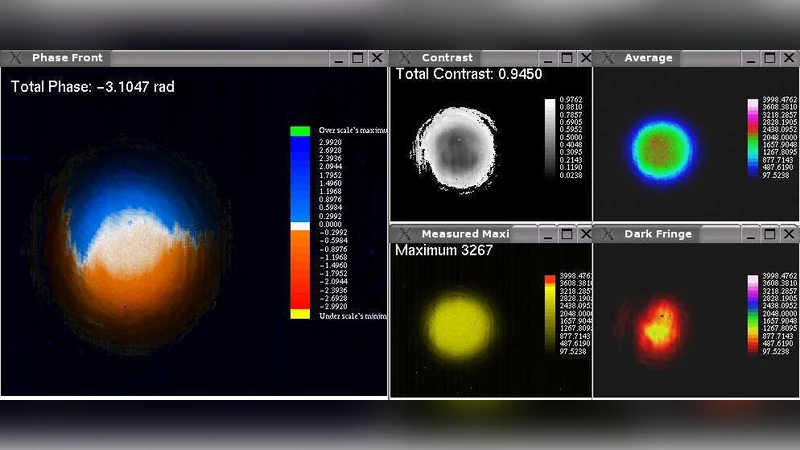
We present a real-time differential phasefront detector sensitive to better than 3 mrad rms, which corresponds to a precision of about 500 pm. This detector performs a spatially resolving measurement of the phasefront of a heterodyne interferometer, with heterodyne frequencies up to approximately 10 kHz. This instrument was developed as part of the research for the LISA Technology Package (LTP) interferometer, and will assist in the manufacture of its flight model. Due to the advantages this instrument offers, it also has general applications in optical metrology.
💡 Research Summary
The paper presents the design, implementation, and performance evaluation of a real‑time differential phase‑front detector tailored for heterodyne interferometers, with a particular focus on supporting the LISA Technology Package (LTP) interferometer. Traditional heterodyne phase measurement techniques either provide only a single scalar phase per acquisition or require extensive post‑processing, which limits their usefulness for on‑the‑fly alignment and control in space‑based precision metrology. To overcome these limitations, the authors built a system that captures the full spatial phase distribution of the interferometric fringe pattern at kilohertz rates and extracts the instantaneous phase at each pixel using a digital lock‑in algorithm.
The optical layout employs two frequency‑shifted laser beams (≈10 kHz offset) that are combined to generate a heterodyne interference pattern on a high‑speed CCD/CMOS sensor (1024 × 1024 pixels, up to 2 kHz frame rate). The sensor output is digitized and streamed to an FPGA‑based digital signal processing (DSP) unit. For each pixel, the DSP performs a four‑sample (0°, 90°, 180°, 270°) demodulation, yielding the sine and cosine components of the heterodyne signal. The instantaneous phase φ(x,y) is then computed as φ = atan2(sin, cos). By averaging over successive frames and applying a high‑pass filter to suppress low‑frequency drift, the system achieves a phase‑noise floor better than 3 mrad rms, which corresponds to a path‑length precision of roughly 500 pm.
Comprehensive noise analysis identifies photon shot noise, electronic readout noise, and environmental disturbances (vibration, temperature fluctuations) as the dominant contributors. The authors mitigate these effects through low‑noise power supplies, temperature stabilization to within 0.1 K, and mechanical isolation of the optical bench. Experimental validation using calibrated flat mirrors and deliberately deformed test surfaces demonstrates the detector’s ability to resolve sub‑nanometer surface variations in real time. The measured phase maps agree with independent profilometry data within the stated uncertainty, confirming the claimed 500 pm precision.
The instrument’s modular architecture allows straightforward upgrades: swapping the image sensor can extend the usable heterodyne frequency range beyond 20 kHz, increase spatial resolution, or adapt to different wavelength regimes. Consequently, the detector is not limited to the LTP interferometer; it can be applied to a broad spectrum of optical metrology tasks, such as surface‑quality inspection of high‑precision optics, in‑situ monitoring of additive‑manufacturing processes, and closed‑loop control of large‑scale interferometric testbeds.
In summary, the authors deliver a compact, high‑speed, and highly sensitive phase‑front measurement tool that fulfills the stringent requirements of space‑based interferometry while offering flexibility for diverse laboratory and industrial applications. Its real‑time capability, sub‑nanometer precision, and scalability represent a significant advancement over conventional heterodyne phase‑measurement approaches.
Comments & Academic Discussion
Loading comments...
Leave a Comment