Permutads
We unravel the algebraic structure which controls the various ways of computing the word ((xy)(zt)) and its siblings. We show that it gives rise to a new type of operads, that we call permutads. It turns out that this notion is equivalent to the noti…
Authors: Jean-Louis Loday, Maria Ronco
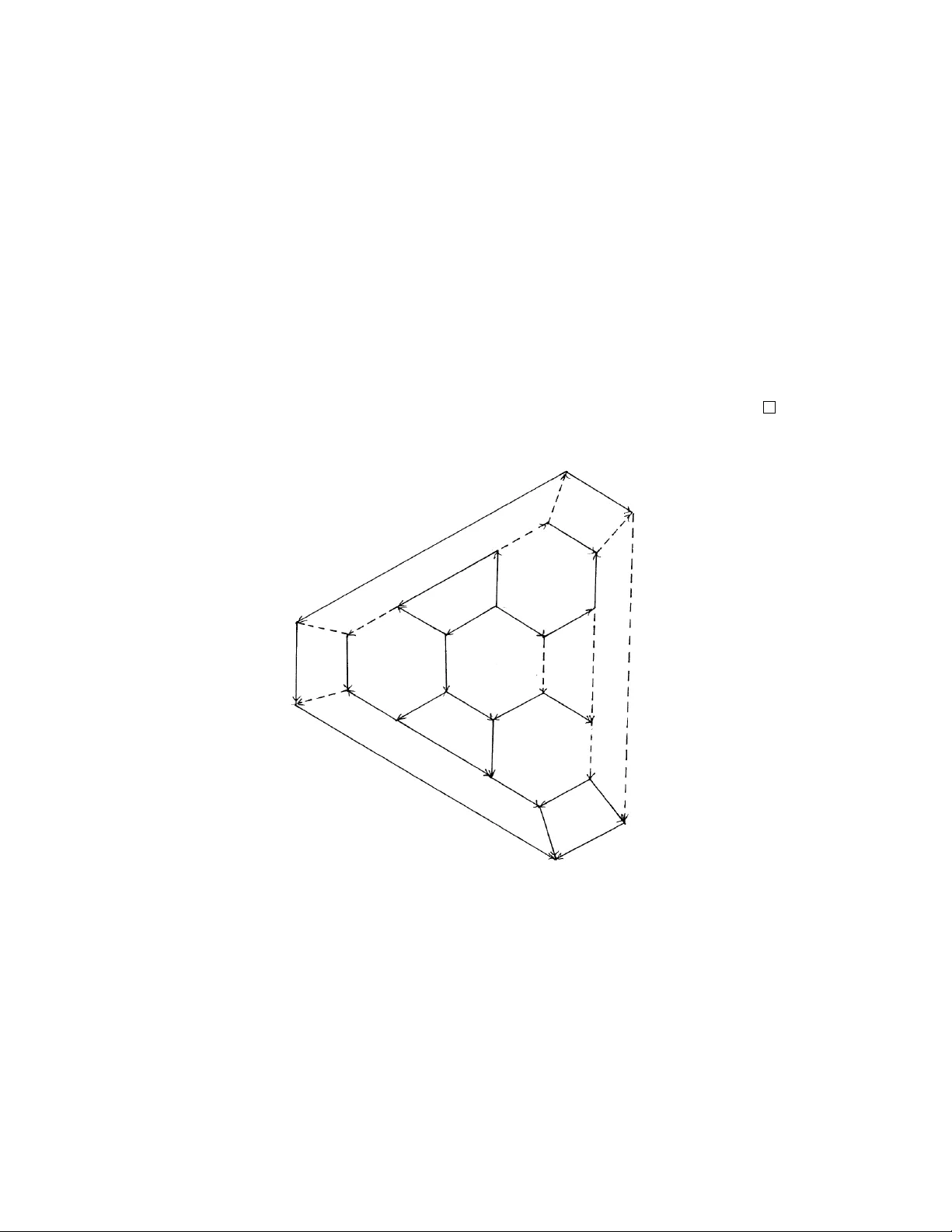
P erm utads Jean-Louis Lo da y Institut de R e cher che Math ´ ematique A vanc´ ee, CNRS et Universit ´ e de Str asb our g, F r anc e Mar ´ ıa Ronco Instituto de Matem´ atic as y F ´ ısic a, Universidad de T alc a, Chile Abstract W e unrav el the algebraic structure whic h controls the v arious w ays of com- puting the w ord (( xy )( z t )) and its siblings. W e sho w that it giv es rise to a new t yp e of op erads, that w e call p erm utads. A p erm utad is an algebra o ver the monad made of surjectiv e maps b etw een finite sets. It turns out that this notion is equiv alent to the notion of “sh uffle algebra” in tro duced previously b y the second author. It is also v ery close to the notion of “shuffle op erad” in tro duced by V. Dotsenko and A. Khoroshkin. It can b e seen as a noncomm utative version of the notion of nonsymmetric operads. W e sho w that the role of the asso ciahedron in the theory of op erads is play ed by the p erm utohedron in the theory of p ermutads. Keywor ds: T ree, p ermutohedron, p ermutad, op erad, shuffle, weak Bruhat order Email addr esses: loday@math.unistra.fr (Jean-Louis Lo da y), mariaronco@inst-mat.utalca.cl (Mar ´ ıa Ronco) Pr eprint submitte d to Journal of Combinatorial The ory A May 16, 2018 P erm utads Jean-Louis Lo da y Institut de R e cher che Math´ ematique Avanc ´ ee, CNRS et Universit´ e de Str asb our g, F r anc e Mar ´ ıa Ronco Instituto de Matem´ atic as y F ´ ısic a, Universidad de T alc a, Chile In tro duction The nonsymmetric op erads are enco ded b y the planar ro oted trees in the following sense. These trees determine a monad on the category of arit y graded mo dules and a nonsymmetric op erad is an algebra o ver this monad. In this pap er w e replace the planar ro oted trees b y the surjection maps b et ween finite sets. W e still get a monad on arity graded mo dules, and an algebra o ver this monad is called a p ermutad . A p ermutad can b e presented with “partial op erations” ◦ σ where σ is a sh uffle, as generators. Under this presentation w e see that the notion of p erm utad is equiv alen t to the notion of “shuffle algebra” in tro duced in [13] b y the second author. There is still another w a y of presen ting a p ermutad, through some particular sh uffle trees. This presentation enables us to to relate the notion of permutad to the notion of “sh uffle op erad” introduced b y Dotsenko and Khoroshkin in [3]. If w e restrict ourself to p erm utads generated by binary op erations, then the general op erations can b e describ ed b y the “lev eled planar binary ro oted trees”. These binary p ermutads are the relev ant to ol to handle algebras for whic h a pro duct like (( xy )( z t )) dep ends on the first pro duct whic h is p erformed: either ( xy ) or ( z t ). An interesting example of p ermutad is presen ted by one binary op eration Email addr esses: loday@math.unistra.fr (Jean-Louis Lo da y), mariaronco@inst-mat.utalca.cl (Mar ´ ıa Ronco) Pr eprint submitte d to Journal of Combinatorial The ory A May 16, 2018 xy sub ject to one relation x ( y z ) = q ( xy ) z , where q is a parameter in the ground field. In the nonsymmetric op erad framew ork suc h an op erad is interesting only for q = 0 , 1 or ∞ , since in the other cases the free algebra collapses. Ho wev er, in the p ermutad setting, it mak es sense for any v alue of q and, computing in this framew ork, leads to the app earance of the length function of the Co xeter group S n . This result is a consequence of an indep enden t in teresting com binatorial result on the p oset structure (w eak Bruhat order) of the symmetric group S n . In this p oset there are t wo kinds of cov ering relations whic h are best understo o d by replacing the p ermutations by the leveled planar binary trees. A co vering relation of the first kind is obtained b y moving a v ertex from left to righ t. A cov ering relation of the second kind is obtained by exchanging tw o lev els. Our result sa ys that the graph obtained by k eeping only the co v ering relations of the first kind is connected. As a consequence of the preceding result the asso ciativ e p ermutad, ob- tained for q = 1 and denoted b y permAs, is the same as the asso ciative nonsymmetric op erad As , i.e. p ermAs n is one dimensional. Ho wev er lo oking at the minimal model in nonsymmetric op erads vs p erm utads leads to dif- feren t ob jects. It is w ell-known that in the nonsymmetric op erad setting the minimal mo del of As is completely determined b y the family of asso ciahe- drons. W e pro ve that in the p erm utad setting the minimal mo del of p ermAs is completely determined b y the family of p ermutohedrons. The notion of p ermutad can be though t of as a certa in “noncomm utativ e” v ariation of the notion of nonsymmetric op erad since w e, essentially , leav e out the parallel comp osition axiom for partial op erations. This noncommu- tativ e feature is illustrated by the computation of the p ermutad enco ding the asso ciative algebras with deriv ation. In the nonsymmetric op erad frame- w ork it in volv es the algebra of p olynomials and in the p erm utad framework it in volv es the algebra of noncomm utativ e p olynomials. Contents 1. Surjective maps and p erm utads 2. Partial op erations and nonsymmetric op erads 3. Shuffle algebras 4. Binary quadratic p erm utads 5. Asso ciative p erm utad and the p erm utohedron 3 6. The p erm utad of asso ciativ e algebras with deriv ation 7. Perm utads and sh uffle op erads 8. App endix 1: Combinatorics of surjections on finite sets 9. App endix 2: The p ermutohedron Notation. Let n = { 1 , . . . , n } b e a finite ordered set with n elemen ts. By con ven tion 0 is the empty set. The automorphisms group of n is the symmetric group denoted by S n . Its unit element is denoted by 1 n (iden tity p erm utation). F or the op eradic terminology the reader ma y refer either to [11] or to [9], from whic h . Ac kno wledgement. W e w armly thank Vladimir Dotsenk o for his commen t on shuffle algebras. Thanks also to Emily Burgunder for her commen ts on the first draft of this pap er. W e are grateful to the referees for their commen ts and questions whic h help us to improv e this pap er. This work has b een partially supported b y the Proy ecto F ondecyt Regular 1100380, and the “MathAmSud” pro ject OPECSHA 01-math-10. 1. Surjectiv e maps and p ermutads W e introduce ad ho c terminology about surjective maps of finite sets. Then w e give the “combinatorial definition” of a p ermutad. 1.1. Surje ctive maps Let n and k b e p ositiv e integers such that 1 ≤ k ≤ n . W e denote by Sur( n, k ) the set of surjective maps t : n → k . W e call vertic es the elemen ts in the target set k . The set of v ertices of the surjective map t is denoted by vert t . The arity of v ∈ vert t is | v | := # t − 1 ( v ) + 1 (note the shift). When k = 1, Sur( n, 1) contains only one elemen t that w e call a c or ol la (denoted b y c n +1 ), and when k = n the set Sur( n, n ) coincides with the symmetric group S n . W e adopt the follo wing notation: Surj n := S k Sur( n, k ) (disjoin t union). By con ven tion Surj 0 = { 1 } and its unique elemen t is considered as a surjective map 1 : 0 → 0 (formally 0 = ∅ ) with no vertex. In section 9 w e list all the surjectiv e maps for n = 2 , 3. 1.2. Substitution Let t ∈ Sur( n, k ) and t i ∈ Sur( i j , m j ) , j = 1 , . . . , k , b e surjectiv e maps suc h that i j = # t − 1 ( j ). W e put m := P j m j . By definition the substitution of { t j } in t is the surjectiv e map ( t ; t 1 , . . . , t k ) ∈ Sur( n, m ) giv en by 4 ( t ; t 1 , . . . , t k )( a ) := m 1 + · · · + m j − 1 + t j ( b ) , whenev er t ( a ) = j and a is the b th elemen t in t − 1 ( j ). Example with k = 2: × × × × @ @ • • • • • × × ! ! ! ! ! ! Z Z Z • • • • • 7→ × × × × @ @ @ • • • • • × × × × × Z Z Z Z • • • • • Observ e that substitution is an asso ciative op eration. The family of surjectiv e maps endo wed with the pro cess of substitution could b e described as a colored op erad (cf. [14]), where the colors are in tegers, and also as a “m ulti-category” (cf. [5]), see 1.5. 1.3. A monad on arity-gr ade d mo dules Let K b e a commutativ e ring and let N + -Mo d b e the category of p ositively graded K -mo dules. An ob ject M of N + -Mo d is a family { M n } , n ≥ 1, of K - mo dules. In this pap er w e say “arity” in place of degree for these ob jects. W e define a monad in the category N + -Mo d of arit y-graded mo dules as follo ws. First, for an y M and an y surjectiv e map t ∈ Sur( n, k ) we define a mo dule M t := O v ∈ vert t M | v | , where | v | is the arity of the vertex v . Second, for an y arit y-graded mo dule M w e define an arit y-graded module P ( M ) as follows: P ( M ) n +1 := M t ∈ Surj n M t for n ≥ 1 , and P ( M ) 1 := K id. Explicitly the mo dule P ( M ) n +1 is spanned by surjective maps with n inputs whose v ertices are decorated by elements of M . 5 Example: • • • • • × µ ∈ M 4 × ν ∈ M 3 So, w e hav e defined a functor P : N + -Mo d → N + -Mo d . There is a natural map ι ( M ) : M → P ( M ) whic h consists in associating to an elemen t µ ∈ M n the corolla c n of arit y n decorated by µ . Prop osition 1.4. The substitution of surje ctive maps defines a tr ansforma- tion of functors Γ : P ◦ P → P which is asso ciative and unital. So ( P , Γ , ι ) is a monad on arity-gr ade d mo dules. Pr o of. F rom the definition of P w e get P ( P ( M )) n = M t ∈ Surj n − 1 P ( M ) t = M t ∈ Surj n − 1 P ( M ) i 1 ⊗ · · · ⊗ P ( M ) i k = M t ∈ Surj n − 1 j = k O j =1 M s ∈ Surj j − 1 M s . Under the substitution of surjectiv e maps we get an elemen t of P ( M ) n , since at any vertex j of t we ha ve an elemen t of P ( M ) i j = L s ∈ Surj j − 1 M s , that is a surjective map s and its decoration. W e substitute this data at eac h v ertex of t to get a new decorated surjectiv e map, decorated by elemen ts of M . Therefore w e ha v e obtained a linear map Γ( M ) : P ( P ( M )) n → P ( M ) n , whic h defines a morphism of arity-graded mo dules Γ( M ) : P ( P ( M )) → P ( M ) . Since it is functorial in M w e get a transformation of functors Γ : P ◦ P → P . Since the substitution pro cess is associative, Γ is associative. Substituting a vertex b y a corolla do es not change the surjective map. Substituting a surjectiv e map to the vertex of a corolla gives the former surjectiv e map. Hence Γ is also unital. W e hav e pro ved that ( P , Γ , ι ) is a monad. 6 1.5. Color e d op er ad A c olor e d op er ad is to an operad what a category is to a monoid. More precisely , there is a set of colors and for each op eration of the op erad there is a color assigned to eac h input and a color assigned to the output. In order for a comp osition like µ ◦ ( ν 1 , . . . , ν k ) to hold the color of the ouput of ν i has to b e equal to the color of the i th input of µ . Of course the colors of the inputs of the comp osite are the colors of the ν i ’s and the color of the output is the color of the output of µ . See for instance [14]. The monad ( P , Γ , ι ) defined ab o ve can b e seen as a nonsymmetric colored op erad, where the colors are the natural n umbers. 1.6. Permutads By definition a p ermutad P is a unital algebra ov er the monad ( P , Γ , ι ). So P is an arity-graded mo dule suc h that P 1 = K id endow ed with a morphism of arit y-graded mo dules Γ P : P ( P ) → P compatible with the comp osition Γ and the unit ι . It means that the follo wing diagrams are comm utative: P ( P ( P )) P (Γ P ) / / P ( P ) Γ P ( P ◦ P )( P ) ∼ = 8 8 Γ( P ) P ( P ) Γ P / / P and Id( P ) ι ( P ) / / = $ $ P ( P ) Γ P P W e often call an element of P an op er ation and the map Γ( P ) the comp osition of op erations. W e, now, give a first example: the free p ermutad. 7 Prop osition 1.7 (F ree permutad) . F or any arity-gr ade d mo dule M such that M 1 = 0 , the arity-gr ade d mo dule P ( M ) is a p ermutad which is the fr e e p ermutad over M . Pr o of. The structure of p ermutad Γ P ( M ) on P ( M ) is induced by Γ, that is Γ P ( M ) : P ( P ( M ) = ( P ◦ P )( M ) Γ( M ) − − − → P ( M ) . The pro of that P ( M ) is free among permutads go es as follows. Let Q b e another p ermutad and let f : M → Q b e a morphism of arity-graded mo dules. The comp osite P ( M ) P ( f ) − − → P ( Q ) → Q , which uses the p erm utadic structure of Q , extends the map f . It is straightforw ard to chec k that it is a map of p erm utads and that it is unique as a permutad morphism extending f . So P ( M ) is free o ver M . 1.8. Ide al and quotient Giv en a p erm utad P , a sub-mo dule I is said to b e an ideal if an y p ermu- tadic comp osition of op erations in P for whic h at least one is in I , is also in I . As an immediate consequence the quotient P / I acquires a structure of p erm utad. 1.9. Differ ential gr ade d p ermutad By replacing the category of modules ov er the ground ring K b y the category of differential graded mo dules (i.e. chain complexes), w e obtain the definition of differ ential gr ade d p ermutads , abbreviated in to dg p ermutads . Explicitly , when ( M , d ) is a dg N + -Mo d w e mak e P ( M ) in to a dg N + -Mo d b y defining the differential d by d ( t ; µ 1 , . . . , µ k ) := k X i =1 ( − 1) i ( t ; µ 1 , . . . , dµ i , . . . , µ k ) where t : n → k is a surjectiv e map and i = | µ 1 | + · · · + | µ i − 1 | . Then the structure map Γ M : P ( M ) → M is required to b e a dg N + -Mo d morphism. 8 2. P artial op erations and non-symmetric op erads The definition of a p ermutad that w e hav e given is similar to the so- called “com binatorial” presen tation of an op erad (see Chapter 5 of [9]). Any surjection b etw een finite sets can b e obtained by successiv e substitutions of surjections with target set of size 2. This prop ert y will enable us to give a definition of a p erm utad with a minimal data. It is similar to the so-called “partial” presen tation of an op erad. 2.1. On the substitution of surje ctive maps with tar get set of size 2 Let us consider a surjective map r : k → 3. W e denote b y n + 1 , m + 1 , ` + 1 the arity of the v ertex 1 , 2 , 3 resp ectively . There are tw o wa ys to consider r as a result of substitution. Either as a substitution whic h gives rise to 1 and 2, or, as a substitution which gives 2 and 3. The first pro cess gives tw o surjectiv e maps s : m + ` → 2 and t : n + m + ` → 2, and the second pro cess giv es v : n + m → 2 and u : n + m + ` → 2. • • • • • • • 1 2 3 • • • • • • • 1 2 3 | {z } v | {z } s | {z } u | {z } t Hence r can b e seen either as the substitution of s in t at 2, or as a substitution of v in u at 1. So, if λ, µ, ν are the decorations of the v ertices 3, 2 and 1 resp ectiv ely , w e get ( λ ◦ s µ ) ◦ t ν = λ ◦ u ( µ ◦ v ν ) . Lemma 2.2. F or any op er ations λ ∈ P ` +1 , µ ∈ P m +1 , ν ∈ P n +1 one has ( λ ◦ s µ ) ◦ t ν = λ ◦ u ( µ ◦ v ν ) . Pr o of. Both terms of the exp ected equalit y are equal to the surjective map obtained by decorating the v ertex 3 b y λ , 2 by µ and 1 by ν in r . This is an immediate consequence the asso ciativit y prop erty of substitution for surjectiv e maps. 9 2.3. Partial pr esentation of a p ermutad Let ( P , Γ , ι ) b e a p ermutad (so w e supp ose P 1 = K id). Any surjection t with target set of size 2 (i.e. t : m + n → 2) determines a linear map that we denote b y ◦ t : P m +1 ⊗ P n +1 → P m + n +1 , where n = # t − 1 (1). Theorem 2.4. A p ermutad ( P , Γ , ι ) is c ompletely determine d by the arity gr ade d mo dule {P n } n ≥ 1 , with P 1 = K , and the p artial op er ations ◦ t : P m +1 ⊗ P n +1 → P m + n +1 , t : m + n → 2 , n = # t − 1 (1) , satisfying ( ♦ ) ( λ ◦ s µ ) ◦ t ν = λ ◦ u ( µ ◦ v ν ) , for any surje ctive map r with tar get 3 such that ( t ; c n +1 , s ) = r = ( u ; v , c l +1 ) , for # r − 1 (1) = n and # r − 1 (3) = l . Pr o of. Let us start with a p ermutad ( P , Γ , ι ). W e define the partial op- erations b y µ ◦ t ν := Γ( t ; ν, µ ). F orm ula ( ♦ ) has b een prov ed in Lemma 2.2. On the other hand, let us start with the arity graded mo dule P and the partial op erations ◦ t , for an y surjective map t , satisfying ( ♦ ). F or an y surjectiv e map t : n − → r , with r ≥ 2, w e introduce new maps v t and ˜ t as follo ws: 1. v t : n 1 − → r − 1 is the surjectiv e map giv en by v t ( i ) := t ( s i ) , where n 1 := n − # t − 1 ( r ) and n \ t − 1 ( r ) = { s 1 < · · · < s n 1 } . 2. ˜ t : n − → 2 is giv en by the formula: ˜ t ( i ) = ( 1 , for t ( i ) < r , 2 , for t ( i ) = r . F or r > 2, w e get that t = ( ˜ t ; v t , c | r | ), with | r | = # t − 1 ( r ) + 1 . W e define Γ( t ; λ 1 , . . . , λ r ) for any surjection t : n − → r and any family of elemen ts λ i ∈ P # t − 1 ( i )+1 , 1 ≤ i ≤ r as follows: If r = 1, then t = c n +1 . So, Γ( t ; λ 1 ) := λ 1 . F or r = 2, w e apply the partial op eration ◦ t to get Γ( t ; λ 1 , λ 2 ) := λ 2 ◦ t λ 1 . 10 F or r > 2 and t = ( ˜ t ; v t , c | r | ), w e define Γ( t ; λ 1 , . . . , λ r ) := λ r ◦ ˜ t Γ( v t ; λ 1 , . . . , λ r − 1 ) . In order to c hec k that P is a p erm utad, we ha ve to v erify that Γ satisfies the equalit y: Γ(( t ; t 1 , . . . , t r ); λ 1 1 , . . . λ 1 k 1 , . . . , λ r k r ) = Γ( t ; Γ( t 1 ; λ 1 1 , . . . , λ 1 k 1 ) , . . . , Γ( t r ; λ r 1 , . . . , λ r k r )) , for an y family of surjective maps t : n − → r and t i : # t − 1 ( i ) − → k i , for 1 ≤ i ≤ r , and any collection of elements { λ j i ∈ P k j +1 | 1 ≤ i ≤ k j and 1 ≤ j ≤ r } . T o prov e it w e use a double recursive argument on r and on k r . If r = 1, the result is eviden t because Γ(( t ; t 1 ) , λ ) = Γ( t 1 ; λ ) = Γ( t : Γ( t 1 ; λ )). F or r ≥ 2, w e hav e: 1. t = ( ˜ t ; v t , c | r | ), 2. t r = ( ˜ t r ; v t r , c | k r | ). Let us denote by w the element ( t ; t 1 , . . . , t r ). The map ˜ w : n − → 2 is giv en by: ˜ w ( i ) = ( 1 , if t ( i ) < r, or if i = s r j ∈ t − 1 ( r ) and t r ( j ) < k r , 2 , if i = s r j ∈ t − 1 ( r ) and t r ( j ) = k r , where t − 1 ( r ) = { s r 1 < · · · < s r # t − 1 ( r ) } . So, w e get w = ( ˜ w , v w , c | k r | ), with: v w ( i ) = t l ( j ) , if i = s l j ∈ t − 1 ( l ) , where t − 1 ( l ) = { s l 1 < · · · < s l # t − 1 ( l ) } , for 1 ≤ l ≤ r . If k r = 1, then t r = c | r | , ˜ w = ˜ t and v w = v t . So, applying the recursiv e h yp othesis on r , we hav e: Γ(( t ; t 1 , . . . , t r ) , λ 1 1 , . . . , λ r 1 ) = λ r 1 ◦ ˜ t Γ(( v t ; t 1 , . . . , t r − 1 ); λ 1 1 , . . . , λ r − 1 k r − 1 ) = λ r 1 ◦ ˜ t Γ( v t ; Γ( t 1 ; λ 1 1 , . . . , λ 1 k 1 ) , . . . , Γ( t r − 1 ; λ r − 1 1 , . . . , λ r − 1 k r − 1 )) = Γ( t ; Γ( t 1 ; λ 1 1 , . . . , λ 1 k 1 ) , . . . , Γ( t r − 1 ; λ r − 1 1 , . . . , λ r − 1 k r − 1 ) , Γ( t r ; λ r 1 )) . 11 F or k r > 1, we hav e: Γ(( t ; t 1 , . . . , t r ) , λ 1 1 , . . . , λ r k r ) = Γ(( ˜ w ; v w , c | k r | ); λ 1 1 , . . . , λ r k r ) = λ r k r ◦ ˜ w Γ( v w ; λ 1 1 , . . . , λ r k r − 1 ) . The set t − 1 ( { 1 , . . . , r − 1 } ) ⊂ w − 1 ( { 1 , . . . , k 1 + · · · + k r − 1 } ) = { s 1 < · · · < s p } , and it is not difficult to see that v w = ( u ; t 1 , . . . , t r − 1 , ˆ t r ) , where u ( i ) = t ( s i ), for 1 ≤ i ≤ p . Moreo v er, if t − 1 r ( { 1 , . . . , k r − 1 } ) = { l 1 < · · · < l q } , then ˆ t r ( j ) = t r ( l j ), for 1 ≤ j ≤ q . Let u = ( ˜ u ; v u , c q +1 ). A straigh tforward computation shows that: 1. ( ˜ w ; ˜ u, c # t − 1 r ( k r ) ) = ( ˜ t ; c n − # t − 1 ( r ) , ˜ t r ) , 2. v u = v t . No w, the recursive argument on r and k r , implies that: Γ( v w ; λ 1 1 , . . . , λ r k r − 1 ) = Γ( u ; Γ( t 1 ; λ 1 1 , . . . , λ 1 k 1 ) , . . . , Γ( t r − 1 ; λ r − 1 1 , . . . , λ r − 1 k r − 1 ) , Γ( ˆ t r ; λ r 1 , . . . , λ r k r − 1 )) = Γ( ˆ t r ; λ r 1 , . . . , λ r k r − 1 ) ◦ ˜ u Γ( v t ; Γ( t 1 ; λ 1 1 , . . . , λ 1 k 1 ) , . . . , Γ( t r − 1 ; λ r − 1 1 , . . . , λ r − 1 k r − 1 )) . Since ( ˜ w ; ˜ u, c # t − 1 r ( k r ) ) = ( ˜ t ; c n − # t − 1 ( r ) , ˜ t r ), condition ( ♦ ), states that: λ r k r ◦ ˜ w (Γ( ˆ t r ; λ r 1 , . . . , λ r k r − 1 ) ◦ ˜ u Γ( v t ; Γ( t 1 ; λ 1 1 , . . . , λ 1 k 1 ) , . . . , Γ( t r − 1 ; λ r − 1 1 , . . . , λ r − 1 k r − 1 ))) = ( λ r k r ◦ ˜ t r Γ( ˆ t r ; λ r 1 , . . . , λ r k r − 1 )) ◦ ˜ t Γ( v t ; Γ( t 1 ; λ 1 1 , . . . , λ 1 k 1 ) , . . . , Γ( t r − 1 ; λ r − 1 1 , . . . , λ r − 1 k r − 1 )) = Γ( t r ; λ r 1 , . . . , λ r k r ) ◦ ˜ t Γ( v t ; Γ( t 1 ; λ 1 1 , . . . , λ 1 k 1 ) , . . . , Γ( t r − 1 ; λ r − 1 1 , . . . , λ r − 1 k r − 1 )) = Γ( t ; Γ( t 1 ; λ 1 1 , . . . , λ 1 k 1 ) , . . . , Γ( t r ; λ r 1 , . . . , λ r k r ) , whic h ends the pro of. 12 2.5. The p artial op er ations ◦ i Let now t : m + n → 2 b e such that the inv erse image of the v ertex 1 is made of n consecutiv e elemen ts t − 1 (1) = { i, i + 1 , . . . , i + n − 1 } . So, once m and n ha ve b een c hosen, t is completely determined by the integer i . W e will sometimes denote it by ◦ i instead of ◦ t b ecause it has properties similar to the partial op erations in the op erad framework (see [9] or [11]). More precisely the p ermutadic op eration ◦ i : P m +1 ⊗ P n +1 → P m + n +1 is similar to the op eradic op eration which corresp onds to the tree obtained b y grafting a corolla on the i th leaf of another corolla: 1 i i + n − 1 m + n • · · · • · · · • · · · • × ν × µ 1 2 surjection ν i µ tree When n = 2 the surjectiv e maps (that is the p ermutations) 1 2 and (12) corresp ond resp ectiv ely to the op erations ◦ 1 and ◦ 2 . F or n = 3 there is only one surjectiv e map 3 → 2 whic h is not of the type ◦ i , it is • • • × × Under the bijection b et ween surjective maps and the cells of the p erm utohe- dron, it corresp onds to the dotted arro w in the hexagon (see Figure 3). Prop osition 2.6. The p artial op er ations ◦ i in a p ermutad P satisfy the sequen tial comp osition relation : ( λ ◦ i µ ) ◦ i − 1+ j ν = λ ◦ i ( µ ◦ j ν ) , for 1 ≤ i ≤ l , 1 ≤ j ≤ m, for any λ ∈ P l , µ ∈ P m , ν ∈ P n . Pr o of. This is a particular case of the formula ( ♦ ) in Theorem 2.4. Observ e that, in a p erm utad, the partial op erations ◦ i do not necessarily satisfy the parallel comp osition relation (see [9], Chapter 5). 13 2.7. Nonsymmetric op er ad Let us recall that a nonsymmetric op erad (we often write ns op erad for short) can be defined as we defined a p erm utad but with planar trees in place of surjections. Here w e consider only the trees whic h hav e at least t w o inputs at each v ertex. The monad of planar trees is denoted by P T and a ns op erad is an algebra o v er this monad (cf. for instance the combinatorial definition of a ns op erad in [9] section 5.8.5). A ns op erad can also b e describ ed by means of the partial op erations ◦ i whic h are required to satisfy , not only the sequential comp osition axiom ( ♦ ) but also the parallel comp osition axiom whic h reads: ( λ ◦ i µ ) ◦ k − 1+ m ν = ( λ ◦ k ν ) ◦ i µ, for 1 ≤ i < k ≤ l, for an y λ ∈ P ( l ) , µ ∈ P ( m ) , ν ∈ P ( n ). 2.8. Pr e-p ermutad W e define a pr e-p ermutad as an arit y-graded mo dule P with P 1 = K id equipp ed with partial op erations ◦ i satisfying the sequen tial comp osition ax- iom ( ♦ ). F rom the previous discussion it follo ws that there are tw o forgetful functors { ns op erads } → { pre-p ermutads } ← { p ermutads } . The notion of pre-p ermutad app eared first in [13] under the name pr e-shuffle algebr a . W e will see in section 4 that in the binary case w e can construct a more direct relationship b et ween ns op erads and p ermutads. 3. Sh uffle algebras W e mak e explicit the bijection b et ween surjections and shuffles. Under this bijection w e show that the notion of permutad (resp. pre-p ermutad) is equiv alent to the notion of sh uffle algebra (resp. pre-sh uffle algebra) intro- duced previously b y the second author in [13]. 3.1. Shuffles By definition an ( i 1 , . . . , i k ) -shuffle in S n , n = i 1 + · · · + i k , is a p ermutation σ such that for any j = 1 , . . . , k one has σ ( i 1 + · · · + i j − 1 + 1) < σ ( i 1 + · · · + i j − 1 + 2) < . . . < σ ( i 1 + · · · + i j − 1 + i j ) . 14 F or instance the (1 , 2)-sh uffles are [1 | 2 , 3] , [2 | 1 , 3] , [3 | 1 , 2]. F ollo wing Stasheff let us call unshuffle the inv erse of a shuffle. So the (1 , 2)-unsh uffles are [1 , 2 , 3] , [2 , 1 , 3] , [2 , 3 , 1]. Lemma 3.2. Ther e is a bije ction b etwe en the set of shuffles Sh( i 1 , . . . , i k ) ⊂ S n and the subset of Sur( n, k ) made of surje ctive maps t : n → k such that i j = # t − 1 ( j ) . Pr o of. Starting with a surjective map t we construct a sequence of integers σ (1) , . . . , σ ( n ) as follo ws: let t − 1 ( j ) = { l j 1 < · · · < l j i j } b e the inv erse image of j b y t , for 1 ≤ j ≤ k . The sequence defines a p erm utation σ − 1 t whose image is: ( σ − 1 t (1) , . . . , σ − 1 t ( n )) := ( l 1 1 , . . . , l 1 i 1 , l 2 1 , . . . , l k 1 , . . . , l k i k ) , whic h is a ( i 1 , . . . , i k )-sh uffle by construction. It is immediate to c heck that w e hav e a bijection as exp ected. Example: surjectiv e map 5 → 3 (3 , 2)-shuffle (3 , 2)-unshuffle • • • • • × × [1 , 3 , 4 | 2 , 5] [1 , 4 , 2 , 3 , 5] . Giv en a pair of p ermutations ( σ, τ ) ∈ S n × S m there is a natural w ay to construct the concatenation σ × τ of them, whic h is an elemen t of S n + m . This pro duct extends naturally to a pro duct × : Sur( n, k ) × Sur( m, h ) → Sur( n + m, k + h ), b y setting: t × w ( j ) := ( t ( j ) , for 1 ≤ j ≤ n w ( j − n ) + k , for n + 1 ≤ j ≤ n + m. The pro duct × is asso ciativ e. A w ell-known result ab out shuffles (see for instance [1]), states that: Sh( i 1 + i 2 , i 3 ) · (Sh( i 1 , i 2 ) × 1 S i 3 ) = Sh( i 1 , i 2 , i 3 ) = Sh( i 1 , i 2 + i 3 ) · (1 S i 1 × Sh( i 2 , i 3 )) , where 1 S n denotes the identit y of the group S n and · denotes the usual pro duct in S i 1 + i 2 + i 3 . 15 The paragraph ab o ve shows that an y ( i 1 , . . . , i k )-sh uffle σ may b e written, in a unique w ay , as σ = σ 1 · ( σ 2 × 1 S i k ) · · · · · ( σ k − 1 × 1 S i 3 + ··· + i k ) , with σ j ∈ Sh( i 1 + · · · + i k − j , i k − j +1 ). Note that surjections with target size 2 corresp ond to sh uffles of type ( i 1 , i 2 ). Prop osition 3.3. L et t : n → 2 b e a surje ctive map and let t j ∈ Sur( i j , m j ) , for j = 1 , 2 , b e such that i j = # t − 1 ( j ) , we have that, σ ( t ; t 1 ,t 2 ) = σ t · ( σ t 1 × σ t 2 ) , wher e · denotes the c omp osition of maps. Pr o of. First, it is easy to chec k that σ t 1 × t 2 = σ t 1 × σ t 2 . Let t − 1 (1) = { l 1 , . . . , l i 1 } and t − 1 (2) = { h 1 , . . . , h i 2 } . W e hav e that: ( t ; t 1 , t 2 )( i ) = ( t 1 ( j ) , for i = l j , t 2 ( j ) + m 1 , for i = h j . Supp ose that t − 1 1 ( k ) = { s k 1 , . . . , s k q k } , for 1 ≤ k ≤ m 1 , and that t − 1 2 ( k − m 1 ) = { r k 1 , . . . , r k p k } , for an y m 1 + 1 ≤ k ≤ m 1 + m 2 . • If 1 ≤ i ≤ i 1 is suc h that q 1 + · · · + q k − 1 < i ≤ q 1 + · · · + q k , then σ ( t ; t 1 ,t 2 ) ( i ) = l s k i − q 1 −···− q k − 1 , • if i 1 + 1 ≤ i ≤ n is suc h that p 1 + · · · + p k − 1 < i − i 1 ≤ p 1 + · · · + p k , then σ ( t ; t 1 ,t 2 ) ( i ) = h r k i − i 1 − p 1 −···− p k − 1 . On the other hand, note that for 1 ≤ i ≤ i 1 , σ t 1 × t 2 ( i ) = s k i − q 1 −···− q k − 1 , when q 1 + · · · + q k − 1 < i ≤ q 1 + · · · + q k , while for i 1 < i ≤ n , σ t 1 × t 2 ( i ) = r k i − i 1 − p 1 −···− p k − 1 , when p 1 + · · · + p k − 1 < i − i 1 ≤ p 1 + · · · + p k . Since σ t ( i ) = ( l i , for 1 ≤ i ≤ i 1 , h i − i 1 , for i 1 < i ≤ n, comp osing with σ t w e get the exp ected result. 16 3.4. Shuffle algebr a [13] A shuffle algebr a is a graded K -mo dule A = L n ≥ 0 A n suc h that A 0 = K 1 endo wed with binary op erations • γ : A n ⊗ A m → A n + m , for γ ∈ Sh( n, m ) , v erifying: ( ‡ ) x • γ ( y • δ z ) = ( x • σ y ) • λ z , whenev er (1 n × δ ) · γ = ( σ × 1 r ) · λ in Sh( n, m, r ). It is also supp osed that 1 is a unit on b oth sides. Since any k -sh uffle σ ∈ Sh( i 1 , . . . , i k ) can b e written as a comp osition of 2-shuffles, the ab o ve relation implies that for an y such σ there is a w ell-defined map • σ : A i 1 ⊗ · · · ⊗ A i k → A i 1 + ··· + i k . The relationship with p erm utads is given by the following result. Prop osition 3.5. Ther e is an e quivalenc e b etwe en p ermutads P and shuffle algebr as A . It is given by P n +1 = A n , ◦ t = • σ t , wher e t is a surje ctive map with tar get 2 . Pr o of. Lemma 3.2 gives a bijection b et ween surjective maps n → k and k - sh uffles, whic h restricts to a bijection b et ween surjectiv e maps with target 2 and 2-sh uffles. Note that the identit y 1 n ∈ S n corresp onds via this bijection to the corolla c n +1 ∈ Sur( n, 1), that is σ c n +1 = 1 n . So, Prop osition 3.3 implies that for an y surjectiv e map r of target 3, suc h that r = ( t ; s, c k +1 ) = ( u ; c j +1 , v ), w e hav e that σ r = ( σ s × 1 k ) · σ t = (1 j × σ v ) · σ u . F rom this relation, the relation ( ‡ ) b etw een sh uffles used in the definition of a shuffle algebra corresp onds, via the bijection, to the relation ( ♦ ) b eween surjectiv e maps prov ed in Theorem 2.4. Sev eral examples of sh uffle algebras, and therefore of p ermutads ha v e b een giv en in [13]. 17 4. Binary quadratic p ermutads F or binary p erm utads it will prov e helpful to replace the p erm utations b y the lev eled planar binary trees (lpb trees for short) in order to handle explicitly the op erations. W e refer to App endix 1 for details on this bijection. W e sho w that the binary p ermutads can b e presen ted by taking only the ◦ i op erations. As a consequence a binary p ermutad is equiv alent to a binary pre-p erm utad. W e will see that it is the relev ant to ol to study pro ducts for whic h the tw o w a ys of computing (( xy )( z t )) differ. 4.1. Definition A binary p ermutad is a p ermutad whic h is generated b y binary op erations. In other words, it is the quotient of a free p ermutad P ( M ), where the N + - mo dule M is concentrated in arity 2: M = (0 , E , 0 , . . . ). By 1.3 a t ypical element of P ( M ) is a surjection such that the arity of eac h v ertex is 2 (hence it is a p erm utation), whose v ertices are decorated b y elemen ts of E . Under the isomorphism b etw een p erm utations and lpb trees, cf. 9.4, it is giv en by a lpb tree whose vertices are decorated b y elements of E . In 2.4 w e presented the notion of permutad b y means of the op erations ◦ t , for t a surjective map with tw o vertices, and some relations. W e will see that, when w e restrict ourself to binary p erm utads, then the op erations ◦ i are sufficien t to present the notion of binary p ermutad. Theorem 4.2. A binary p ermutad P is c ompletely determine d by the arity gr ade d mo dule {P n } n ≥ 1 , with P 1 = K , and the p artial op er ations ◦ i : P m +1 ⊗ P n +1 → P m + n +1 , 1 ≤ i ≤ m + 1 , satisfying the se quential c omp osition r elation. As a c onse quenc e a binary p ermutad is e quivalent to a binary pr e-p ermutad. Pr o of. It suffices to show the statemen t of the theorem for the free p erm utad p erm( Y ) on one generator, namely Y := . By Prop osition 1.7 and the bijection b etw een p erm utations and lpb trees, this free p ermutad is spanned b y the lpb trees. Hence since p erm( Y ) is generated by Y under comp osition, it suffices to sho w that any comp osition of copies of Y is equiv alen t to a lpb tree under the sequential comp osition relation. Observ e that this is a set-theoretic question. In arity one we hav e only id (the tree | ), and in arity t wo the generator Y . In arit y 3 there are tw o w ays of comp osing and no 18 relation y et, so we get and . In arit y 4 w e get 10 p ossible comp ositions (2 for eac h one of the 5 trees) and we get 4 relations: ( − ◦ 1 − ) ◦ 1 − = − ◦ 1 ( − ◦ 1 − ) , ( − ◦ 1 − ) ◦ 2 − = − ◦ 1 ( − ◦ 2 − ) , ( − ◦ 2 − ) ◦ 2 − = − ◦ 2 ( − ◦ 1 − ) , ( − ◦ 2 − ) ◦ 3 − = − ◦ 2 ( − ◦ 2 − ) . The quotient is therefore made of 6 element s, one for eac h of the 4 cases ab o ve, and the 2 comp ositions ( − ◦ 2 − ) ◦ 1 − and ( − ◦ 1 − ) ◦ 3 − . It is clear that eac h case corresp onds to one of the lpb trees: . By induction we supp ose that we get lpb trees in arity n − 1 and we are going to pro ve the same statemen t in arity n . An element is the class of some composite ω 0 ◦ k ω of elements of lo wer arity . By induction ω is a lpb tree, hence is of the form ω 00 ◦ j Y . By the sequen tial comp osition relation we ha ve ω 0 ◦ k ( ω 00 ◦ j Y ) = ( ω 0 ◦ k ω 00 ) ◦ k − 1+ j Y . Hence b y induction this element can b e iden tified with a lpb tree, and we are done. 4.3. A lgebr as over a binary p ermutad By definition an algebr a over a binary p ermutad P is a space A equipp ed with linear maps P n ⊗ A ⊗ n → A, ( µ ; a 1 · · · a n ) 7→ µ ( a 1 · · · a n ) for an y n ≥ 1 suc h that id( a ) = a and ( µ ◦ i ν )( a 1 · · · a m + n − 1 ) = µ ( a 1 · · · a i − 1 ν ( a i · · · a i + n − 1 ) a i + n · · · a m + n − 1 ) , for an y µ ∈ P m and an y ν ∈ P n . 19 4.4. Binary quadr atic p ermutad Let M b e an arity graded space of generating op erations. The space spanned b y comp osition of tw o op erations in M is denoted by P ( M ) (2) . A quadr atic p ermutad is a p ermutad P = P ( M , R ) whic h is presen ted by generators and relations ( M , R ) and whose space of relations R is in P ( M ) (2) . In the binary case (i.e. M is completely determined b y its comp onen t in arit y 2 denoted E ) P ( M ) (2) is the direct sum of tw o copies of E ⊗ E , one for the iden tity p ermutation 1 2 and the other one for the transp osition (12): ν µ , ν µ . So the data to presen t a binary quadratic p erm utad, resp. pre-p ermutad, resp. ns op erad is the same. By Theorem 4.2 the p ermutad and the pre- p erm utad are the same. The ns op erad is a quotien t obtained b y mo ding out b y the parallel comp osition relations (see for instance [9] Chapter 5). One can find man y examples of binary quadratic ns op erads in the En- cyclop edia [15] : eac h one of them gives a p ermutad. As shown b elo w, in the q -P er mAs case the underlying arity mo dules can b e very different in the op erad case and in the p ermutad case (for instance if q = − 1 and n ≥ 4, then dim ( − 1)-p ermAs n = 1 and dim ( − 1)- As n = 0). 4.5. Par ametrize d asso ciative p ermutad Let q ∈ K b e a parameter. W e define the p ar ametrize d asso ciative p ermu- tad q -p ermAs as the p erm utad generated b y one elemen t in arit y 2, denoted b y µ , and satisfying the relation Γ((12); µ, µ ) = q Γ(1 2 ; µ, µ ) , where 1 2 is the identit y and (12) = [21] is the cycle. Equiv alently this relation can b e written µ ◦ 2 µ = q µ ◦ 1 µ . W e will sho w that ( q -p ermAs) n is one-dimensional for any n ≥ 1. The p erm utadic comp osition gives the follo wing result. Prop osition 4.6. F or any n ≥ 1 the mo dule ( q - permAs) n is one-dimensional sp anne d by Γ(1 n ; µ, . . . , µ ) . F or any p ermutation σ ∈ S n , c onsider e d as a surje ctive map fr om n to n , we have the fol lowing e quality Γ( σ ; µ, . . . , µ ) = q ` ( σ ) Γ(1 n ; µ, . . . , µ ) , 20 wher e ` ( σ ) is the length of σ in the Coxeter gr oup S n . Pr o of. W e consider the Coxeter presen tation of the symmetric group S n with generators s 1 , . . . , s n − 1 (transp ositions). The length of σ , denoted b y ` ( σ ), is the num ber of Co xeter generators in a minimal writing of σ . Consider the poset of p erm utations equipp ed with the weak Bruhat order. So, σ → τ is a co vering relation iff τ is obtained from σ b y the left multiplication b y a Co xeter generator and ` ( τ ) = ` ( σ ) + 1. Under the bijection b etw een p erm utations and leveled binary trees, cf. 9.4, there are t w o differen t cov ering relations: – those whic h are obtained through a lo cal application of → , – those whic h are obtained by some change of levels, like → . The prop ert y that w e use is the follo wing, prov ed in the app endix, cf. Prop osition 9.6: the subp oset of the p oset S n made of the c overing r elations of first kind is a c onne cte d gr aph. The relation whic h defines the p ermutad q -permAs is precisely Γ( ; µ, µ ) = q Γ( ; µ, µ ) . Since any σ can be related to 1 n b y a sequence of cov ering relations of the first kind, we can apply rep eatedly the relation and w e get the exp ected formula. W e remark that in the p erm utadic case w e do not encoun ter the ob- struction q 3 = q 2 met in the op eradic case. In the op eradic case the mo dule ( q -p ermAs) n is one-dimensional, when n ≥ 4, only for q = 0 , 1 or ∞ (compare with [10]). Corollary 4.7. The asso ciative p ermutad p ermAs pr esente d by a binary op- er ation and the asso ciativity r elation is one dimensional in e ach arity. Henc e it is the p ermutad asso ciate d to the ns op er ad As . Pr o of. It is a particular case of Prop osition 4.6 since p ermAs = 1-p ermAs. 21 4.8. Examples of c omputation If the p ermutad P has generating op erations M , then it is a quotien t of the free p ermutad P ( M ). An elemen t in the free p ermutad P ( M ) is a “computational pattern” in the sense that, given a sequence of elemen ts in a P -algebra A , we can compute an elemen t of A out of this pattern. So, the paren thesizings of the op erad framew ork, i.e. planar trees, are replaced here b y leveled planar binary t rees. F or instance, supp osing that M is determined b y one binary op eration, the tw o computational patterns and giv e, a priori, tw o distinct v alues denoted by: (( xy ) 1 ( z t ) 2 ) and (( xy ) 2 ( z t ) 1 ) resp ectiv ely . Here is an explicit example. In the case of an algebra A o ver the p ermutad q -permAs we hav e (( ab ) 2 ( cd ) 1 ) = q (( ab ) 1 ( cd ) 2 ) for any a, b, c, d ∈ A . In the particular case of the free algebra on one genera- tor x , the elements x n , defined inductiv ely as x n = x n − 1 x , span this algebra. W e compute (( xx ) 1 ( xx ) 2 ) = q x 4 and (( xx ) 2 ( xx ) 1 ) = q 2 x 4 . The study of comp osition of op erations for whic h one tak es care of the order in which these op erations are p erformed has already b een addressed in programming theory , see for instance [2] and the references therein. 5. Asso ciativ e p erm utad and the p ermutohedron In the op erad framew ork the op erad As , whic h enco des the asso ciativ e algebras, admits a minimal mo del whic h is describ ed explicitly in terms of the Stasheff p olytop e (asso ciahedron). It means that this minimal model is a differen tial graded op erad whose space of n -ary op erations is the c hain com- plex of the ( n − 2)-dimensional asso ciahe dr on (considered as a cell complex). When we consider As as a p ermutad, denoted by p ermAs, then one can also construct its minimal mo del. W e show that, in arity n , this differential graded permutad is given by the c hain complex of the ( n − 2)-dimensional p ermutohe dr on . 22 5.1. Asso ciative p ermutad W e consider an arity-graded mo dule whic h is 0 except in arit y 2 for whic h it is one-dimensional, spanned by µ . The free p erm utad on µ , de- noted p ermMag ( µ ) is suc h that p ermMag( µ ) n ∼ = S n − 1 since the non-zero decorated surjectiv e maps are bijections, cf. Prop osition 1.7. F or instance, in arit y 3, we get µ ◦ 1 µ = Γ(1 2 ; µ, µ ) = • • × µ × µ = [1 2] µ ◦ 2 µ = Γ((12); µ, µ ) = • • × µ × µ = [2 1] Let us put the relation Γ(1 2 ; µ, µ ) = Γ((12); µ, µ ) (whic h is the asso ciativ- it y relation µ ◦ 1 µ = µ ◦ 2 µ ) and denote the asso ciated p ermutad b y p ermAs (this is the p erm utad 1-p ermAs introduced in 4.5). 5.2. A quasi-fr e e dg p ermutad W e construct a quasi-free dg p ermutad p ermAs ∞ as follo ws. Let V b e the arit y-graded module whic h is one-dimensional in eac h arit y n ≥ 2 and 0 in arit y 1. W e denote the linear generator in arity n by m n , so V n = K m n . W e declare that the homological degree of m n is n − 2. As a p ermutad p ermAs ∞ is the free p erm utad on the graded N + -mo dule V (tw o gradings: homological and arity). It comes immediately from Prop osition 1.7 that (permAs ∞ ) n can be identified to the free module on the surjections (i.e. the set Surj n ), hence the cells of the permutohedron of dimension n − 2, cf. 9.3. Under this iden tification the op eration m n is iden tified with the big cell c n of the ( n − 2)-dimensional p erm utohedron. W e put on it the b oundary map of the p erm utohedron, cf. 9.3. There is a unique extension of the b ounda y map to the free p erm utad by universalit y of a free ob ject. Theorem 5.3. The p ermutadic structur e of p ermAs ∞ is c omp atible with the b oundary map, henc e p ermAs ∞ is a dg quasi-fr e e p ermutad such that (p ermAs ∞ ) n ∼ = C • ( P n − 2 ) . 23 Pr o of. W e in tro duced the notion of dg p erm utad in 1.9. W e need to pro ve that the structure map P ( P ( V )) n → P ( V ) n is compatible with the b oundary map. It is sufficient to c hec k that the substitution at any vertex is compatible, that is, to c heck that for t : m + n → 2 the map ◦ t : P ( V ) m +1 ⊗ P ( V ) n +1 → P ( V ) m + n +1 comm utes with the differential. Since an y cell of P k is a pro duct of p erm uto- hedrons of low er dimensions, it suffices to c heck this prop erty for c n ∈ P ( V ) n and c m ∈ P ( V ) m . The element c m ◦ t c n is in fact a cell of the p erm utohedron whic h is the pro duct of tw o p erm utohedrons P m − 2 × P n − 2 . Its b oundary is ∂ ( P m − 2 × P n − 2 ) = ∂ ( P m − 2 ) × P n − 2 ∪ P m − 2 × ∂ ( P n − 2 ) . Therefore w e hav e, at the c hain complex lev el, d ( c m ◦ t c n ) = dc m ◦ t c n ± c m ◦ t dc n as exp ected. Prop osition 5.4. The dg p ermutad p ermAs ∞ is a quasi-fr e e mo del of the p ermutad permAs . Pr o of. The augmen tation map p ermAs ∞ → p ermAs sends all the 0-cells to µ n and the other higher dimensional cells to 0. It is ob viously a map of dg p erm utads (trivial differential graded structure for p ermAs). It is a quasi-isomorphism, since the p ermutohedron is con tractible. So we ha v e constructed a quasi-free mo del of the p erm utad p ermAs. 5.5. p ermAs -algebr as up to homotopy F rom the explicit description of the minimal mo del of the p erm utad p ermAs w e get the follo wing definition of a p ermAs ∞ -algebra, analogous to the definition of an A ∞ -algebra. A permAs ∞ -algebra is a chain complex ( A, d ) o v er K equipp ed with linear maps of degree n − 2: m t : A ⊗ n → A for any cell t of the p ermutohedron P n − 2 . These maps are supp osed to satisfy the follo wing prop erties: ∂ ( m t ) = X s ± m s , 24 where the sum is ov er the cells s of co dimension 1 in the b oundary of the cell t . Examples. Let us adopt the shuffle notation for the cells of the p ermuto- hedron. So the top cell of P n − 2 is { 1 2 . . . n − 1 } and the map m { 1 2 ... n − 1 } is pla ying the role of the op eradic op eration m n . In lo w dimensions the formulas are the follo wing: ( m { 1 } ) = 0 ∂ ( m { 12 } ) = m { 1 | 2 } − m { 2 | 1 } ∂ ( m { 123 } ) = m { 12 | 3 } + m { 2 | 13 } + m { 23 | 1 } − m { 1 | 23 } − m { 13 | 2 } − m { 3 | 12 } . The in terest of this s tructure lies in the follo wing “Homotopy T ransfer Theorem”: if a chain complex ( W, d ) is an algebra ov er the p ermutad p ermAs, then an y deformation retract ( V , d ) of ( W , d ) is naturally equipp ed with a structure of p ermAs ∞ -algebra. This is part of a Koszul duality theory for p erm utads, which will b e work ed out elsewhere. 6. The permutad of asso ciativ e algebras with deriv ation W e describ e explicitly the permutad of associative algebras equipp ed with a deriv ation. W e show that, in arity n , it is the algebra of noncommutativ e p olynomials in n v ariables. Recall that, in the op erad framew ork, it is the comm utative p olynomials which o ccur, cf. [8]. 6.1. Permutads with 1 -ary op er ations In the previous sections w e supp osed, for simplicity , that a p erm utad had only one 1-ary operation, namely id. But there is no obstruction to extend this notion. When w orking with the leveled planar trees, for instance, it suffices to admit the v ertices with one input (for instance the ladders). W e need this generalization for the follo wing example. 6.2. The p ermutad p ermAsDer W e denote by p ermAsDer the p erm utad whic h is generated b y a unary op eration D and a binary op eration µ , whic h satisfy the following relations: µ ◦ 1 µ = µ ◦ 2 µ , D ◦ 1 µ = µ ◦ 1 D + µ ◦ 2 D , ( α ◦ i D ) ◦ j µ = ( α ◦ j µ ) ◦ i D , ( α ◦ i µ ) ◦ j +1 D = ( α ◦ j D ) ◦ i µ , 25 for an y op eration α and i < j . Observ e that the first relation is the associativit y of µ , the second relation is sa ying that D is a deriv ation, the third and fourth relations say that the op erations D and µ comm ute for parallel comp osition. Theorem 6.3. As a ve ctor sp ac e p ermAsDer n is isomorphic to the sp ac e of nonc ommutative p olynomials in n variables: p ermAsDer n = K h x 1 , . . . , x n i . L et t : n → 2 b e the surje ctive map given by the unshuffle { i 1 , . . . , i m | j 1 , . . . , j n } . The c omp osition map ◦ t is given by ( P ◦ t Q )( x 1 , . . . , x n + m − 1 ) = P ( x j 1 , . . . , x j i − 1 , x i 1 + · · · + x i m , x j i , . . . , x j n ) Q ( x i 1 , . . . , x i m ) . Under this identific ation the op er ations id , D , µ c orr esp ond to 1 1 , x 1 ∈ K h x 1 i and to 1 2 ∈ K h x 1 , x 2 i r esp e ctively. Mor e gener al ly the op er ation · (( µ ◦ j k D ) ◦ j k − 1 D ) · · · ◦ j 1 D c orr esp onds to the nonc ommutative monomial x j k x j k − 1 · · · x j 1 . Graphically the operation x j k x j k − 1 · · · x j 1 is pictured as a planar decorated tree with lev els as follows (example: x 1 x 2 x n x 2 ) : · · · D · · · · · · D D · · · D · · · Pr o of. Up to a minor change of notation and terminology this result has b een prov ed in [8] for the case ◦ t = ◦ i , that is when the inv erse image of 1 for t is made of consecutiv e elements. The pro of for any t is similar. 26 7. P erm utads and sh uffle operads F ollo wing the work of E. Hoffb ec k [4], V. Dotsenk o and A. Khoroshkin in tro duced in [3] the notion of sh uffle operad. It is based on the combinatorial ob jects with substitution called shuffle trees. It turns out that the surjective maps can be considered as particular shuffle trees, whence the relationship b et ween shuffle op erads and p ermutads. 7.1. Shuffle tr e es and shuffle op er ads A shuffle tr e e is a planar tree equipp ed with a labeling of the lea v es b y in tegers { 0 , 1 , 2 , . . . , n } satisfying some condition stated b elo w. First, we lab el eac h edge of the tree as follows. The leav es are already lab elled. An y other edge is the output of some vertex v of the tree. W e lab el this edge b y min( v ) whic h is the minimum of the labels of the inputs of v . Second, the condition for a lab eled tree to b e called a sh uffle tree is that, for each v ertex, the lab els of the inputs, read from left to righ t, are increasing. Example: 0 1 5 9 2 4 6 7 8 The substitution of a shuffle tree at a vertex of a sh uffle tree still gives a sh uffle tree. Hence we can define a monad on arity-graded mo dules (see [3], or [9], Chapter 8 for details). An algebra o ver this monad is b y definition a shuffle op er ad . 7.2. L eft c ombs and p ermutads A left c omb is a planar tree suc h that, at each v ertex, all the inputs but p ossibly the most left one, is a leaf. A shuffle left c omb is a sh uffle tree whose underlying tree is a left com b. There is a bijection b etw een shuffle left com bs and surjective maps as follo ws. Order the vertices of the left com b do wnw ards from 1 to k . The surjectiv e map f : n → k is such that f − 1 ( j ) is the set of lab els of the lea ves p ertaining to the vertex num b er j . Here is an example: 27 0 1 3 4 2 5 giv es the surjective map: • • • • • × × Prop osition 7.3. The bije ction b etwe en surje ctions and shuffle left c ombs is c omp atible with substitution. As a c onse quenc e any shuffle op er ad gives rise to a p ermutad. F or instanc e any symmetric op er ad gives rise to a p ermutad. Pr o of. The first statemen t is prov ed by direct insp ection. Since a sh uffle op erad is an algebra o ver the monad of shuffle trees, it suffices to restrict oneself to the sh uffle left combs to get a p ermutad. It is sho wn in [3] that any symmetric op erad P = {P ( n ) } n ≥ 1 giv es a shuffle op erad P s h = {P s h n } n ≥ 1 with P s h n = P ( n ). Hence a fortiori any symmetric op erad giv es rise to a p ermutad. 7.4. On the “p artial” pr esentation of a p ermutad Replacing surjections by left comb shuffle trees w e observ e that an y left com b shuffle tree can b e obtained by successive substitutions of left com b sh uffle trees whic h hav e only 2 vertices. In fact these trees are the only left com b sh uffle trees with 2 levels and also the only ones which giv e partial op erations (compare with section 8.2 of [9]). 7.5. A lgebr as over a p ermutad W e can define an algebra A o v er any p ermutad P as a morphism of p er- m utads P → End( A ) where the permutad structure of End( A ) comes from its structure of symmetric op erad, hence sh uffle op erad, hence p ermutad b y restriction. But observe that, in the case of binary p erm utads, it is different from the notion of algebra defined in 4.3 since here it in volv es the action of the symmetric group. 28 7.6. The p ermutad asso ciate d to the symmetric op er ad Ass W e consider the symmetric op erad Ass encoding the associative algebras. W e kno w that P ( n ) = K [ S n ]. Hence the shuffle op erad Ass sh asso ciated to it is such that Ass sh n = K [ S n ]. Let us denote by p ermAs sh this shuffle op erad view ed as a p ermutad. It has t w o linear generators in arity 2 that we denote b y 1 (the iden tit y in the group S 2 ) and τ (the flip in S 2 ) resp ectiv ely . These t wo op erations generate 8 op erations in arit y 3. Since Ass sh 3 = K [ S 3 ] is of dimension 6, it means that there are tw o quadratic relations. An easy computation sho ws that they are: • • • • × 1 × τ = × τ × 1 • • • • × τ × 1 = × 1 × τ This permutad lo oks analogous to the ns op erad D end enco ding den- driform algebras. Indeed, for each of them the dimension of the space of op erations is the same as the dimension of the free ob ject on one generator, shifted b y one. 8. App endix 1: Combinatorics of surjections on finite sets In this pap er w e are using four differen t combinatorial w ays of enco ding the same ob jects: sh uffle left combs, sh uffles, surjections, leveled planar trees. In this app endix w e describ e explicitly three of the bijections b etw een these families of com binatorial ob jects. 29 sh uffle left comb sh uffle surjection lev eled planar tree n + 1 leav es, k v ertices σ ∈ S n , k subsets t : n → k n + 1 leav es, k lev els 0 1 [1] • × 0 1 2 [1 | 2] • • × × 0 2 1 [2 | 1] • • × × 0 1 2 3 [1 | 2 | 3] • • • × × × 0 1 2 3 [12 | 3] • • • × × 0 1 3 2 [1 | 3 | 2] • • • × × × 0 1 3 2 [13 | 2] • • • × × A shuffle left com b is a left com b whose lea ves ha ve b een en umerated so that, at each v ertex, the n umbers of the lea ves are increasing from left to righ t. The bijection from sh uffles to sh uffle left combs is giv en as follows. Let σ = [ l 1 1 , . . . , l 1 i 1 | l 2 1 , . . . | l k 1 , . . . , l k i k ] b e a k -shuffle. The n umber of inputs of the upp er vertex of the left comb is 1 + i 1 , of the next one it is 1 + i 2 , etc. The decoration of the lea ves are 0 , l 1 1 , . . . , l 1 i 1 , l 2 1 , . . . , l k 1 , . . . , l k i k . The bijection from shuffles to surjections is given as follows. Let σ b e a sh uffle as abov e. The surjective map t : n → k is determined b y t − 1 ( j ) = 30 { l j 1 , . . . , l j i j } . W e consider the set of leveled planar ro oted trees with n + 1 leav es. By “lev eled” w e mean that an y v ertex is assigned a lev el. Of course the lev els of the vertices are compatible with the structure of the tree. F or instance the follo wing trees are admissible and different: The bijection from the lev eled trees to the surjections is giv en as follo ws. First, w e lab el the leav es from left to righ t by 0 , 1 , . . . , n . Second, we lab el the levels down w ards from 1 to k . Let t b e the searched surjection. The in teger t ( i ) is the num b er of the lev el which is attained by a ball whic h is dropp ed in b et ween the leav es i and i + 1. 9. App endix 2: the p erm utohedron W e define and construct the p erm utohedron together with sev eral w ays of lab elling its cells: either by surjections or by leveled planar rooted trees. Then, we prov e a lemma on some subp oset of the w eak Bruhat p oset of p erm utations. 9.1. The p ermutohe dr on as a c el l c omplex F or an y p erm utation σ ∈ S n w e asso ciate a p oin t M ( σ ) ∈ R n with co or- dinates M ( σ ) = ( σ (1) , . . . , σ ( n )) . Since P i σ ( i ) = n ( n +1) 2 , the p oin ts M ( σ ) lie in the hyperplane P i x i = n ( n +1) 2 of R n . The con vex h ull of the p oin ts M ( σ ) , σ ∈ S n , forms a conv ex p olytop e P n − 1 of dimension n − 1, whose vertices are precisely the M ( σ )’s. P n • n = 0 1 2 3 31 The polytop e P n is called the p ermutohe dr on . It is a cell complex. The cells of the permutohedron P n − 1 are in one to one correspondence with the surjectiv e maps n k , cf. for instance [12]. F or k = n we obtain the bijection b et ween the set of v ertices and the p ermutations since any surjectiv e map b et ween finite sets is bijectiv e. F or k = 1 there is only one map which corresp onds to the big cell. More generally a surjective map t = n k corresp onds to a n − k dimensional cell P n − 1 . Let i j = # t − 1 ( j ). The sub cell corresp onding to t is of the form P i 1 − 1 × · · · × P i k − 1 . 9.2. Examples The p ermutohedron in dimension 1 and 2 together with their asso ciated surjectiv e maps: • / / • In the following picture the surjections with three, resp. t w o, resp. one, outputs enco de the v ertices, resp. edges, resp. 2-cell of P 2 : Figure 1: The p erm utad clock In figure 2 b elo w we indicate the bijections lab elling the vertices. 9.3. The chain c omplex of the p ermutohe dr on Since the p ermutohedron is a cell complex, w e can take its asso ciated c hain complex C • ( P n ). In degree k , the space C k ( P n ) is spanned b y the k - dimensional cells, that is by the surjective maps n + 1 → n + 1 − k . The 32 b oundary map on the big cell c n is giv en by the formula d ( c n ) = X t sgn( t ) t where the sum is ov er all the surjective maps t with target 2. The sign sgn( t ) in volv ed in this formula is sgn( t ) := sgn( σ t )( − 1) # t − 1 (1) where σ t is the shuffle asso ciated to the surjectiv e map t (cf. Lemma 3.2). See 9.2 for examples. 9.4. V ertic es of the p ermutohe dr on and levele d planar binary tr e es The bijection from surjections to leveled planar trees can b e restricted to the p ermutations and the lev eled planar binary trees. F orgetting the lev els of the trees giv es a surjective map ϕ : S n → P B T n +1 . This map app ears naturally when comparing the free dendriform algebra on n generators with the free asso ciativ e algebra, cf. [6]. 9.5. On a pr op erty of the we ak Bruhat or der The 1-sk eleton of the p erm utohedron can b e oriented suc h that each edge σ ω • / / • corresp onds to the left multiplication by some Co xeter generator ω = s i σ suc h that ` ( ω ) = ` ( σ ) + 1. The partial order spanned transitiv ely b y this co vering relation is called the we ak Bruhat or der . So the 1-sk eleton is the geometric realization of a p oset with minimal element [1 2 . . . n ] = 1 n and maximal elemen t [ n n − 1 . . . 1] = s 1 s 2 . . . s n − 1 . . . s 2 s 1 . Under the bijection b etw een p ermutations and lev eled binary trees, there are t wo different typ es of c overing r elations : (1) those obtained through a local application of 7→ , whic h correspond to ω = s i σ for σ satisfying that, for all σ − 1 ( i ) < j < σ − 1 ( i + 1), the integer σ ( j ) < i , (2) those obtained b y some change of lev els, lik e 7→ . whic h corresp ond to ω = s i σ for σ satisfying that there exist al least one in teger j such that σ − 1 ( i ) < j < σ − 1 ( i + 1) and σ ( j ) > i + 1. 33 Edges determined by a cov ering relation of type (1) are c haracterized b y the follo wing prop ert y of their lev eled tree: there is only one v ertex p er lev el. In P 2 there is only one edge which corresp onds to a cov ering relation of t yp e (2). It corresp onds to the surjection: • • • × × (dotted arro w in Figures 2 and 3). The cov ering relation, from a p erm utation to another one, is obtained b y left m ultiplication by some Co xeter generator s i . The effect consists in exc hanging the elements i and i + 1 in the image of the p ermutation. If the cov ering relation implied is of t yp e (1), w e call it an admissible move . If the elements whic h lie in the in terv al b et ween i and i + 1 contains only elemen ts which are less than i , then m ultiply by s i is admissible. F or instance, for n = 3, the only co v ering relation whic h is not admissible is s 1 [132], see Figure 2 and Figure 3. [123] w w ' ' [213] [132] [312] ' ' w w [231] [321] Figure 2: P 2 and bijections The follo wing result is used in the pro of of Proposition 4.6 which deter- mines the asso ciativ e p ermutad. 34 Figure 3: P 2 and trees Prop osition 9.6. The subp oset of the we ak Bruhat p oset S n made of the c overing r elations of typ e (1) is a c onne cte d gr aph. Let us denote a p erm utation σ by its image [ σ (1) . . . σ ( n )]. W e first prov e a Lemma. Lemma 9.7. L et σ ∈ S n b e a p ermutation such that σ − 1 ( i ) < σ − 1 ( i + 2) < σ − 1 ( i + 1) , for some 1 ≤ i ≤ n − 1 , and, the unique inte ger j such that σ − 1 ( i ) < j < σ − 1 ( i + 1) and σ ( j ) > i + 1 is σ − 1 ( i + 2) . The p ermutation s i σ may b e obtaine d fr om σ by admissible moves. Pr o of. It suffices to show that one can exc hange i and i + 1. It follo ws from the follo wing sequence of mov es: [ . . . i . . . i + 2 . . . i + 1 . . . ] [ . . . i . . . i + 1 . . . i + 2 . . . ] [ . . . i + 1 . . . i . . . i + 2 . . . ] [ . . . i + 2 . . . i . . . i + 1 . . . ] [ . . . i + 2 . . . i + 1 . . . i . . . ] [ . . . i + 1 . . . i + 2 . . . i . . . ] Pr o of of Pr op osition 9.6. W e will sho w that, starting with some permutation σ , there is alwa ys a path of admissible mo v es leading to the p ermutation with i and i + 1 exchanged . W e use a double recursiv e argumen t on l = n − i and on the num b er of elemen ts b etw een i and i + 1 in the image of σ whic h are larger that i + 1. 35 W e need to sho w that for any p erm utation σ ∈ S n suc h that σ − 1 ( i ) < σ − 1 ( i + 1), for some 1 ≤ i ≤ n − 1, there exists a collection of p ermutations σ 1 , . . . , σ m suc h that : 1. σ 1 = σ and σ m = s i σ , 2. for all 1 ≤ j ≤ m − 1 either σ j is obtained from σ j +1 b y an admissible mo ve, or σ j +1 is obtained from σ j b y an admissible mov e. W e first pro ceed by induction on l = n − i . If l = 1, then i = n − 1 and there exists no σ − 1 ( n − 1) < j < σ − 1 ( n ) suc h that σ ( j ) > n , so s n − 1 σ is obtained from σ by an admissible mov e. F or l > 1, let { j 1 < · · · < j r } b e the set of integers satisfying that σ − 1 ( i ) < j s < σ − 1 ( i + 1) and i + 1 < σ ( j s ), for 1 ≤ j ≤ r . F or l = 2, w e hav e that i = n − 2 and r ∈ { 0 , 1 } . If r = 0, then s n − 2 σ is obtained from σ b y an admissible mo ve. If r = 1, then Lemma 9.7 pro ves the result. Supp ose now that the result is true for all in tegers k ≤ l and for all 0 ≤ r ≤ k − 1. W e consider the case l + 1, with i = n − l − 1 and 0 ≤ r ≤ l , and proceed by a recursiv e argumen t on r . If r = 0, then the result is ob viously true. If r ≥ 1, then using repeatedly that the result is true for l , we get that [ . . . i . . . j 1 . . . j r . . . i + 1 . . . ] is connected b y 1-co v ering relations to [ . . . i . . . i + 2 . . . j 2 . . . j r . . . i + 1 . . . ]. Again, applying many timesthat the result is true for l − 1, we get that [ . . . i . . . j 1 . . . j r . . . i + 1 . . . ] is connected by admissible mo ves to [ . . . i . . . i + 2 . . . i + 3 . . . j 2 . . . j r . . . i + 1 . . . ]. By the same argu- men t, w e ma y replace at eac h step j k b y i + k + 1, and finally get that σ = [ . . . i . . . j 1 . . . j r . . . i + 1 . . . ] is connected to [ . . . i . . . i + 2 . . . i + 3 . . . i + r + 1 . . . i + 1 . . . ]. So, it suffices to prov e that σ is connected b y admissible mo ves to [ . . . i + 1 . . . i + 2 . . . i + 3 . . . i + r + 1 . . . i . . . ]. W e apply now the recursive argumen t on r . If r = 1, we get the following sequence of p erm utations which are connected: [ . . . i . . . i + 2 . . . i + 1 . . . ] [ . . . i . . . i + 1 . . . i + 2 . . . ] [ . . . i + 1 . . . i . . . i + 2 . . . ] [ . . . i + 2 . . . i . . . i + 1 . . . ] [ . . . i + 2 . . . i + 1 . . . i . . . ] [ . . . i + 1 . . . i + 2 . . . i . . . ] 36 If r > 1, applying recursive hypothesis on b oth l and r , we get the following sequence of mo ves: [ . . . i . . . i + 2 . . . i + r + 1 . . . i + 1 . . . ] [ . . . i . . . i + 1 . . . i + 3 . . . i + r + 1 . . . i + 2 . . . ] [ . . . i + 1 . . . i . . . i + 3 . . . i + r + 1 . . . i + 2 . . . ] [ . . . i + 2 . . . i . . . i + 3 . . . i + r + 1 . . . i + 1 . . . ] [ . . . i + 2 . . . i + 1 . . . i + 3 . . . i + r + 1 . . . i . . . ] [ . . . i + 1 . . . i + 2 . . . i + 3 . . . i + r + 1 . . . i . . . ] Here is the graph corresp onding to P 3 : References [1] F. Bergeron, N. Bergeron, R. Howlett and R. T a ylor, A decomp osition of the Descen t Algebra of a finite Coxeter group, J. Algebraic Comb. 1 (1992), 23–44. 37 [2] P .-L. Curien, Symmetry and interactivit y in programming, New pro- grams and op en problems in the foundation of mathematics (Paris, 2000), Bull. Sym b olic Logic 9 (2003), no. 2, 169–180. [3] V. Dotsenk o and A. Khoroshkin, Gr¨ obner bases for operads, Duk e Math. J. 153 (2010), 363–396. [4] E. Hoffb ec k, A Poincar´ e-Birkhoff-Witt criterion for Koszul op erads, Man uscripta Math. 131 (2010), 87–110. [5] T. Leinster, Higher Op erads, Higher Categories. London Mathematical So ciet y Lecture Note Series, 298. Cam bridge Univ ersit y Press, Cam- bridge, 2004. xiv+433 pp. [6] J.-L. Lo da y , Dialgebras, in Dialgebras and Related Op erads, Springer Lecture Notes in Math. 1763 (2001), 7– 66. [7] J.-L. Loday and M. Ronco, Hopf algebra of the planar binary trees. Adv. in Maths 139 (1998), 293–309. [8] J.-L. Loday , On the op erad of associative algebras with deriv ation, Geor- gian Mathematical Journal 17 (2010), 347–372. [9] J.-L. Lo day and B. V allette, Algebraic Op erads, Grundlehren der Math- ematisc hen Wissensc haften, 346. Springer, Heidelb erg, 2012. T o app ear. [10] M. Markl and E. Remm, (Non)-Koszulity of op erads for n -ary algebras, cohomology and deformations, [11] M. Markl, S. Shnider and J. Stasheff, Op erads in Algebra, T op ology and Ph ysics, Mathematical Surveys and Monographs, 96. American Mathe- matical So ciet y , Pro vidence, RI, 2002. x+349 pp. [12] P . P alacios and M. Ronco, W eak Bruhat order on the set of faces of the p erm utohedron and the asso ciahedron. J. Algebra 299 (2006), 648–678. [13] M. Ronco, Shuffle bialgebras, Ann. Inst. F ourier 61, no. 3 (2011), 799– 850. [14] P . v an der Laan, Coloured Koszul dualit y and strongly homotop y op er- ads, arXiv:math/0312147. 38 [15] G.W. Zin biel, Encyclop edia of t yp es of algebras 2010, Pro c. In t. Conf., in Nank ai Series in Pure, Applied Mathematics and Theoretical Ph ysics, V ol. 9 (W orld Scien tific, Singap ore, 2012), 217–298. 39
Original Paper
Loading high-quality paper...
Comments & Academic Discussion
Loading comments...
Leave a Comment