When the Cut Condition is Enough: A Complete Characterization for Multiflow Problems in Series-Parallel Networks
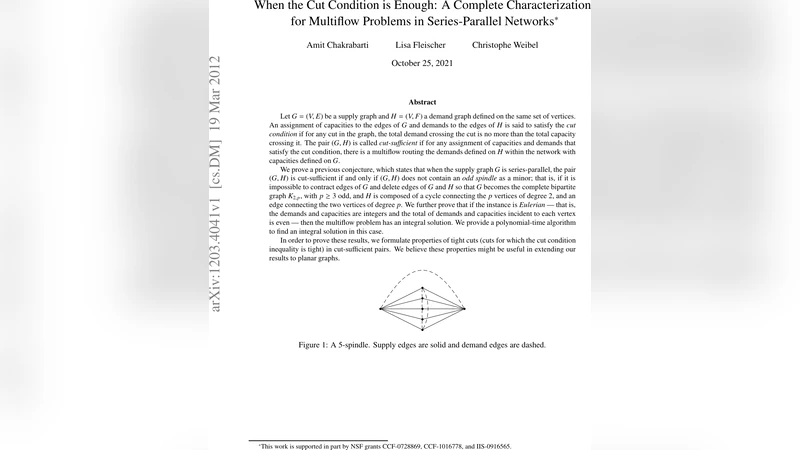
Let $G=(V,E)$ be a supply graph and $H=(V,F)$ a demand graph defined on the same set of vertices. An assignment of capacities to the edges of $G$ and demands to the edges of $H$ is said to satisfy the \emph{cut condition} if for any cut in the graph, the total demand crossing the cut is no more than the total capacity crossing it. The pair $(G,H)$ is called \emph{cut-sufficient} if for any assignment of capacities and demands that satisfy the cut condition, there is a multiflow routing the demands defined on $H$ within the network with capacities defined on $G$. We prove a previous conjecture, which states that when the supply graph $G$ is series-parallel, the pair $(G,H)$ is cut-sufficient if and only if $(G,H)$ does not contain an \emph{odd spindle} as a minor; that is, if it is impossible to contract edges of $G$ and delete edges of $G$ and $H$ so that $G$ becomes the complete bipartite graph $K_{2,p}$, with $p\geq 3$ odd, and $H$ is composed of a cycle connecting the $p$ vertices of degree 2, and an edge connecting the two vertices of degree $p$. We further prove that if the instance is \emph{Eulerian} — that is, the demands and capacities are integers and the total of demands and capacities incident to each vertex is even — then the multiflow problem has an integral solution. We provide a polynomial-time algorithm to find an integral solution in this case. In order to prove these results, we formulate properties of tight cuts (cuts for which the cut condition inequality is tight) in cut-sufficient pairs. We believe these properties might be useful in extending our results to planar graphs.
💡 Research Summary
The paper addresses a classic question in multicommodity flow theory: when does the cut condition guarantee the existence of a feasible multiflow? Given a supply graph G =(V,E) with capacities and a demand graph H =(V,F) with demands, the cut condition requires that for every cut (S, V \ S) the total demand crossing the cut does not exceed the total capacity crossing it. While this condition is necessary for any feasible routing, it is not sufficient in general. The authors focus on the case where the supply graph G is series‑parallel, a well‑studied class that can be built recursively by series and parallel compositions.
The main contribution is a complete characterization of cut‑sufficiency for series‑parallel supply graphs. They prove that a pair (G, H) is cut‑sufficient if and only if it does not contain an “odd spindle” as a minor. An odd spindle minor is obtained by contracting edges of G and deleting edges of both G and H so that G reduces to the complete bipartite graph K₂,ₚ with p ≥ 3 odd, while H becomes a cycle on the p degree‑2 vertices together with a single edge joining the two high‑degree vertices. The authors show that the presence of such a minor yields a counterexample where the cut condition holds but no feasible multiflow exists; conversely, the absence of any odd spindle minor guarantees that every cut‑feasible capacity‑demand assignment can be routed.
To establish the “if” direction, the paper develops a detailed theory of tight cuts—cuts for which the cut inequality holds with equality. In a cut‑sufficient pair, tight cuts have a highly constrained structure: they are laminar (no two cross), and each tight cut separates the graph into two sub‑instances that inherit cut‑sufficiency. By exploiting the recursive series‑parallel decomposition, the authors prove that any tight cut can be handled locally, and the global routing can be assembled from solutions on the sub‑instances. This inductive argument hinges on the fact that series‑parallel graphs admit a tree‑like decomposition where each node corresponds to either a series or a parallel composition, allowing the authors to propagate tight‑cut information upward and downward in the decomposition tree.
A second major result concerns integrality. The authors define an Eulerian instance as one where capacities and demands are integers and, for every vertex, the sum of incident capacities plus incident demands is even. Under this condition, they prove that any cut‑feasible instance admits an integral multiflow. The proof builds on the tight‑cut structure: because each vertex’s incident total is even, the flow values assigned to edges in the construction can be kept integral throughout the recursive decomposition. This extends classic integrality theorems (e.g., the max‑flow min‑cut theorem for single‑commodity flows) to a non‑trivial multicommodity setting.
From an algorithmic perspective, the paper presents a polynomial‑time procedure that, given a series‑parallel supply graph and a demand graph, either finds an integral multiflow (when the instance is Eulerian) or reports that the cut condition is insufficient (by detecting an odd spindle minor). The algorithm proceeds in three stages:
- Series‑parallel verification and decomposition – using known linear‑time tests to build the series‑parallel decomposition tree.
- Minor detection – scanning the decomposition to check for the forbidden odd‑spindle configuration; this can be done in O(|V|·|E|) time because the structure of K₂,ₚ is simple and the decomposition limits where such a minor could appear.
- Integral flow construction – if the instance is Eulerian and no forbidden minor is found, the algorithm recursively processes the decomposition tree. At each node it identifies tight cuts, assigns flow along series or parallel components, and ensures that the parity constraints are respected, thereby maintaining integrality.
The overall running time is polynomial (specifically O(|V|·|E|)), making the method practical for moderately sized networks.
Finally, the authors discuss the broader implications of their work. Series‑parallel graphs are a subclass of planar graphs, and the tight‑cut properties identified here may extend to the full planar case. The odd‑spindle minor plays a role analogous to the well‑known “odd‑cycle” obstruction in matching theory, suggesting a deeper combinatorial principle governing when cut conditions are sufficient for multicommodity routing. The paper therefore opens a promising line of research toward a complete cut‑sufficiency characterization for planar (or even more general) networks.
In summary, the paper delivers three key contributions: (i) a precise forbidden‑minor characterization (odd spindle) of cut‑sufficiency for series‑parallel supply graphs; (ii) an integrality theorem for Eulerian instances, guaranteeing integral multiflows; and (iii) a constructive polynomial‑time algorithm that either produces such an integral flow or exhibits the obstructing minor. These results significantly advance our theoretical understanding of multicommodity flow feasibility and provide concrete tools for network designers dealing with series‑parallel topologies.