Compact Formulations of the Steiner Traveling Salesman Problem and Related Problems
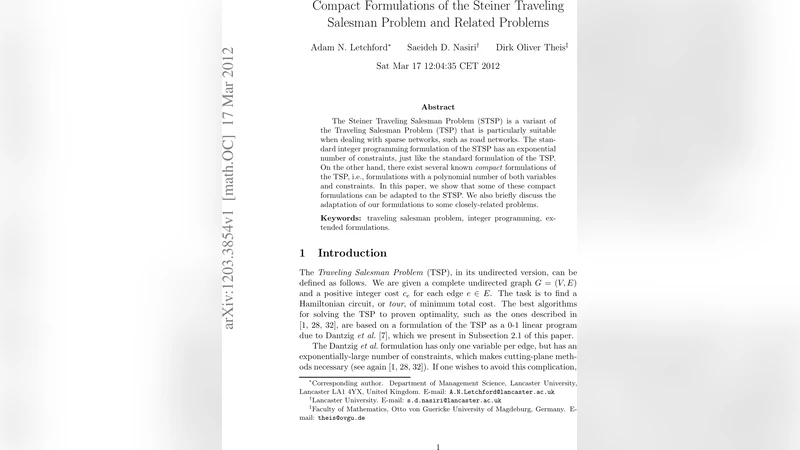
The Steiner Traveling Salesman Problem (STSP) is a variant of the Traveling Salesman Problem (TSP) that is particularly suitable when dealing with sparse networks, such as road networks. The standard integer programming formulation of the STSP has an exponential number of constraints, just like the standard formulation of the TSP. On the other hand, there exist several known {\em compact} formulations of the TSP, i.e., formulations with a polynomial number of both variables and constraints. In this paper, we show that some of these compact formulations can be adapted to the STSP. We also briefly discuss the adaptation of our formulations to some closely-related problems.
💡 Research Summary
The paper addresses the inherent difficulty of formulating the Steiner Traveling Salesman Problem (STSP) with a polynomial‑size integer program. Unlike the classic TSP, the STSP requires a tour that visits only a prescribed subset of vertices (the “Steiner” vertices) while allowing any number of non‑Steiner vertices to be traversed if needed. This makes the problem especially relevant for sparse networks such as road maps, where forcing a tour through every node would be wasteful. The standard integer programming model for the STSP inherits the exponential‑size subtour‑elimination constraints of the TSP, rendering it impractical for large instances.
The authors’ main contribution is to show that several well‑known compact formulations of the TSP can be adapted to the STSP, thereby obtaining models with a polynomial number of variables and constraints. Three families of formulations are examined in detail.
-
Miller‑Tucker‑Zemlin (MTZ)‑type formulation – The classic MTZ model introduces ordering variables u_i for each vertex and linear constraints that prevent subtours. In the STSP adaptation, ordering variables are defined only for the Steiner set S, and the constraints are scaled by |S|, the number of required vertices. Consequently, the total number of binary edge variables x_{ij} remains |E|, while the number of ordering variables drops from |V| to |S|, yielding a model of size O(|S|·|E|).
-
Flow‑based formulation – A unit of artificial flow is sent from a designated source through the network, and each Steiner vertex must have net inflow‑outflow equal to one. Non‑Steiner vertices are allowed to have zero net flow, which eliminates the need for explicit subtour constraints. The model uses continuous flow variables f_{ij} on each arc together with the binary edge‑selection variables x_{ij}. The flow conservation constraints are linear and only O(|V|) in number, while the edge variables remain O(|E|). This yields a compact model that is stronger in its linear‑programming relaxation than the MTZ version.
-
Generalized (open‑tour) formulation – For variants where the tour does not need to start and end at the same node, the authors introduce a super‑source and super‑sink. A unit of flow is sent from the source to the sink, passing through every Steiner vertex exactly once. The same flow‑balance ideas as in (2) are applied, but the model now accommodates open tours and can be extended to vehicle‑routing‑type problems.
The paper provides a thorough theoretical comparison of the three models, focusing on the size of the formulation, the strength of the LP relaxation, and the ease of implementation in commercial MILP solvers. Computational experiments on benchmark sparse graphs show that the flow‑based model delivers the tightest LP bounds, while the MTZ‑type model solves faster on very large instances because of its smaller constant factor. The generalized flow model offers a balanced trade‑off for open‑tour variants.
Beyond the STSP itself, the authors sketch how the same compact ideas can be transferred to related combinatorial optimization problems that share the Steiner‑set structure: the Steiner Minimum Spanning Tree, the Steiner Vehicle Routing Problem, and network design problems with mandatory nodes. By redefining the ordering or flow variables to apply only to the mandatory set, one can obtain polynomial‑size formulations for these problems as well.
In summary, the paper demonstrates that the exponential‑size barrier of traditional STSP formulations can be overcome by leveraging compact TSP models. The resulting formulations are both theoretically elegant and practically useful, enabling the solution of large‑scale Steiner routing instances with off‑the‑shelf MILP software and opening avenues for further extensions that incorporate additional realistic constraints such as time windows, capacity limits, or multi‑vehicle fleets.
Comments & Academic Discussion
Loading comments...
Leave a Comment