On Hawaiian Groups of Some Topological Spaces
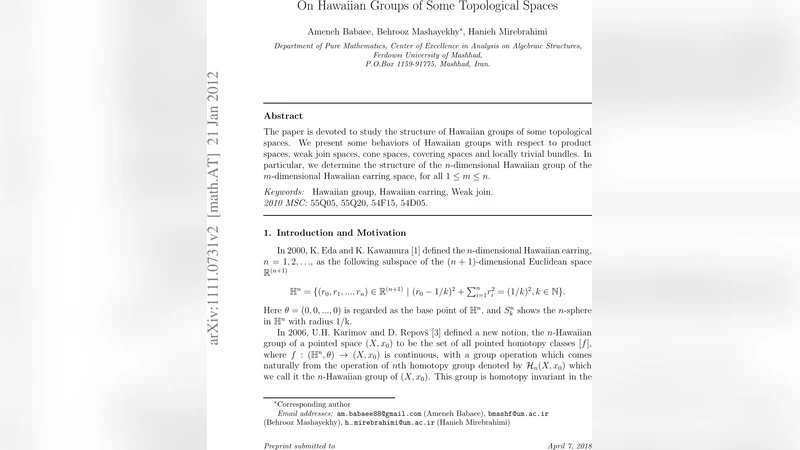
The paper is devoted to study the structure of Hawaiian groups of some topological spaces. We present some behaviors of Hawaiian groups with respect to product spaces, weak join spaces, cone spaces, covering spaces and locally trivial bundles. In particular, we determine the structure of the $n$-dimensional Hawaiian group of the $m$-dimensional Hawaiian earring space, for all $1\leq m\leq n$.
💡 Research Summary
The paper investigates the algebraic structure of Hawaiian groups, a homotopy‑type invariant introduced by Eda and Kawamura and later formalized by Karimova and Repovš. For a pointed space ((X,x_{0})) the (n)-dimensional Hawaiian group (\mathcal H_{n}(X,x_{0})) consists of pointed homotopy classes of continuous maps from the (n)-dimensional Hawaiian earring ((H_{n},\theta)) to ((X,x_{0})). The authors treat (\mathcal H_{n}) as a covariant functor from the pointed homotopy category to groups and explore its behavior under several standard topological constructions.
First, they establish basic properties. Lemma 2.2 introduces the notion of a null‑convergent family of maps and shows that continuity and homotopy of a map from the earring are equivalent to the null‑convergence of its restrictions to the constituent spheres. Using this, Theorem 2.3 proves that (\mathcal H_{n}(X,x_{0})) is abelian for all (n\ge2) by constructing a null‑convergent family of commutator homotopies on each sphere. Lemma 2.4 embeds the weak product (\prod_{i\in\mathbb N}\pi_{n}(X,x_{0})) into (\mathcal H_{n}(X,x_{0})); the embedding sends a sequence that is eventually trivial to a map that is constant on all but finitely many spheres.
The paper then focuses on spaces that are “semilocally strongly contractible” at the base point. Theorem 2.5 shows that for such spaces the natural homomorphism \
Comments & Academic Discussion
Loading comments...
Leave a Comment