Between Arrow and Gibbard-Satterthwaite; A representation theoretic approach
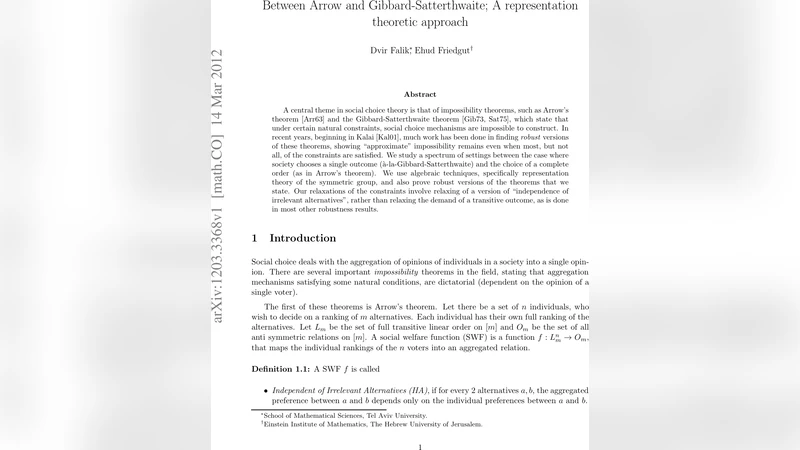
A central theme in social choice theory is that of impossibility theorems, such as Arrow’s theorem and the Gibbard-Satterthwaite theorem, which state that under certain natural constraints, social choice mechanisms are impossible to construct. In recent years, beginning in Kalai`01, much work has been done in finding \textit{robust} versions of these theorems, showing “approximate” impossibility remains even when most, but not all, of the constraints are satisfied. We study a spectrum of settings between the case where society chooses a single outcome ('a-la-Gibbard-Satterthwaite) and the choice of a complete order (as in Arrow’s theorem). We use algebraic techniques, specifically representation theory of the symmetric group, and also prove robust versions of the theorems that we state. Our relaxations of the constraints involve relaxing of a version of “independence of irrelevant alternatives”, rather than relaxing the demand of a transitive outcome, as is done in most other robustness results.
💡 Research Summary
The paper investigates a continuum of social‑choice settings that lie between the classic single‑winner framework of the Gibbard‑Satterthwaite theorem and the full‑ranking framework of Arrow’s impossibility theorem. Rather than weakening the transitivity requirement, as most recent “robust” impossibility results do, the authors focus on a relaxed version of Independence of Irrelevant Alternatives (IIA). Their central claim is that even a modest relaxation of IIA forces any non‑dictatorial, non‑transitive social‑choice function to be essentially dictatorial, thereby extending the spirit of both Arrow’s and Gibbard‑Satterthwaite’s results to a broader class of outcome spaces.
Model and Notation.
- There are (n) voters and a set of (m) alternatives.
- A profile is a tuple of linear orders (or more generally partial orders) over the alternatives, one per voter.
- The social‑choice rule is a function (f) mapping profiles to outcomes; outcomes may be a single winner, a partial ranking, or any element of a prescribed outcome space (\mathcal{O}).
- The authors introduce (\varepsilon)-IIA: for a randomly chosen pair of alternatives ((a,b)) and a random profile, the probability that the social preference between (a) and (b) changes when the preferences over all other alternatives are altered is at most (\varepsilon).
Representation‑Theoretic Framework.
The key technical tool is the representation theory of the symmetric group (S_n). The space of all profiles carries a natural left action of (S_n) by permuting voters. Any social‑choice rule can be viewed as a vector in the function space (\mathbb{R}^{\mathcal{P}}) (where (\mathcal{P}) is the set of profiles) that is invariant under this action. By decomposing this space into irreducible (S_n)‑modules—namely the trivial representation, the standard representation, and higher‑order representations—the authors express (f) as a linear combination of orthogonal components.
The trivial component corresponds to constant functions (no dependence on the profile). The standard component captures the “dictatorial” influence of a single voter; its coefficient is precisely the influence of that voter. Higher‑order components encode pairwise and higher‑order interactions among voters’ preferences. Crucially, the IIA condition translates into linear constraints on these coefficients: the pairwise component must be nearly orthogonal to the subspace spanned by irrelevant‑alternative changes.
Main Technical Lemmas.
- Noise‑Stability Lemma. Adding a small random perturbation (noise) to a profile changes the outcome with probability proportional to the squared norm of the non‑trivial components. This links IIA violation to the spectral mass outside the trivial representation.
- Influence Bound. If (\varepsilon)-IIA holds, the total influence of all voters on the non‑trivial components is bounded by a function (g(\varepsilon)) that tends to zero as (\varepsilon\to0). Consequently, the standard component dominates, implying the rule is close to a dictatorship.
- Robust Arrow‑type Theorem. For any outcome space that includes pairwise comparisons (e.g., partial rankings), (\varepsilon)-IIA together with non‑dictatorship forces the rule to be (\delta(\varepsilon))-far from any rule satisfying full IIA. The function (\delta) is explicit and polynomial in (\varepsilon).
Robust Gibbard‑Satterthwaite Theorem.
When the outcome space is a single winner, the same spectral analysis yields a bound on manipulability: any rule that is (\varepsilon)-IIA and (\eta)-strategy‑proof must be (\theta(\varepsilon,\eta))-close to a dictatorship. This recovers the classic Gibbard‑Satterthwaite conclusion in a quantitative form and shows that the two impossibility theorems are unified under a common representation‑theoretic lens.
Implications and Applications.
- Unified View of Impossibility. By treating IIA as the primary constraint and using group representations, the paper demonstrates that Arrow’s and Gibbard‑Satterthwaite’s theorems are special cases of a single spectral phenomenon.
- Design of Approximate Mechanisms. The quantitative bounds provide concrete thresholds for designers of voting protocols: if a mechanism tolerates IIA violations below a certain (\varepsilon), it inevitably concentrates power in a small subset of voters.
- Extension to Multi‑Dimensional Preferences. The framework naturally extends to settings where each voter reports a vector of rankings (e.g., multi‑issue voting) because the same (S_n) action applies component‑wise.
- Algorithmic Perspective. The decomposition can be computed efficiently using Fourier analysis on the symmetric group, suggesting practical tools for testing the robustness of real‑world voting data.
Structure of the Paper.
- Introduction – motivation, literature review, and statement of contributions.
- Model – formal definition of profiles, outcome spaces, and the (\varepsilon)-IIA relaxation.
- Representation Theory Primer – overview of irreducible representations of (S_n) and their relevance to social choice.
- Spectral Decomposition of Social‑Choice Rules – explicit formulas for the projection onto each irreducible component.
- Robust Impossibility Results – proofs of the main theorems, including quantitative bounds.
- Discussion – comparison with prior robust impossibility work, limitations, and open problems.
- Appendices – technical lemmas on noise operators, influence calculations, and detailed representation‑theoretic computations.
Conclusion.
The authors deliver a mathematically elegant and conceptually unifying treatment of impossibility theorems in social choice. By leveraging the representation theory of the symmetric group, they translate a relaxed independence condition into spectral constraints, yielding robust versions of both Arrow’s and Gibbard‑Satterthwaite’s theorems across a spectrum of outcome spaces. The work not only deepens our theoretical understanding of why collective decision mechanisms are fragile but also equips practitioners with quantitative tools to assess and design voting systems that operate near the boundary of impossibility.
Comments & Academic Discussion
Loading comments...
Leave a Comment