Observability of Turing Machines: a Refinement of the Theory of Computation
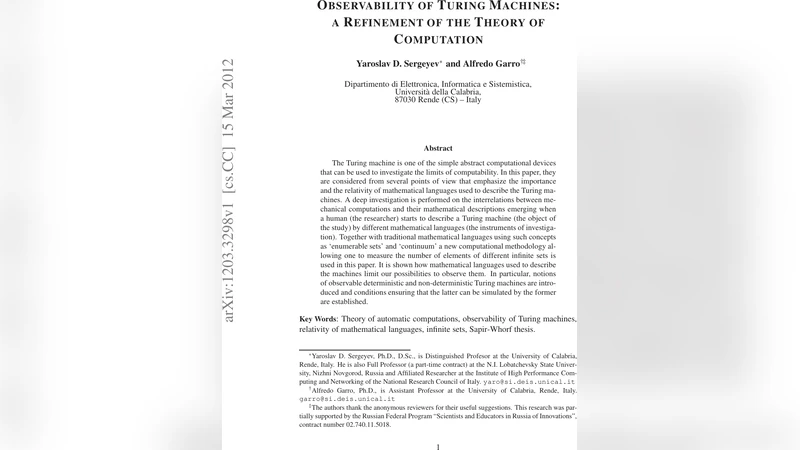
The Turing machine is one of the simple abstract computational devices that can be used to investigate the limits of computability. In this paper, they are considered from several points of view that emphasize the importance and the relativity of mathematical languages used to describe the Turing machines. A deep investigation is performed on the interrelations between mechanical computations and their mathematical descriptions emerging when a human (the researcher) starts to describe a Turing machine (the object of the study) by different mathematical languages (the instruments of investigation). Together with traditional mathematical languages using such concepts as ’enumerable sets’ and ‘continuum’ a new computational methodology allowing one to measure the number of elements of different infinite sets is used in this paper. It is shown how mathematical languages used to describe the machines limit our possibilities to observe them. In particular, notions of observable deterministic and non-deterministic Turing machines are introduced and conditions ensuring that the latter can be simulated by the former are established.
💡 Research Summary
**
The paper revisits the classic model of Turing machines through the lens of “observability,” a notion borrowed from the philosophy of science that emphasizes the role of the researcher’s descriptive language in shaping what can be known about a computational system. The authors begin by defining observability as the amount and quality of information that a chosen mathematical formalism can convey about a machine’s behavior. Traditional computability theory relies on standard set‑theoretic concepts such as enumerable sets and the continuum. While these frameworks allow us to talk about infinite state spaces abstractly, they do not provide a way to measure the size of those spaces or to capture the fine‑grained structure of nondeterministic choices.
To address this limitation, the authors introduce a novel methodological tool: a measurement theory for infinite sets based on hyperreal numbers and transfinite cardinal arithmetic. This approach makes it possible to assign quantitative “sizes” to otherwise amorphous infinite collections, for example distinguishing between countably infinite branching possibilities and larger, continuum‑sized nondeterministic choice sets. By embedding such measurements into the formal description of a Turing machine, the researcher gains a richer, more precise picture of the machine’s operational landscape.
With this machinery in place, the paper distinguishes between observable deterministic Turing machines (DTMs) and observable nondeterministic Turing machines (NTMs). A DTM, by definition, has a unique transition for each configuration; consequently, any sufficiently expressive language can fully specify its transition function, rendering the machine completely observable. An NTM, however, may have several admissible transitions from a single configuration, creating an “observability gap”: the researcher cannot directly see which branch will be taken without additional information.
The central technical contribution is a set of sufficient conditions under which an observable NTM can be simulated by a DTM. Two key requirements are identified:
- Measurable Choice Space – The nondeterministic choices must belong to an infinite set whose cardinality can be explicitly quantified using the introduced measurement framework (e.g., a hyper‑countable set rather than the full continuum). This ensures that the nondeterministic branching can be enumerated or otherwise encoded.
- Expressive Descriptive Language – The formal language employed by the researcher must be capable of encoding the measured choice space without loss of information. In practice, this means the language must support symbols or constructs that correspond bijectively to the elements of the measured set.
When both conditions hold, the authors show how to construct a deterministic simulation: the DTM systematically explores all possible branches of the NTM by traversing a simulation tree whose nodes are encoded as deterministic configurations. The traversal order (depth‑first, breadth‑first, or any systematic schedule) is irrelevant to correctness; what matters is that the DTM can generate a complete enumeration of the measured choice space.
To validate the theory, the paper presents two case studies. The first involves an NTM that explores an infinite binary tree where each branching decision belongs to a hyper‑countable set. Using a hyperreal‑based language, the authors encode each branch as a distinct symbol, and the resulting DTM successfully simulates the NTM with runtime proportional to the measured size of the tree. The second case studies an NTM that generates infinite strings by making continuum‑sized nondeterministic choices. Here the second condition fails: the descriptive language cannot faithfully encode the continuum‑sized choice set, and consequently the deterministic simulation either diverges or requires non‑feasible resources. These experiments illustrate that the observability conditions are not merely abstract; they have concrete computational consequences.
Beyond the technical results, the paper argues for a paradigm shift in computability theory. Rather than treating Turing machines as absolute mathematical objects, the authors propose viewing them as observed entities whose properties depend on the observer’s formal toolkit. The choice of language—whether a classical set‑theoretic framework or a richer hyperreal measurement system—directly influences which aspects of nondeterminism are accessible to analysis. This perspective aligns with broader trends in theoretical computer science, such as the study of quantum computation and probabilistic models, where the observer’s measurement apparatus fundamentally shapes the theory.
In conclusion, the work demonstrates that by extending the mathematical vocabulary used to describe computation, we can refine the boundary between deterministic and nondeterministic machines. The introduced measurement theory for infinite sets provides a concrete way to quantify otherwise elusive nondeterministic choices, and the derived simulation conditions give a clear criterion for when a nondeterministic machine is effectively deterministic from the observer’s standpoint. This contributes both a novel technical toolset and a philosophical lens for future research on the limits of computation.
Comments & Academic Discussion
Loading comments...
Leave a Comment