Non-commutative Stone duality: inverse semigroups, topological groupoids and C*-algebras
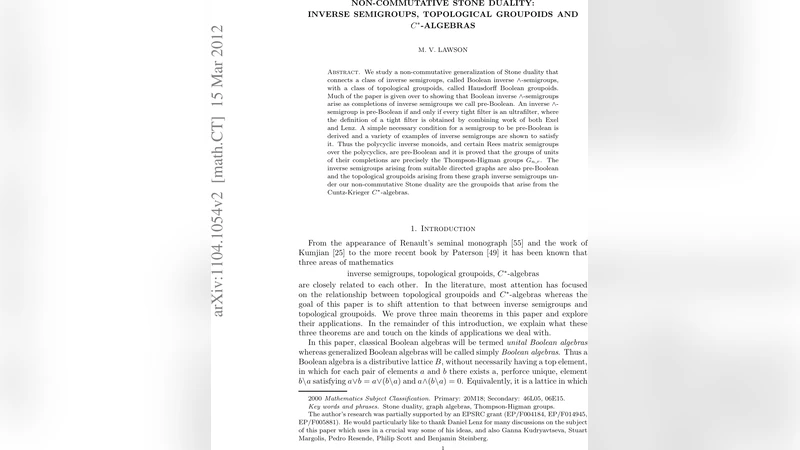
We study a non-commutative generalization of Stone duality that connects a class of inverse semigroups, called Boolean inverse $\wedge$-semigroups, with a class of topological groupoids, called Hausdorff Boolean groupoids. Much of the paper is given over to showing that Boolean inverse $\wedge$-semigroups arise as completions of inverse semigroups we call pre-Boolean. An inverse $\wedge$-semigroup is pre-Boolean if and only if every tight filter is an ultrafilter, where the definition of a tight filter is obtained by combining work of both Exel and Lenz. A simple necessary condition for a semigroup to be pre-Boolean is derived and a variety of examples of inverse semigroups are shown to satisfy it. Thus the polycyclic inverse monoids, and certain Rees matrix semigroups over the polycyclics, are pre-Boolean and it is proved that the groups of units of their completions are precisely the Thompson-Higman groups $G_{n,r}$. The inverse semigroups arising from suitable directed graphs are also pre-Boolean and the topological groupoids arising from these graph inverse semigroups under our non-commutative Stone duality are the groupoids that arise from the Cuntz-Krieger $C^{\ast}$-algebras.
💡 Research Summary
The paper develops a non‑commutative version of Stone duality that links a class of inverse semigroups—called Boolean inverse ∧‑semigroups—with a class of topological groupoids—Hausdorff Boolean groupoids. The central construction is the notion of a pre‑Boolean inverse semigroup. An inverse semigroup S is pre‑Boolean precisely when every tight filter on S is an ultrafilter. Tight filters are defined by merging the concepts introduced by Exel in the theory of tight representations of C*‑algebras and by Lenz in the study of tight filters on inverse semigroups. The authors first give a simple necessary condition for a semigroup to be pre‑Boolean and then verify this condition in a wide range of examples.
A major family of examples consists of the polycyclic inverse monoids Pₙ,r. By showing that each Pₙ,r is pre‑Boolean, the authors construct its Boolean completion B(Pₙ,r). The group of units of B(Pₙ,r) turns out to be exactly the Thompson‑Higman group Gₙ,r. This provides a new algebraic description of these well‑known infinite groups as unit groups of Boolean completions of inverse semigroups. The same method applies to certain Rees matrix semigroups built over the polycyclics, yielding further families of groups that arise as unit groups of Boolean completions.
The paper also treats inverse semigroups arising from directed graphs. For a graph E, the associated graph inverse semigroup G(E) is shown to be pre‑Boolean. Its Boolean completion B(G(E)) gives rise, via the non‑commutative Stone duality, to a Hausdorff Boolean groupoid that coincides with the Renault–Kumjian–Pask groupoid constructed from E. This groupoid is precisely the one whose C*‑algebra is the Cuntz‑Krieger algebra O_E. Thus the duality recovers the well‑studied correspondence between graph inverse semigroups, their groupoids, and graph C*‑algebras.
Technically, the authors develop the following tools: (1) a lattice‑theoretic description of ∧‑semigroups and their Boolean completions; (2) a detailed analysis of tight filters, proving that in the pre‑Boolean case tightness forces maximality; (3) a construction of a Stone space from the set of ultrafilters, equipped with a natural étale topology; (4) the identification of the inverse semigroup of compact‑open bisections of the resulting groupoid with the original Boolean inverse ∧‑semigroup. This establishes a categorical equivalence between the two classes, extending the classical Stone duality from commutative Boolean algebras to non‑commutative inverse semigroups.
The paper concludes by outlining several directions for future work: extending the duality to broader classes of inverse semigroups that are not Boolean, exploring connections with dynamical systems such as subshifts and Smale spaces, and investigating K‑theoretic invariants of the associated groupoid C*‑algebras. Overall, the work provides a powerful unifying framework that brings together inverse semigroup theory, topological groupoid theory, and operator algebras, and it opens new pathways for applying non‑commutative Stone duality to problems across algebra, topology, and analysis.
Comments & Academic Discussion
Loading comments...
Leave a Comment