Relativistic acceleration of Landau resonant particles as a consequence of Hopf bifurcations
Using bifurcation theory on a dynamical system simulating the interaction of a particle with an obliquely propagating wave in relativistic regimes, we demonstrate that uniform acceleration arises as a consequence of Hopf bifurcations of Landau resonant particles. The acceleration process arises as a form of surfatron established through the locking in pitch angle, gyrophase, and physical trapping along the wave-vector direction. Integrating the dynamical system for large amplitudes ($\delta B/B_0\sim0.1$) obliquely propagating waves, we find that electrons with initial energies in the keV range can be accelerated to MeV energies on timescales of the order of milliseconds. The Hopf condition of Landau resonant particles could underlie some of the most efficient energization of particles in space and astrophysical plasmas.
💡 Research Summary
In this paper the authors investigate a relativistic particle–wave interaction by formulating a five‑dimensional dynamical system that captures the essential physics of an electron moving in a large‑amplitude, obliquely propagating electromagnetic wave superposed on a uniform background magnetic field. The wave vector is taken along the z‑axis while the background field lies in the y‑z plane, so that the propagation angle θ determines the component of the electric field parallel to B₀. Starting from the Lorentz force equation, the authors introduce the wave phase velocity vΦ=ω/k and the relativistic gyro‑frequencies Ω₀=eB₀/(m c γ) and Ω₁=eδB/(m c γ). By shifting to a frame moving with the wave phase (p₀ₓ=pₓ, p₀_y=p_y, p₀_z=p_z−pΦ, z₀=z−vΦ t) they eliminate explicit time dependence and obtain a set of autonomous equations (Eq. 6) for the momentum components and the wave phase coordinate.
A fixed point of this system corresponds to p₀ₓ=p₀_z=0 and p₀_y=−pΦ tanθ, i.e. the condition for Landau resonance (the particle’s parallel velocity matches the wave phase speed). Linear stability analysis around this point yields a characteristic polynomial λ⁴+η₁λ²+η₂=0, where the coefficients η₁ and η₂ depend on θ, the refractive index n²=c²/vΦ², and the dimensionless parameters δ₁=Ω₀/Ω₁ and δ₂=ω/(Ω₀γ). Crucially, when the relation n²−1=tan²θ holds, a pair of complex‑conjugate eigenvalues crosses the imaginary axis, producing a Hopf bifurcation. At this bifurcation the fixed point changes from a stable focus to an unstable one, and a new attractor appears in the (α,Φ) sub‑space (α is the pitch angle, Φ the gyrophase). Particles whose initial conditions lie within the basin of attraction are phase‑locked to the wave, become trapped along the wave‑vector direction (z), and experience continuous acceleration by the constant parallel electric field – a process analogous to the surfatron mechanism.
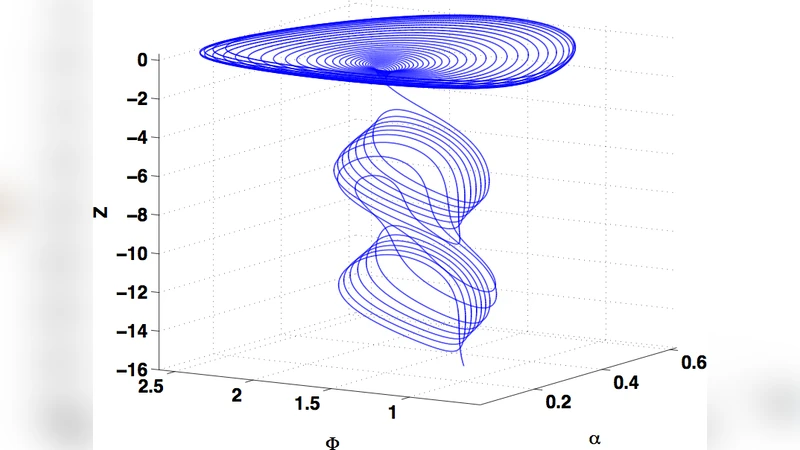
Numerical integrations are performed using spherical momentum coordinates to visualize the trajectories. For propagation angles just below the critical angle θc (≈60° for the chosen parameters), particle orbits spiral toward the attractor in (α,Φ) while remaining confined in z, and their Lorentz factor γ grows exponentially. With wave amplitudes δ₁≈0.04–0.06, low normalized frequencies δ₂≈0.1, and refractive index n²≈9, electrons initially in the keV range are accelerated to MeV energies within less than a millisecond—comparable to a few gyro‑periods. When θ exceeds θc, the phase space develops two toroidal structures and particles are neither trapped nor uniformly accelerated.
The authors place their findings in the context of earlier surfatron and phase‑locking studies, emphasizing that the Hopf bifurcation at the Landau resonance provides a rigorous dynamical‑systems explanation for the onset of sustained acceleration. They argue that the basin of attraction is sufficiently large to affect a significant fraction of a particle distribution, making the mechanism relevant for radiation‑belt electron energization, solar‑wind heating, and possibly galactic plasma acceleration where large‑amplitude oblique waves are present. The paper concludes with a brief outlook on extending the analysis to realistic wave spectra, incorporating particle‑wave feedback, and applying the theory to specific astrophysical environments.
Comments & Academic Discussion
Loading comments...
Leave a Comment