The computational hardness of counting in two-spin models on d-regular graphs
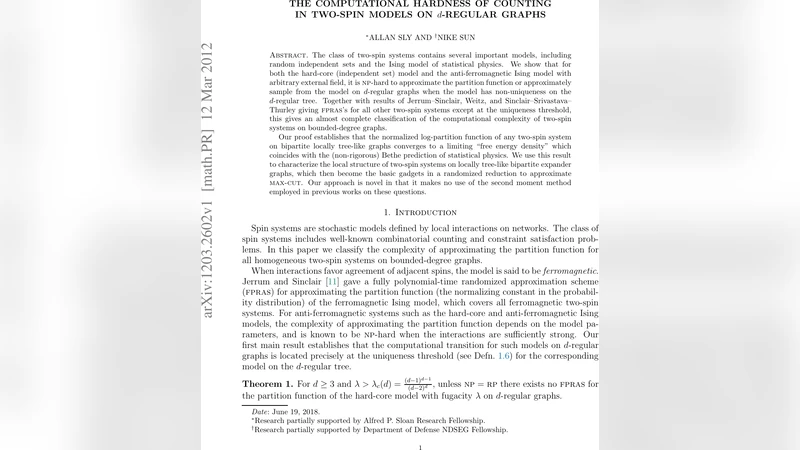
The class of two-spin systems contains several important models, including random independent sets and the Ising model of statistical physics. We show that for both the hard-core (independent set) model and the anti-ferromagnetic Ising model with arbitrary external field, it is NP-hard to approximate the partition function or approximately sample from the model on d-regular graphs when the model has non-uniqueness on the d-regular tree. Together with results of Jerrum–Sinclair, Weitz, and Sinclair–Srivastava–Thurley giving FPRAS’s for all other two-spin systems except at the uniqueness threshold, this gives an almost complete classification of the computational complexity of two-spin systems on bounded-degree graphs. Our proof establishes that the normalized log-partition function of any two-spin system on bipartite locally tree-like graphs converges to a limiting “free energy density” which coincides with the (non-rigorous) Bethe prediction of statistical physics. We use this result to characterize the local structure of two-spin systems on locally tree-like bipartite expander graphs, which then become the basic gadgets in a randomized reduction to approximate MAX-CUT. Our approach is novel in that it makes no use of the second moment method employed in previous works on these questions.
💡 Research Summary
The paper investigates the computational complexity of approximating the partition function and sampling from two‑spin systems on bounded‑degree graphs, focusing on d‑regular graphs. Two‑spin systems encompass a broad class of models, including the hard‑core (independent‑set) model and the Ising model with arbitrary external field. Prior work (Jerrum‑Sinclair, Weitz, Sinclair‑Srivastava‑Thurley) established fully polynomial‑time randomized approximation schemes (FPRAS) for all two‑spin systems that are in the uniqueness regime on the infinite d‑regular tree, but left open the hardness in the non‑uniqueness regime.
The authors prove that for both the hard‑core model (any activity λ) and the anti‑ferromagnetic Ising model (β < 0) with any external field, approximating the partition function within any constant factor, or producing an approximately correct sample, is NP‑hard on d‑regular graphs whenever the corresponding parameters lie in the non‑uniqueness region of the d‑regular tree. This result, together with the known FPRAS for the uniqueness region, yields an almost complete dichotomy for two‑spin systems on bounded‑degree graphs: either a polynomial‑time approximation exists (uniqueness) or the problem is NP‑hard (non‑uniqueness).
A central technical contribution is the proof that the normalized log‑partition function (free‑energy density) of any two‑spin system on bipartite, locally tree‑like graphs converges to a limit that coincides exactly with the Bethe free‑energy prediction from statistical physics. The authors achieve this without invoking the second‑moment method that underlies many earlier hardness proofs. Instead, they analyze the local weak convergence of Gibbs measures on expander bipartite graphs, showing that the local marginal distributions match those on the infinite tree and that the global free energy is additive in the limit.
Using this free‑energy convergence, the paper constructs a randomized reduction from approximating the partition function to approximating MAX‑CUT. The reduction builds large bipartite expander gadgets whose local structure forces spins to align opposite to a planted cut when the system is in the non‑uniqueness regime. Consequently, any algorithm that could approximate the partition function would also yield a (1 − ε)‑approximation for MAX‑CUT on regular graphs, contradicting known NP‑hardness results. This reduction works for arbitrary external fields, extending previous hardness results that were limited to zero field or specific parameter choices.
The proof proceeds in three main stages: (1) establishing free‑energy convergence on locally tree‑like bipartite expanders; (2) characterizing the local spin configuration on such expanders, showing a strong bias toward opposite spins across the bipartition in the non‑uniqueness regime; (3) embedding a MAX‑CUT instance into the spin system via a randomized gadget construction and translating an approximation of the partition function into an approximation of the cut size.
By avoiding the second‑moment method, the authors sidestep delicate concentration arguments and obtain a clean, general framework that applies to any two‑spin system with anti‑ferromagnetic interaction, regardless of the external field. The work thus bridges a gap between rigorous statistical‑physics predictions (Bethe free energy) and computational complexity, confirming the long‑standing conjecture that the uniqueness threshold precisely delineates the tractable and intractable regimes for two‑spin models on bounded‑degree graphs.
Beyond the immediate dichotomy, the techniques introduced—free‑energy density convergence on expanders and the spin‑to‑cut reduction—suggest new avenues for studying hardness of other graphical models (multi‑spin, Potts, or quantum spin systems) and for designing algorithms that exploit tree‑like local structure in high‑girth expanders. The paper sets a benchmark for future work aiming to classify the complexity of approximate counting and sampling across a wide spectrum of combinatorial and physical models.
Comments & Academic Discussion
Loading comments...
Leave a Comment