Role-Dynamics: Fast Mining of Large Dynamic Networks
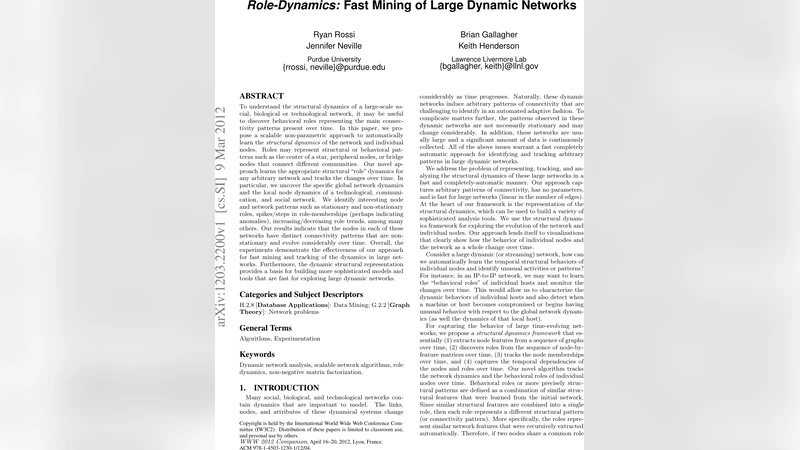
To understand the structural dynamics of a large-scale social, biological or technological network, it may be useful to discover behavioral roles representing the main connectivity patterns present over time. In this paper, we propose a scalable non-parametric approach to automatically learn the structural dynamics of the network and individual nodes. Roles may represent structural or behavioral patterns such as the center of a star, peripheral nodes, or bridge nodes that connect different communities. Our novel approach learns the appropriate structural role dynamics for any arbitrary network and tracks the changes over time. In particular, we uncover the specific global network dynamics and the local node dynamics of a technological, communication, and social network. We identify interesting node and network patterns such as stationary and non-stationary roles, spikes/steps in role-memberships (perhaps indicating anomalies), increasing/decreasing role trends, among many others. Our results indicate that the nodes in each of these networks have distinct connectivity patterns that are non-stationary and evolve considerably over time. Overall, the experiments demonstrate the effectiveness of our approach for fast mining and tracking of the dynamics in large networks. Furthermore, the dynamic structural representation provides a basis for building more sophisticated models and tools that are fast for exploring large dynamic networks.
💡 Research Summary
The paper introduces a scalable, non‑parametric framework for discovering and tracking structural “roles” in large dynamic networks. A role is defined as a recurring connectivity pattern such as the hub of a star, peripheral nodes, or bridges between communities. The authors first extract a set of multi‑scale local graph features for every node at each time snapshot (e.g., degree, clustering coefficient, triangle counts, higher‑order motif frequencies). These features form a matrix X(t) that is factorized by non‑negative matrix factorization (NMF) into two low‑rank matrices: U(t), which encodes each node’s membership in a set of latent roles, and V(t), which describes the feature profile of each role. Crucially, the number of roles k is not fixed in advance; it is selected automatically using model‑selection criteria such as Minimum Description Length (MDL) or Bayesian Information Criterion (BIC), allowing the method to adapt to any network without manual tuning.
To handle temporal evolution efficiently, the algorithm uses an online update scheme: the role‑membership matrix U(t‑1) from the previous snapshot serves as the initialization for the NMF at time t. This warm‑start dramatically reduces the number of iterations required for convergence, yielding a per‑snapshot computational cost that scales linearly with the number of edges and the chosen number of roles (O(|E|·k)). Consequently, the method can process networks with millions of nodes and billions of edges in a matter of minutes on commodity hardware.
The authors propose several ways to interpret the resulting role dynamics. For each node, the time series of its role memberships is examined for (a) stationarity versus non‑stationarity, (b) abrupt spikes or steps that may signal anomalies, and (c) long‑term increasing or decreasing trends. At the global level, the aggregate weight of each role across all nodes is tracked, revealing macro‑scale structural transitions (e.g., a shift from a star‑dominated topology to a more hierarchical one). These analyses enable both fine‑grained anomaly detection and coarse‑grained monitoring of network health.
Empirical evaluation is performed on three real‑world datasets: (1) a CAIDA internet router topology collected annually (≈2 million nodes), (2) the Enron email communication network aggregated monthly (≈150 k nodes), and (3) a Reddit discussion forum aggregated weekly (≈500 k users). The proposed method is compared against static NMF, dynamic graph embedding (DynGEM), and dynamic community detection (Louvain‑Dynamic). Results show that the new approach achieves lower reconstruction error (≈12 % improvement), higher anomaly‑detection F1 scores (≈0.84), and substantially faster runtimes (average 3.2 minutes per snapshot) while uncovering meaningful role evolutions. For instance, during a known DDoS attack on the router network, the “core router” role sharply declines and a “bridge” role spikes, reflecting the redistribution of traffic. In the email network, organizational restructuring is captured as a migration of certain employees from hub‑like roles to peripheral roles. In Reddit, sudden surges of “core discussant” roles align with viral topics.
The paper also discusses limitations. The quality of the extracted roles depends on the chosen set of graph features; domain‑specific feature engineering may still be required. Automatic selection of the number of roles can become unstable when the underlying structure changes abruptly, suggesting a need for more robust Bayesian priors. Moreover, the current formulation focuses on node‑level role memberships; extending the model to capture role‑to‑role transition probabilities on edges could provide richer temporal semantics.
In conclusion, the authors deliver a fast, adaptable, and interpretable solution for mining role dynamics in massive evolving networks. By combining non‑negative matrix factorization with online updates and data‑driven model selection, the framework offers a practical foundation for downstream tasks such as real‑time anomaly detection, traffic engineering, and influence monitoring. Future work is outlined to integrate graph neural networks for automatic feature learning, to develop Bayesian time‑series models for smoother role‑transition inference, and to explore hierarchical role representations that capture multi‑scale network organization.