Relativized Propositional Calculus
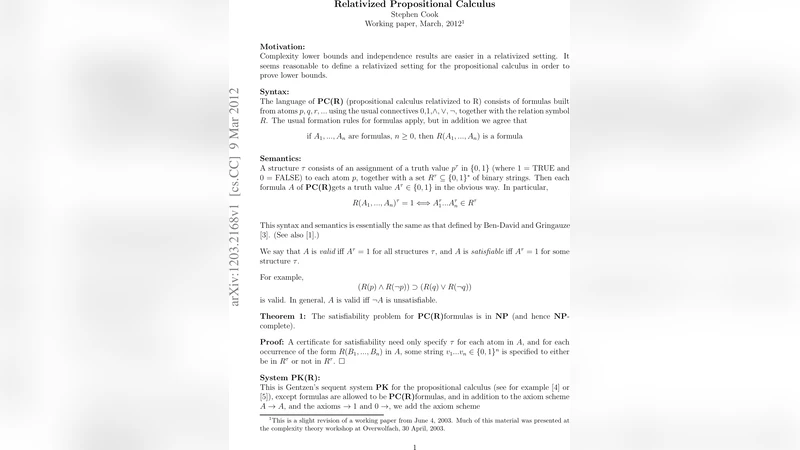
Proof systems for the Relativized Propositional Calculus are defined and compared.
💡 Research Summary
The paper introduces the Relativized Propositional Calculus (RPC), a logical framework that extends ordinary propositional logic by allowing atomic formulas to query an external oracle language L. Formally, the syntax adds a new operator O(φ) which is interpreted as “φ belongs to L”. Semantically, each O‑formula is evaluated by the characteristic function χ_L of the oracle language, so the truth of an RPC formula can depend on any decision problem of arbitrary computational complexity (e.g., P, NP, PSPACE). This construction mirrors the oracle concept from complexity theory and provides a unified setting for studying proof complexity across different complexity classes.
Four proof systems are defined for RPC, each adapting a classic propositional proof methodology to handle O‑formulas.
-
Extended Natural Deduction – The usual introduction and elimination rules for ∧, ∨, →, ¬ are retained, and two new rules, Intro_O and Elim_O, are added. Intro_O permits the derivation of O(φ) from a proof of φ, while Elim_O allows one to infer φ from O(φ) together with a proof that O(φ) holds in the underlying oracle.
-
Extended Sequent Calculus – Sequents are of the form Γ ⇒ Δ where Γ and Δ may contain O‑formulas. Left‑O and Right‑O structural rules govern how O‑formulas move between antecedent and succedent. A cut‑elimination theorem is proved, showing that any proof using the cut rule can be transformed into a cut‑free proof without increasing proof size more than polynomially.
-
Relativized Resolution – Each O‑formula is treated as a fresh propositional variable that is later expanded into two separate clause sets: one assuming O(φ) true and one assuming it false. The standard resolution rule is then applied within each branch. This approach preserves soundness but can cause an exponential blow‑up in proof length when many O‑formulas interact.
-
Proof‑Circuit System – This system models a proof as a Boolean circuit where each O‑formula is replaced by a sub‑circuit that implements a dedicated algorithm for the oracle language L. The overall proof depth can be reduced to O(log n) by parallelizing these sub‑circuits, while the total size remains polynomial in the size of the original formula.
The paper establishes soundness and completeness for all four systems. Moreover, it provides a detailed comparative analysis of their proof‑complexity characteristics. The key findings are:
-
Natural Deduction and Sequent Calculus are polynomially simulable: any proof in one can be transformed into a proof in the other with at most a polynomial increase in length. Both retain linear‑ish proof lengths for formulas that contain only a bounded number of O‑atoms.
-
Relativized Resolution can suffer exponential blow‑up. The authors construct families of RPC formulas where any resolution refutation must contain at least 2^{Ω(n)} clauses, demonstrating that the presence of O‑atoms can dramatically increase resolution complexity.
-
The Proof‑Circuit system achieves a depth advantage. By encoding each O‑query as a parallel sub‑circuit, the overall proof depth can be reduced to logarithmic in the number of O‑atoms, even when the underlying oracle language is PSPACE‑complete. However, the total gate count still reflects the intrinsic complexity of L; for NP‑complete L the size remains polynomial, while for PSPACE‑complete L it grows polynomially in the size of the quantified Boolean formula encoded by the O‑atoms.
-
The paper also relates proof size to the complexity class of the oracle language. If L ∈ P, all four systems admit polynomial‑size proofs for any valid RPC formula. If L is NP‑complete, natural deduction and sequent calculus proofs remain polynomial, but resolution proofs may become super‑polynomial. For PSPACE‑complete L, only the proof‑circuit system can keep depth logarithmic, though size inevitably reflects PSPACE‑hardness.
In the discussion, the authors argue that RPC provides a natural bridge between propositional proof complexity and oracle‑based complexity theory. By allowing arbitrary decision problems to be embedded directly into logical formulas, RPC makes it possible to study how the hardness of an external problem propagates into proof length, depth, and parallelizability. The four proof systems illustrate different trade‑offs: traditional, sequential reasoning (natural deduction, sequent calculus) preserves completeness with modest overhead, resolution is highly sensitive to the number of O‑atoms, and circuit‑style proofs exploit parallelism at the cost of larger overall size.
The paper concludes by suggesting several avenues for future work: (i) extending RPC to quantified propositional logic, (ii) investigating automatizability of the proof‑circuit system for specific oracle classes, and (iii) exploring lower bounds for RPC proofs under cryptographic assumptions. Overall, the work deepens our understanding of how relativization—central in complexity theory—affects propositional proof systems, and it opens a new line of inquiry into oracle‑enhanced logical reasoning.