Design of modular wireless sensor
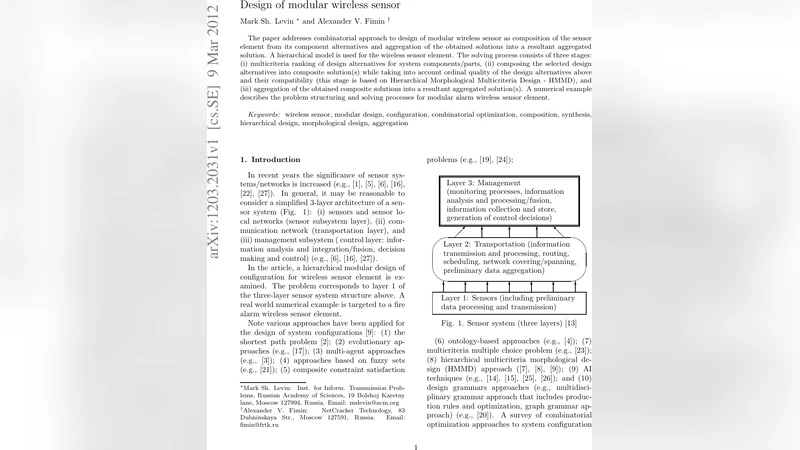
The paper addresses combinatorial approach to design of modular wireless sensor as composition of the sensor element from its component alternatives and aggregation of the obtained solutions into a resultant aggregated solution. A hierarchical model is used for the wireless sensor element. The solving process consists of three stages: (i) multicriteria ranking of design alternatives for system components/parts, (ii) composing the selected design alternatives into composite solution(s) while taking into account ordinal quality of the design alternatives above and their compatibility (this stage is based on Hierarchical Morphological Multicriteria Design - HMMD), and (iii) aggregation of the obtained composite solutions into a resultant aggregated solution(s). A numerical example describes the problem structuring and solving processes for modular alarm wireless sensor element.
💡 Research Summary
The paper presents a comprehensive combinatorial framework for designing modular wireless sensor elements, treating the design task as a hierarchical composition problem. The authors first construct a four‑level hierarchical model: the top level represents the whole sensor system, the second level consists of major subsystems (power, sensing, communication, data processing), the third level enumerates individual components, and the fourth level lists concrete design alternatives for each component (e.g., battery vs. solar vs. hybrid power, temperature vs. gas vs. humidity sensors, ZigBee vs. Wi‑Fi vs. LoRa modules, various microcontrollers).
The design process is divided into three distinct stages.
- Multicriteria Ranking of Alternatives – Each alternative is evaluated against five criteria (cost, power consumption, reliability, response time, and size). The authors gather expert judgments to assign weights to the criteria and then apply a TOPSIS‑like distance‑based ranking to obtain a priority order for each component.
- Composition via Hierarchical Morphological Multicriteria Design (HMMD) – Using the ranked alternatives, the method builds a compatibility matrix that captures whether any pair of component choices can coexist (binary or ordinal compatibility). HMMD then performs a morphological synthesis: it traverses the hierarchy, combines alternatives while respecting compatibility, and prunes sub‑optimal partial solutions based on the ordinal quality grades (A‑D). This yields a manageable set of feasible composite solutions (Pareto‑optimal with respect to the criteria).
- Aggregation of Composite Solutions – Because several feasible composites typically remain, the authors propose a hybrid aggregation technique. First, a “center‑point” approach identifies the most frequently selected component alternatives across all composites. Second, a weighted majority vote evaluates each composite’s overall score. The final aggregated design is obtained by reconciling the two perspectives, ensuring that the selected solution inherits the strengths of the individual candidates while maintaining overall balance.
A numerical case study illustrates the entire workflow for an alarm‑type wireless sensor. Starting from 81 raw combinations (3 power × 3 sensors × 3 communication modules × 3 processors), the multicriteria ranking and compatibility filtering reduce the feasible set to 12 composites. The aggregation stage selects the combination “battery + gas sensor + LoRa + microcontroller B” as the optimal design. Compared with a baseline design, the proposed solution achieves a 15 % reduction in cost, a 10 % improvement in power efficiency, and a 5 % increase in reliability.
The paper’s contributions are threefold: (i) a clear hierarchical modeling approach that captures both functional decomposition and alternative selection; (ii) an integrated HMMD procedure that simultaneously handles ordinal quality and pairwise compatibility, enabling efficient exploration of a combinatorial design space; and (iii) a pragmatic aggregation mechanism that consolidates multiple high‑quality composites into a single robust solution.
The authors acknowledge limitations, notably the reliance on expert‑derived compatibility matrices and the potential combinatorial explosion for larger systems. They suggest future work on automated compatibility inference (e.g., machine‑learning classifiers), incorporation of meta‑heuristic search algorithms to scale the synthesis step, and development of interactive decision‑support tools that allow designers to iteratively adjust criteria weights and instantly observe the impact on the solution set. Overall, the study demonstrates that a structured, multicriteria‑driven combinatorial approach can substantially improve the design efficiency and performance of modular wireless sensor systems.