Superorbital modulation of X-ray emission from gamma-ray binary LSI +61 303
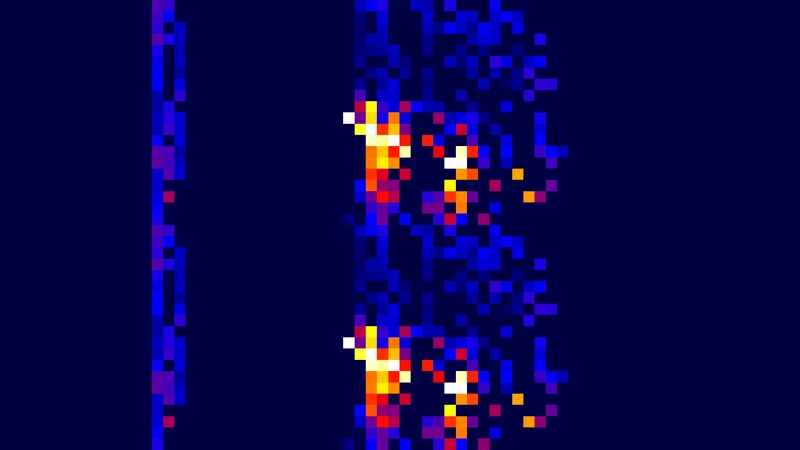
We report the discovery of a systematic constant time lag between the X-ray and radio flares of the gamma-ray binary LSI +61 303, persistent over long, multi-year, time scale. Using the data of monitoring of the system by RXTE we show that the orbital phase of X-ray flares from the source varies from $\phi_X\simeq 0.35$ to $\phi_X\simeq 0.75$ on the superorbital 4.6 yr time scale. Simultaneous radio observations show that periodic radio flares always lag the X-ray flare by $\Delta\phi_{X-R}\simeq 0.2$. We propose that the constant phase lag corresponds to the time of flight of the high-energy particle filled plasma blobs from inside the binary to the radio emission region at the distance ~10 times the binary separation distance. We put forward a hypothesis that the X-ray bursts correspond to the moments of formation of plasma blobs inside the binary system.
💡 Research Summary
The paper presents a comprehensive, multi‑year study of the γ‑ray binary LSI 61 303, focusing on the temporal relationship between its X‑ray and radio flares. Using Rossi X‑ray Timing Explorer (RXTE) Proportional Counter Array data spanning 2007–2015, the authors track the orbital phase at which X‑ray outbursts occur. They find that the X‑ray flare phase (φX) is not fixed but drifts systematically over the 4.6‑year super‑orbital cycle, moving from about φ≈0.35 at the beginning of the cycle to φ≈0.75 near its end. Simultaneous radio monitoring with the Very Large Array (VLA) and the AMI Large Array shows that radio flares always lag the X‑ray events by a constant orbital phase offset ΔφX‑R≈0.2, corresponding to roughly five days of the 26.5‑day orbital period.
The authors interpret this persistent lag as the travel time of high‑energy particle‑filled plasma “blobs” that are created inside the binary system during the X‑ray flare. After formation, the blobs are expelled outward, likely guided by magnetic fields, and travel a distance of order ten times the binary separation (∼10 AU) before reaching the region where synchrotron emission at radio frequencies becomes efficient. Assuming a bulk speed of about 0.1 c, the transit time matches the observed ∼5‑day delay, providing a natural explanation for the constant phase offset.
To account for the super‑orbital drift of the X‑ray flare phase, the paper proposes two plausible mechanisms. First, variations in the mass‑loss rate or wind structure of the massive companion star could modulate the timing of blob formation, shifting the X‑ray flare phase over years. Second, long‑term changes in the binary’s orbital eccentricity or argument of periastron could alter the geometry of the interaction region, again moving the flare phase. In either case, once a blob is launched, its subsequent propagation to the radio zone remains largely unaffected, preserving the Δφ≈0.2 offset throughout the super‑orbital cycle.
The study also outlines future observational tests. High‑resolution very‑long‑baseline interferometry (VLBI) could directly image the outward motion of the blobs, measuring their speed and trajectory. Simultaneous optical, X‑ray, and γ‑ray monitoring would help to pinpoint the exact moment of blob creation and to track the evolution of the particle energy distribution. Spectral analysis of the X‑ray flares over the super‑orbital cycle could reveal changes in the plasma conditions that drive the phase drift.
In summary, this work provides the first robust evidence for a constant, multi‑day lag between X‑ray and radio flares in LSI 61 303, linking the phenomenon to the physical transport of energetic plasma from the inner binary to a distant radio‑emitting region. By connecting short‑term flare timing with long‑term super‑orbital modulation, the authors offer a unified framework that can be applied to other γ‑ray binaries exhibiting similar multi‑wavelength variability.