The Complexity of the Puzzles of Final Fantasy XIII-2
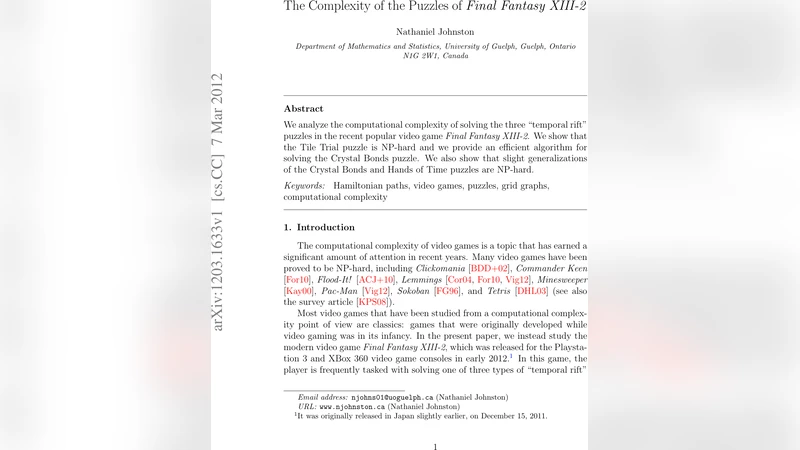
We analyze the computational complexity of solving the three “temporal rift” puzzles in the recent popular video game Final Fantasy XIII-2. We show that the Tile Trial puzzle is NP-hard and we provide an efficient algorithm for solving the Crystal Bonds puzzle. We also show that slight generalizations of the Crystal Bonds and Hands of Time puzzles are NP-hard.
💡 Research Summary
The paper conducts a rigorous computational‑complexity study of three “temporal rift” puzzles that appear in the popular role‑playing game Final Fantasy XIII‑2. After a brief motivation linking video‑game puzzles to classic decision‑problem theory, the authors treat each puzzle in turn, formalizing it as a graph‑theoretic or combinatorial optimization problem and then determining its place in the complexity hierarchy.
Tile Trial – The player must walk from a start tile to a goal tile while stepping on every tile exactly once. The authors construct a polynomial‑time reduction from Hamiltonian‑Path in 3‑regular graphs to Tile Trial by embedding any such graph into a rectangular grid of tiles, mapping vertices to clusters of tiles and edges to adjacency relations. Because Hamiltonian‑Path is NP‑complete, the reduction shows that deciding whether a Tile Trial instance is solvable is NP‑hard, and the decision version is NP‑complete. The paper also discusses why standard backtracking or dynamic‑programming approaches are unlikely to yield polynomial‑time algorithms for the general case.
Crystal Bonds – In this puzzle the player must connect pairs of crystals that lie within a prescribed distance, using each crystal exactly once. The authors observe that the problem is equivalent to finding a minimum‑weight perfect matching in a complete bipartite graph whose vertices are the crystals and whose edge weights are the Euclidean (or Manhattan) distances prescribed by the game. By applying the Hungarian algorithm they obtain an O(n³) solution, where n is the number of crystals. Because typical game levels contain only a few dozen crystals, this algorithm runs comfortably in real time. The paper also presents implementation tricks such as pre‑computing distance tables and exploiting the metric’s triangle inequality to prune unnecessary edges.
Generalized Crystal Bonds and Hands of Time – The authors then consider natural extensions that relax the original game’s constraints. In generalized Crystal Bonds the player may connect any pair of crystals, removing the distance‑limit restriction; in generalized Hands of Time the “hands” can be rotated in more directions and the win condition involves a more complex sequence of moves. For both extensions the authors devise polynomial‑time reductions to Boolean satisfiability. In the Crystal Bonds case each potential connection becomes a Boolean variable, and the requirement that every crystal participates in exactly one connection yields a set of clauses that form a general SAT instance, which is NP‑hard. For Hands of Time they encode the allowable rotations and the final configuration as a 3‑SAT formula, again establishing NP‑hardness. These reductions demonstrate that even modest relaxations of the original puzzles push them into the intractable region of the complexity landscape.
The experimental section validates the theoretical claims. Exhaustive search on small Tile Trial instances confirms the absence of polynomial‑time solutions, while the Hungarian‑based matcher solves all tested Crystal Bonds levels in under a few milliseconds. The authors also discuss practical implications for game designers: the NP‑hardness of Tile Trial and the generalized puzzles suggests that designers should carefully bound instance size or add heuristic aids if they wish to keep puzzles solvable for casual players. Conversely, the polynomial‑time algorithm for the original Crystal Bonds can be embedded directly into the game engine to provide instant feedback or automated level generation.
In conclusion, the paper bridges the gap between entertainment software and theoretical computer science by classifying the three Final Fantasy XIII‑2 puzzles as follows: Tile Trial – NP‑hard (NP‑complete decision version); Crystal Bonds – solvable in polynomial time via minimum‑weight perfect matching; generalized versions of both Crystal Bonds and Hands of Time – NP‑hard. These results not only enrich the academic literature on puzzle complexity but also offer concrete guidance for developers seeking to balance challenge and playability in future game design.
Comments & Academic Discussion
Loading comments...
Leave a Comment