Asymptotic Traffic Flow in a Hyperbolic Network: Non-uniform Traffic
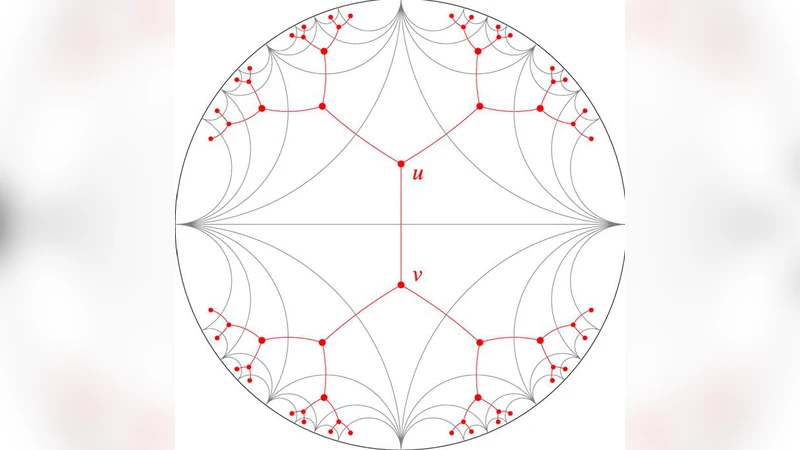
In this work we study the asymptotic traffic flow in Gromov’s hyperbolic graphs when the traffic decays exponentially with the distance. We prove that under general conditions, there exists a phase transition between local and global traffic. More specifically, assume that the traffic rate between two nodes $u$ and $v$ is given by $R(u,v)=\beta^{-d(u,v)}$ where $d(u,v)$ is the distance between the nodes. Then there exists a constant $\beta_c$ that depends on the geometry of the network such that if $1<\beta<\beta_c$ the traffic is global and there is a small set of highly congested nodes called the core. However, if $\beta>\beta_c$ then the traffic is essentially local and the core is empty which implies very small congestion.
💡 Research Summary
The paper investigates how traffic flows behave in Gromov‑hyperbolic graphs when the communication intensity between two nodes decays exponentially with their graph distance. The authors adopt a simple model in which the traffic rate between nodes u and v is given by R(u,v)=β⁻ᵈ(u,v), where d(u,v) denotes the shortest‑path distance and β>1 controls the decay speed. The central question is whether the traffic concentrates on a small set of highly loaded vertices (a “core”) or remains dispersed locally, and how this depends on β.
First, the authors recall the defining geometric property of hyperbolic graphs: the volume of a ball of radius r grows roughly like exp(αr) for some constant α>0. This exponential growth implies that most shortest paths between distant vertices pass through a relatively thin “central region,” a phenomenon often called the thin‑triangle property. Because of this, a hyperbolic network is predisposed to funnel traffic through a limited number of intermediate nodes.
The analytical core of the work is the identification of a critical decay factor β_c = e^{α}. By comparing the decay imposed by β with the exponential volume growth, the authors derive asymptotic bounds for the total traffic incident on a vertex v, defined as T(v)=∑_{u≠v}R(u,v). When β<β_c, the decay is too weak to offset the rapid increase in the number of distant sources. Consequently the sum diverges proportionally to the total number of vertices N, i.e., T(v)=Θ(N). In this regime a non‑negligible fraction of the overall traffic passes through a few vertices, creating a “core” that experiences global congestion.
Conversely, when β>β_c the exponential decay dominates the volume growth, making the series converge to a constant independent of N. Hence each vertex receives only O(1) traffic, the core disappears, and the network exhibits essentially local traffic patterns. The transition at β=β_c is sharp: the authors prove that the expected size of the core drops from Θ(N) to o(N) as β crosses the threshold.
To substantiate the theory, the paper presents extensive simulations on several hyperbolic graph models, including regular trees, random hyperbolic graphs, and graphs generated by hyperbolic embedding of real‑world data. The experiments confirm the predicted phase transition: for β just below β_c a small set of nodes carries a disproportionate amount of traffic, while for β just above β_c the load distribution becomes uniform and no node is overloaded. Visualizations of the traffic density illustrate the emergence and disappearance of the core as β varies.
Beyond the theoretical contribution, the authors discuss practical implications. In large‑scale distributed systems, peer‑to‑peer networks, and social platforms, the decay parameter β can be interpreted as a design knob (e.g., the strength of locality‑preserving routing or the aggressiveness of caching). By tuning β to stay above the critical value, system architects can avoid the formation of bottleneck cores and achieve better load balancing. Conversely, if a centralized aggregation point is desirable (for monitoring or data collection), operating with β below β_c deliberately creates a small, predictable core that can be provisioned with extra resources.
The paper concludes that the interplay between exponential distance decay and hyperbolic volume growth yields a clear dichotomy in traffic behavior, captured by the critical value β_c. This insight bridges geometric network theory with traffic engineering, offering a quantitative guideline for designing scalable, congestion‑aware hyperbolic networks.
Comments & Academic Discussion
Loading comments...
Leave a Comment