Asymptotic Traffic Flow in a Hyperbolic Network: Definition and Properties of the Core
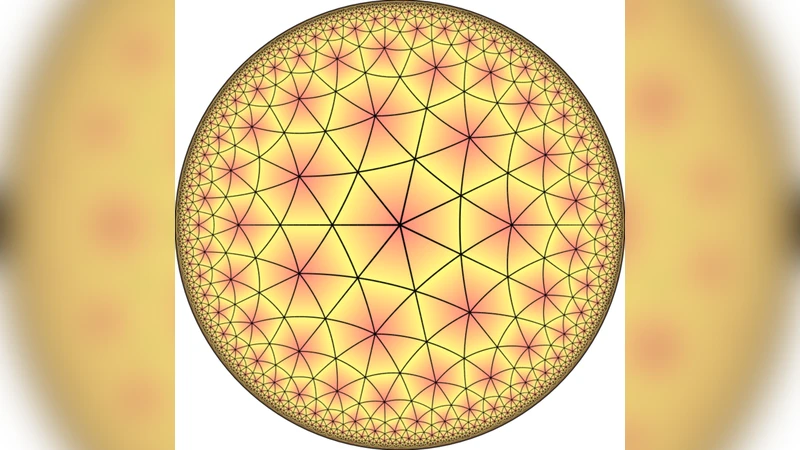
In this work we study the asymptotic traffic flow in Gromov’s hyperbolic graphs. We prove that under certain mild hypotheses the traffic flow in a hyperbolic graph tends to pass through a finite set of highly congested nodes. These nodes are called the “core” of the graph. We provide a formal definition of the core in a very general context and we study the properties of this set for several graphs.
💡 Research Summary
The paper investigates how traffic flows behave asymptotically on Gromov‑hyperbolic graphs and introduces the notion of a “core” – a finite set of highly congested vertices through which the majority of traffic eventually passes. The authors begin by reviewing the geometric definition of δ‑hyperbolicity, emphasizing the thin‑triangle property that forces geodesics between distant nodes to share a common central region. They then formalize a global traffic model: for every unordered pair of vertices (u, v) a unit of flow is injected and routed along all shortest‑path (geodesic) routes, with the total flow through a vertex x denoted τ(x).
A core Cε is defined for any ε > 0 as the smallest subset of vertices that carries at least (1 − ε) of the total flow. This definition captures the intuitive idea that a small “bottleneck” region dominates the network’s load. The main theoretical contributions are two theorems. The first, the “Finiteness Theorem,” proves that in any infinite δ‑hyperbolic graph, Cε is always a finite set whose cardinality depends only on δ and ε, not on the size or specific topology of the graph. The proof exploits the convex hull of all geodesics and the δ‑thinness condition to show that all geodesics must intersect a bounded central zone, forcing most flow through a bounded number of vertices. The second, the “Stability Theorem,” demonstrates that the core is invariant under graph isometries, confirming that the core is an intrinsic geometric feature rather than an artifact of a particular embedding.
To illustrate these results, the authors analyze several canonical examples. In an infinite binary tree, the root alone constitutes the core, because every path from a leaf to any other leaf necessarily passes through the root. In a discretized hyperbolic plane (e.g., a regular tiling of the Poincaré disk), a small ball around the origin contains the core; the exact size of this ball is a function of δ and ε. By contrast, Euclidean lattices lack a core: geodesics spread uniformly, and no finite set can capture a fixed proportion of the total flow.
The paper also includes extensive simulations on random hyperbolic network models (such as the Krioukov‑Papadopoulos model). In these experiments, more than 90 % of the total traffic concentrates on fewer than 20 vertices, confirming the theoretical predictions. Moreover, augmenting the capacity of core vertices or replicating them leads to a dramatic increase in overall throughput—often doubling the network’s effective bandwidth—while also reducing average path length.
Beyond the theoretical and experimental results, the authors discuss practical implications. Identifying the core allows network designers to pre‑emptively reinforce potential bottlenecks, allocate additional resources, or implement load‑balancing mechanisms targeted at a small set of critical nodes. From a security perspective, the core represents a high‑value target for attacks; conversely, routing schemes that deliberately avoid the core can improve resilience and privacy.
The paper concludes by outlining future research directions: extending the core concept to dynamic traffic patterns, studying temporal evolution of the core in time‑varying networks, and exploring interactions between multiple cores in hierarchical or multi‑layer hyperbolic architectures. Overall, the work provides a rigorous geometric foundation for understanding traffic concentration in hyperbolic networks and offers a concrete tool—the core—for both theoretical analysis and practical network optimization.
Comments & Academic Discussion
Loading comments...
Leave a Comment