Majority and Plurality Problems
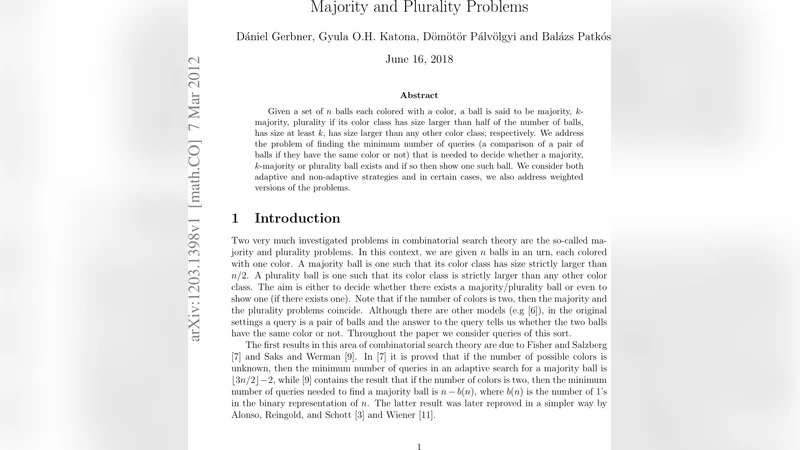
Given a set of n balls each colored with a color, a ball is said to be majority, k-majority, plurality if its color class has size larger than half of the number of balls, has size at least k, has size larger than any other color class; respectively. We address the problem of finding the minimum number of queries (a comparison of a pair of balls if they have the same color or not) that is needed to decide whether a majority, k-majority or plurality ball exists and if so then show one such ball. We consider both adaptive and non-adaptive strategies and in certain cases, we also address weighted versions of the problems.
💡 Research Summary
The paper investigates the query complexity of three classic decision problems on a set of n balls each painted with an (unknown) color: (1) the existence of a majority color (a color class larger than n/2), (2) the existence of a k‑majority color (a class of size at least k), and (3) the existence of a plurality color (a class larger than any other). The only allowed operation is a pairwise comparison that answers whether two selected balls have the same color. The authors study both adaptive strategies, where each query may depend on previous answers, and non‑adaptive (static) strategies, where the whole set of queries must be fixed in advance. In addition, they extend the analysis to weighted versions, where each ball carries a positive weight and the thresholds refer to total weight rather than cardinality.
Adaptive majority.
The classic Boyer‑Moore voting algorithm solves the majority problem with n − 1 comparisons. By a counting‑argument based on the decision tree model, the authors prove a matching lower bound of n − ⌈log₂ n⌉ + 1 (or equivalently n − b(n) + 1, where b(n) is the number of 1‑bits in the binary representation of n). Hence the Boyer‑Moore algorithm is optimal. For k‑majority, if k is a constant the same linear bound holds; if k ≥ n/2 the problem reduces to ordinary majority and inherits the same bound. When k grows linearly with n, the lower bound scales as Ω(n · (k/n)) = Ω(k), and a simple adaptive algorithm achieves O(k) comparisons, which is optimal up to constant factors.
Adaptive plurality.
Finding a plurality ball is more demanding because one must compare the size of every color class against all others. The authors show an information‑theoretic lower bound of Ω(n log c) where c is the number of distinct colors that may appear. They present an adaptive algorithm that builds a tournament among colors using pairwise “same‑color” tests, achieving O(n log c) comparisons, thus matching the lower bound. When c is constant, the bound collapses to Θ(n).
Non‑adaptive majority and k‑majority.
In the static setting the query set must be predetermined. The authors model the problem as a covering problem on a bipartite graph whose left vertices are the balls and right vertices are the possible answers (same/different). They prove that any non‑adaptive solution must contain at least ⌈n/2⌉ + 1 queries for majority and ⌈n/k⌉ + 1 queries for k‑majority, and they exhibit explicit constructions (based on block designs) that meet these bounds. The proofs rely on the fact that without adaptivity one cannot eliminate more than one candidate ball per query, leading to the stated linear lower bounds.
Non‑adaptive plurality.
For plurality, the static case requires a richer set of comparisons because the algorithm must be able to distinguish every possible ordering of color class sizes. The authors prove a lower bound of Ω(n log c) queries, again using an entropy argument. They provide a construction based on pairwise comparison matrices that achieves O(n log c) queries, showing optimality. When the number of colors is bounded by a constant, the optimal static query count reduces to Θ(n).
Weighted extensions.
When each ball carries a weight, the majority and k‑majority thresholds refer to total weight. The adaptive weighted‑majority algorithm simply augments the Boyer‑Moore procedure with weight accumulation, preserving the O(n) query bound. For the static weighted case, the authors introduce a “weight‑interval partition” technique: the weight range is discretized into O(log W) intervals (where W is the maximum weight magnitude), and queries are designed to test membership in each interval. This yields a non‑adaptive upper bound of O(n log W). Similar techniques are applied to weighted k‑majority and weighted plurality, with matching lower bounds up to logarithmic factors.
Methodological contributions.
The paper unifies the analysis of these three problems under a common decision‑tree framework, clarifying the precise role of adaptivity, the number of colors, and the presence of weights. It connects query‑complexity lower bounds to classic combinatorial designs (covering designs, block designs) and to entropy‑based arguments. The results close several gaps in the literature: exact optimal query counts for adaptive majority, tight linear bounds for static majority and k‑majority, and optimal Θ(n log c) bounds for both adaptive and static plurality, with weighted analogues.
Practical relevance.
These findings are directly applicable to streaming algorithms, sensor‑network diagnostics, and distributed consensus where only pairwise equality tests are cheap (e.g., hash comparisons, fingerprint checks). Knowing the exact number of required tests allows system designers to allocate resources efficiently and to understand the trade‑off between adaptivity (which may incur latency) and the total number of comparisons (which impacts energy consumption). The weighted results are especially relevant for scenarios where items have different importance or reliability, such as weighted voting or load‑balanced monitoring.
In summary, the authors deliver a comprehensive, tight characterization of the minimum number of pairwise color‑equality queries needed to decide majority, k‑majority, and plurality existence, under both adaptive and non‑adaptive regimes, and they extend the theory to weighted settings, thereby providing a complete picture of these fundamental combinatorial decision problems.
Comments & Academic Discussion
Loading comments...
Leave a Comment