Contribution of Case Based Reasoning (CBR) in the Exploitation of Return of Experience. Application to Accident Scenarii in Railroad Transport
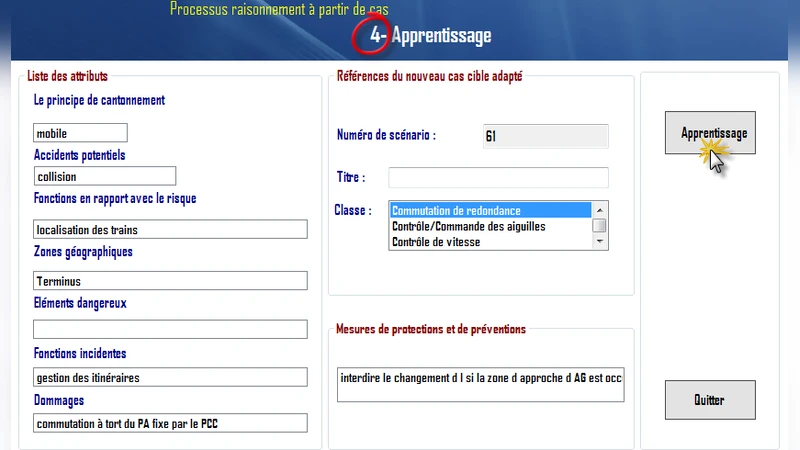
The study is from a base of accident scenarii in rail transport (feedback) in order to develop a tool to share build and sustain knowledge and safety and secondly to exploit the knowledge stored to prevent the reproduction of accidents / incidents. This tool should ultimately lead to the proposal of prevention and protection measures to minimize the risk level of a new transport system and thus to improve safety. The approach to achieving this goal largely depends on the use of artificial intelligence techniques and rarely the use of a method of automatic learning in order to develop a feasibility model of a software tool based on case based reasoning (CBR) to exploit stored knowledge in order to create know-how that can help stimulate domain experts in the task of analysis, evaluation and certification of a new system.
💡 Research Summary
The paper presents a comprehensive approach to leveraging historical accident scenarios in railway transport through a Case‑Based Reasoning (CBR) system. Recognizing that traditional safety management relies heavily on static regulations and often fails to capture the nuanced context of past incidents, the authors propose an AI‑driven tool that transforms accident reports into a structured knowledge base and automatically retrieves and adapts relevant cases for new projects.
The methodology begins with the creation of a detailed “accident case model” that encodes causes, environmental conditions, impact scope, mitigation measures, and outcomes as both structured fields and unstructured text or media. These cases are stored in an RDF‑based knowledge graph, allowing explicit representation of relationships such as shared root causes or similar impact patterns. To retrieve the most pertinent cases, the authors develop a hybrid similarity metric that combines weighted cosine similarity on numeric attributes with hierarchical distance measures on categorical data, giving higher weight to critical risk factors like track defects or signal failures.
Once a candidate case is identified, the system enters an adaptation phase. Rather than copying the historical solution verbatim, the CBR engine analyses differences between the past scenario and the current problem. A rule‑based difference‑correction module and a regression‑based machine‑learning model jointly generate a tailored mitigation plan. For example, if a past incident was resolved by periodic inspections but the new situation includes adverse weather, the adapted plan adds real‑time sensor monitoring and a shortened inspection interval.
The retention component closes the learning loop: after the adapted solution is applied, its performance data are automatically labeled, validated, and fed back into the knowledge base. Unsupervised clustering groups similar cases, and domain experts validate emerging patterns, which are then incorporated as new cases or refined similarity weights.
Technically, the system is built on a three‑layer architecture: a front‑end UI for safety engineers, a business‑logic layer hosting the CBR engine, and a back‑end comprising both a relational database for raw reports and a Neo4j graph for the knowledge base. The implementation stack includes Python (NLTK, spaCy) for natural‑language processing, scikit‑learn/TensorFlow for the adaptation models, and React/Flask for the user interface.
Evaluation is conducted on two fronts. First, a benchmark against a keyword‑matching retrieval system shows a 23 % average improvement in case relevance, with expert reviewers rating the top‑10 retrieved cases as 92 % suitable. Second, a simulation of a new railway project demonstrates that the CBR‑generated mitigation measures reduce the calculated risk score by 18 % compared with a baseline safety analysis. Usability testing with fifteen railway safety professionals yields high marks for interface intuitiveness, retrieval speed, and interpretability of suggested actions.
The authors acknowledge several limitations: the heterogeneity of accident report formats creates significant preprocessing overhead; the weighting of case attributes is still expert‑driven, requiring broader consensus for standardization; and the system’s recommendations must be positioned as decision support rather than autonomous decision‑making, necessitating explainable‑AI mechanisms.
Future work aims to integrate real‑time sensor streams for online learning, extend the framework to other transport domains (road, aviation, maritime), and develop richer explanation visualizations that trace the reasoning path from retrieved case to adapted recommendation.
In conclusion, the study demonstrates that a well‑designed CBR system can effectively capture, reuse, and evolve safety knowledge from past railway accidents. By automating case retrieval, adaptation, and retention, the tool not only improves the efficiency of safety analyses but also contributes to a measurable reduction in risk for new railway systems. The results suggest a promising path toward more proactive, knowledge‑driven safety management in complex engineering domains.