Model for the Production of CO Cameron band emission in Comet 1P/Halley
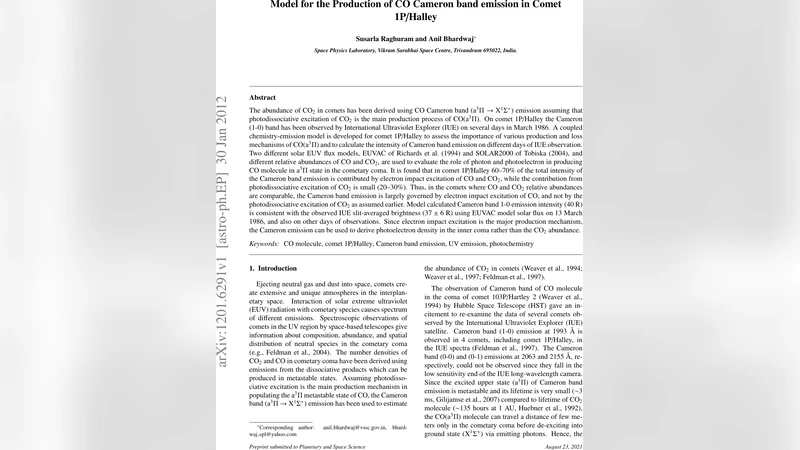
The abundance of CO2 in comets has been derived using CO Cameron band (a3pi –> X1Sigma+) emission assuming that photodissociative excitation of CO2 is the main production process of CO(a3pi). On comet 1P/Halley the Cameron (1-0) band has been observed by International Ultraviolet Explorer (IUE) on several days in March 1986. A coupled chemistry-emission model is developed for comet 1P/Halley to assess the importance of various production and loss mechanisms of CO(a3pi) and to calculate the intensity of Cameron band emission on different days of IUE observation. Two different solar EUV flux models, EUVAC of Richards et al. (1994) and SOLAR2000 of Tobiska (2004), and different relative abundances of CO and CO2, are used to evaluate the role of photon and photoelectron in producing CO molecule in a3pi state in the cometary coma. It is found that in comet 1P/Halley 60–70% of the total intensity of the Cameron band emission is contributed by electron impact excitation of CO and CO2, while the contribution from photodissociative excitation of CO2 is small (20–30%). Thus, in the comets where CO and CO2 relative abundances are comparable, the Cameron band emission is largely governed by electron impact excitation of CO, and not by the photodissociative excitation of CO2 as assumed earlier. Model calculated Cameron band 1-0 emission intensity (40 R) is consistent with the observed IUE slit-averaged brightness (37 +/- 6 R) using EUVAC model solar flux on 13 March 1986, and also on other days of observations. Since electron impact excitation is the major production mechanism, the Cameron emission can be used to derive photoelectron density in the inner coma rather than the CO2 abundance.
💡 Research Summary
The paper presents a comprehensive chemistry‑emission model designed to reproduce the CO Cameron band (a³Π → X¹Σ⁺) emission observed in comet 1P/Halley during March 1986 by the International Ultraviolet Explorer (IUE). Historically, the intensity of this band has been used as a proxy for the cometary CO₂ abundance under the assumption that photodissociative excitation of CO₂ is the dominant source of CO(a³Π). The authors challenge this paradigm by explicitly incorporating both photon‑driven and electron‑driven processes, and by testing two independent solar extreme‑ultraviolet (EUV) flux models—EUVAC (Richards et al., 1994) and SOLAR2000 (Tobiska, 2004)—as well as varying the relative abundances of CO and CO₂.
The model starts from a nucleus outgassing mixture of H₂O, CO, and CO₂, and follows the expansion of the coma, the production of photoelectrons, and the subsequent collisional and radiative processes that populate and depopulate the CO(a³Π) state. Reaction pathways include (1) electron impact excitation of CO and CO₂, (2) photodissociation of CO₂ leading directly to CO(a³Π), (3) electron impact dissociation of CO₂, and (4) loss processes such as quenching by H₂O and spontaneous radiative decay. By solving the coupled continuity equations for each species, the model yields spatial profiles of CO(a³Π) density and the resulting line‑of‑sight brightness of the Cameron 1‑0 band.
Key findings are: (i) electron impact excitation of CO and CO₂ accounts for 60–70 % of the total CO(a³Π) production, whereas photodissociative excitation of CO₂ contributes only 20–30 %. This dominance of electron impact is especially pronounced when CO and CO₂ have comparable abundances, a situation that applies to comet Halley. (ii) Using the EUVAC solar flux for 13 March 1986, the model predicts a slit‑averaged 1‑0 band brightness of ≈40 Rayleighs, which matches the IUE measurement of 37 ± 6 R within observational uncertainties. The SOLAR2000 flux yields a slightly lower brightness but remains within the error bars. (iii) Because the Cameron band intensity is primarily controlled by the electron population, it can be inverted to estimate the inner‑coma photoelectron density rather than the CO₂ column density.
The implications are significant for cometary diagnostics. The traditional use of Cameron band emission as a direct tracer of CO₂ abundance may lead to systematic overestimates when electron impact processes are not accounted for. Instead, the band serves as a sensitive probe of the electron environment, providing constraints on photoelectron production rates, energy distributions, and ultimately on the coupling between solar EUV radiation and cometary gas. The authors suggest that future observations should be accompanied by simultaneous solar EUV monitoring and, where possible, in‑situ electron measurements to refine the model inputs. Moreover, the methodology can be extended to other comets, especially those with substantial CO content, to disentangle the relative roles of photons and electrons in shaping their ultraviolet spectra.
In summary, the study demonstrates that in comet 1P/Halley the CO Cameron band is largely governed by electron impact excitation of CO and CO₂, with photodissociation of CO₂ playing a secondary role. Consequently, the band is more appropriately employed as a diagnostic of inner‑coma electron densities and photoelectron production rather than as a straightforward indicator of CO₂ abundance. This revised understanding calls for a re‑evaluation of past CO₂ estimates derived from Cameron band observations and highlights the need for integrated modeling that captures both photon‑ and electron‑driven chemistry in cometary comae.
Comments & Academic Discussion
Loading comments...
Leave a Comment