Asymptotic normality of integer compositions inside a rectangle
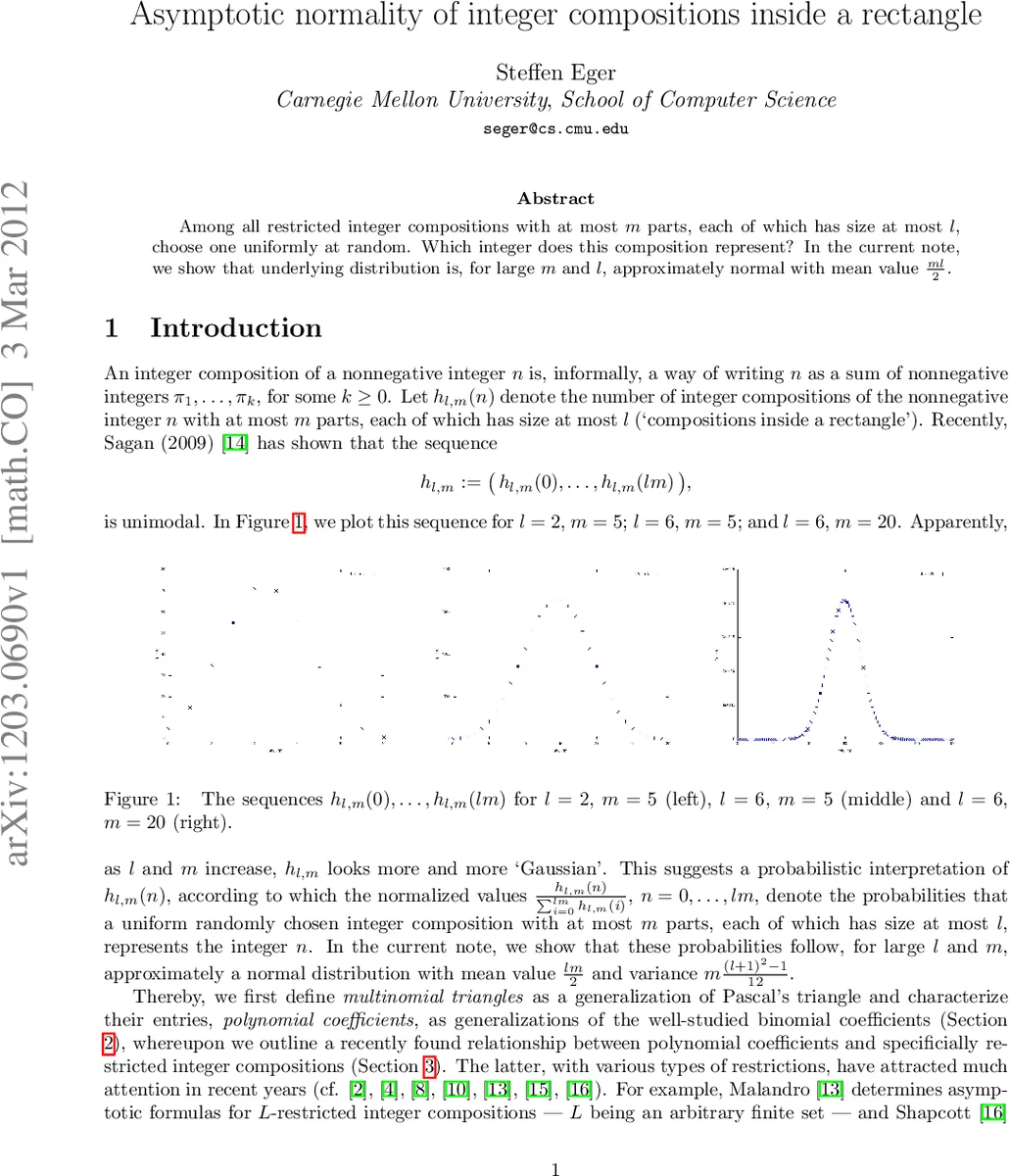
Among all restricted integer compositions with at most $m$ parts, each of which has size at most $l$, choose one uniformly at random. Which integer does this composition represent? In the current note, we show that underlying distribution is, for large $m$ and $l$, approximately normal with mean value $\frac{ml}{2}$.
💡 Research Summary
The paper investigates the probabilistic behavior of restricted integer compositions when both the number of parts and the size of each part are bounded. A composition of an integer n is an ordered sum of positive integers that equals n. The authors consider compositions in which the number of parts does not exceed m and each part is at most l. To handle the “at most m” condition uniformly, they allow parts of size 0, so every admissible composition can be represented by an m‑tuple (x₁,…,x_m) with each x_i ∈ {0,1,…,l}. The total number of such tuples is (l + 1)^m, and the uniform random choice among all admissible compositions corresponds to a uniform distribution over these tuples.
The generating function for a single part is
P(z) = 1 + z + z² + … + z^l = (1 – z^{l+1})/(1 – z).
Because the m parts are independent, the generating function for the whole composition is P(z)^m. The coefficient
Comments & Academic Discussion
Loading comments...
Leave a Comment