The Walk Distances in Graphs
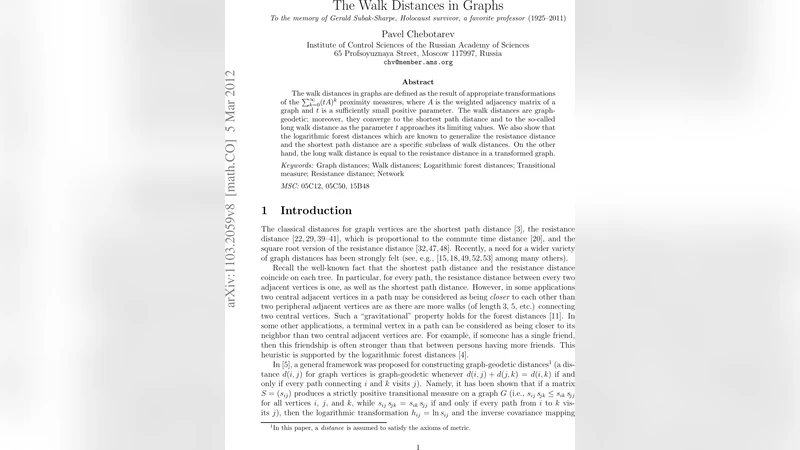
The walk distances in graphs are defined as the result of appropriate transformations of the $\sum_{k=0}^\infty(tA)^k$ proximity measures, where $A$ is the weighted adjacency matrix of a graph and $t$ is a sufficiently small positive parameter. The walk distances are graph-geodetic; moreover, they converge to the shortest path distance and to the so-called long walk distance as the parameter $t$ approaches its limiting values. We also show that the logarithmic forest distances which are known to generalize the resistance distance and the shortest path distance are a subclass of walk distances. On the other hand, the long walk distance is equal to the resistance distance in a transformed graph.
💡 Research Summary
The paper introduces a novel family of graph‑based distances called walk distances, which arise from a transformed version of the infinite series (\sum_{k=0}^{\infty}(tA)^{k}). Here (A) is the weighted adjacency matrix of a graph and (t) is a positive scalar chosen small enough to guarantee convergence (specifically (0<t<\rho(A)^{-1}), where (\rho(A)) denotes the spectral radius of (A)). The series sums to the resolvent (\Phi(t)=(I-tA)^{-1}), whose entries (\Phi_{ij}(t)) can be interpreted as the total weight of all walks from vertex (i) to vertex (j) with each walk of length (k) receiving a factor (t^{k}).
To turn this proximity measure into a genuine metric, the authors apply a logarithmic transformation and a symmetric normalization:
\
Comments & Academic Discussion
Loading comments...
Leave a Comment