The Fermi GBM Gamma-Ray Burst Spectral Catalog: The First Two Years
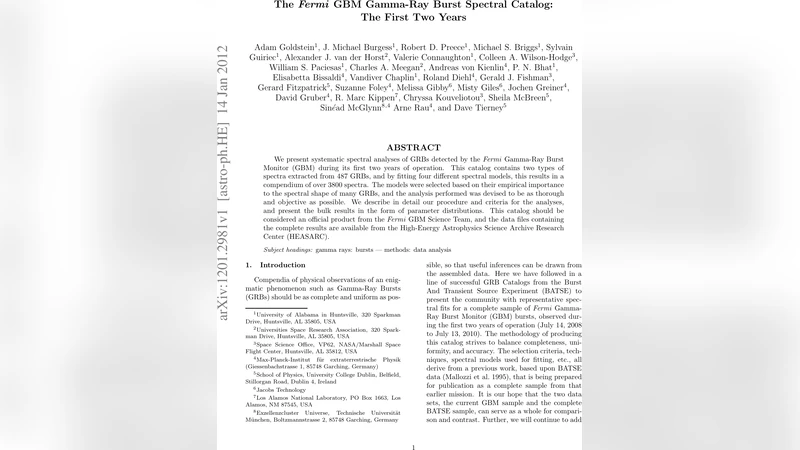
We present systematic spectral analyses of GRBs detected by the Fermi Gamma-Ray Burst Monitor (GBM) during its first two years of operation. This catalog contains two types of spectra extracted from 487 GRBs, and by fitting four different spectral models, this results in a compendium of over 3800 spectra. The models were selected based on their empirical importance to the spectral shape of many GRBs, and the analysis performed was devised to be as thorough and objective as possible. We describe in detail our procedure and criteria for the analyses, and present the bulk results in the form of parameter distributions. This catalog should be considered an official product from the Fermi GBM Science Team, and the data files containing the complete results are available from the High-Energy Astrophysics Science Archive Research Center (HEASARC).
💡 Research Summary
The paper presents a comprehensive spectral catalog of gamma‑ray bursts (GRBs) detected by the Fermi Gamma‑Ray Burst Monitor (GBM) during its first two years of operation (July 2012 – July 2014). A total of 487 GRBs were selected, and for each burst two distinct spectra were extracted: a time‑integrated (TI) spectrum covering the full T90 interval and a peak‑flux (PF) spectrum representing the interval of maximum flux (either 1 s or 0.256 s, depending on the burst duration). The authors employed all twelve NaI detectors (8 keV – 1 MeV) and the two BGO detectors (0.2 MeV – 40 MeV) to achieve broad energy coverage and to improve constraints on high‑energy spectral components.
Four empirical models were fitted to each spectrum: the Band function (two power‑law indices α and β plus a peak energy Epeak), the Comptonized model (a power‑law with an exponential cutoff, i.e., α and Epeak), a simple power‑law (PL) and a power‑law with a fixed high‑energy index (PL+β). Fitting was performed using the Castor C‑statistic, and parameter uncertainties were derived via Markov Chain Monte Carlo sampling to obtain robust 1σ confidence intervals. Model selection was driven by a combination of likelihood‑ratio tests and the Akaike Information Criterion (AIC), ensuring that a more complex model was adopted only when it provided a statistically significant improvement over simpler alternatives.
The analysis yielded over 3,800 fitted spectra, making this the most extensive GBM spectral dataset to date. In the TI sample, the Band function emerged as the best‑fit model for roughly 45 % of bursts, the Comptonized model for about 35 %, the simple PL for 15 %, and the PL+β for the remaining 5 %. In the PF sample, the proportion of Band fits decreased slightly while Comptonized fits increased, reflecting the tendency of GRB spectra to harden during peak emission. Parameter distributions show a log‑normal Epeak spanning 30 keV to 2 MeV with a median near 200 keV. The low‑energy index α clusters between –1.0 and –0.5, whereas the high‑energy index β is typically between –2.5 and –2.0. A clear anti‑correlation between α and Epeak is observed, consistent with the well‑known “hard‑to‑soft” evolution of GRB spectra. No strong correlation is found between β and Epeak, suggesting that β is largely driven by signal‑to‑noise rather than intrinsic physics.
The inclusion of BGO data significantly extends the energy reach of the catalog, allowing reliable measurement of high‑energy tails up to tens of MeV for the brightest events. This improves upon earlier BATSE catalogs, where β was often poorly constrained. For weak bursts, the data quality sometimes precludes discrimination between models, leading to a default PL fit.
All data products—PHA files, background models, and fitted parameter tables—are publicly available through the High‑Energy Astrophysics Science Archive Research Center (HEASARC). The authors emphasize that the catalog is intended as an official GBM Science Team product and can serve as a benchmark for multi‑wavelength studies, theoretical modeling (e.g., synchrotron, photospheric emission), and machine‑learning classification efforts. They also outline future plans to integrate the catalog with later GBM observations, enabling long‑term population studies and the development of standardized spectral templates.
In conclusion, the paper delivers a rigorously processed, objectively selected, and fully documented spectral database that sets a new standard for GRB spectral analysis. The transparent methodology, extensive coverage, and open data policy make it an indispensable resource for the high‑energy astrophysics community.