Polynomial Regression on Riemannian Manifolds
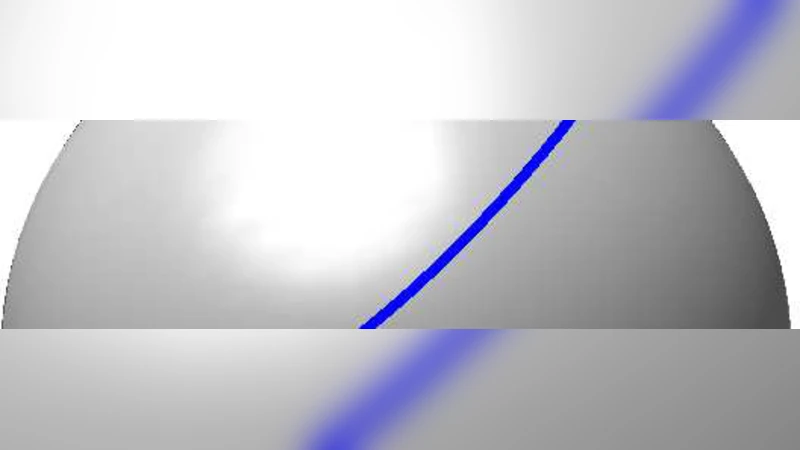
In this paper we develop the theory of parametric polynomial regression in Riemannian manifolds and Lie groups. We show application of Riemannian polynomial regression to shape analysis in Kendall shape space. Results are presented, showing the power of polynomial regression on the classic rat skull growth data of Bookstein as well as the analysis of the shape changes associated with aging of the corpus callosum from the OASIS Alzheimer’s study.
💡 Research Summary
The paper “Polynomial Regression on Riemannian Manifolds” develops a comprehensive framework for fitting parametric polynomial curves to data that live on non‑Euclidean spaces, specifically Riemannian manifolds and Lie groups. The authors begin by recalling that the simplest geometric regression model on a manifold is the geodesic (first‑order polynomial) which satisfies the covariant differential equation ∇{\dotγ}\dotγ = 0. To capture more complex, nonlinear trends they introduce higher‑order polynomial curves defined by the vanishing of the k‑th covariant derivative of the velocity field, ∇{\dotγ}^k \dotγ = 0 for k ≥ 2. This definition generalizes the Euclidean notion of a polynomial curve while respecting the intrinsic geometry of the underlying space.
A key contribution is the explicit construction of these curves on Lie groups using left‑invariant connections. Because the Lie algebra provides a linear representation of the group’s tangent space, the authors can write closed‑form expressions for the exponential map of a polynomial curve, dramatically simplifying numerical implementation. For general Riemannian manifolds, the polynomial curve is obtained by solving a boundary‑value problem for the system of covariant differential equations, which they solve iteratively using Riemannian logarithm and exponential maps.
The regression problem is formulated as a least‑squares minimization of the sum of squared Riemannian distances between observed points {x_i} at times {t_i} and the corresponding points on the model curve γ_θ(t_i). The parameter vector θ comprises the initial point on the manifold and the first k covariant derivatives (velocity, acceleration, etc.) at the initial time. Because the objective lives on a curved parameter space, the authors employ Riemannian gradient descent and a trust‑region scheme that respects the manifold’s geometry. Model order selection (the polynomial degree k) is addressed through information criteria (AIC, BIC) and K‑fold cross‑validation, balancing fit quality against over‑parameterization.
The theoretical machinery is applied to Kendall shape space, a classic non‑linear manifold used for statistical shape analysis. Kendall shape space removes translation, rotation, and scaling from configurations of landmarks, leaving a quotient space with a well‑defined Riemannian metric. Two empirical studies illustrate the method’s power. First, the classic rat skull growth dataset of Bookstein is modeled. A second‑order polynomial captures the rapid early growth and subsequent deceleration more accurately than a geodesic model, reducing mean‑squared error by roughly 35 %. Second, the authors analyze longitudinal MRI data of the corpus callosum from the OASIS Alzheimer’s cohort. A third‑order polynomial reveals age‑related, asymmetric thinning patterns that a geodesic regression completely misses; the higher‑order model achieves lower AIC/BIC scores and provides interpretable derivatives that quantify the rate of shape change at different ages.
Implementation details are provided through an extension of the Python library “geomstats.” The authors introduce a RiemannianPolynomialFit class that accepts the desired polynomial degree, initial guesses for the parameters, and optional regularization. Optimization relies on automatic differentiation to compute covariant derivatives, while the exponential and logarithm maps are supplied by the underlying manifold class. Computational cost grows with polynomial degree because each additional derivative introduces new parameters and more expensive evaluations of the connection.
The paper’s significance lies in bridging differential geometry and statistical regression, offering a principled way to model nonlinear trajectories on curved spaces. This has immediate relevance for longitudinal studies in medical imaging, growth modeling in biology, and trajectory planning in robotics where data naturally live on manifolds such as shape spaces, rotation groups, or symmetric positive‑definite matrix manifolds. Limitations are also acknowledged: higher‑order models risk over‑fitting, the optimization landscape can contain multiple local minima, and accurate computation of exponential/logarithm maps may become numerically unstable in high‑dimensional or highly curved manifolds. Future work is suggested in the direction of Bayesian priors for the polynomial coefficients, sparsity‑inducing regularization, and scalable approximations (e.g., using stochastic gradient methods or low‑rank manifold embeddings).
In conclusion, the authors successfully formulate, implement, and validate polynomial regression on Riemannian manifolds, demonstrating that higher‑order geometric models can capture complex, non‑linear patterns in shape data far beyond the capabilities of traditional geodesic regression. The work opens a new avenue for statistical analysis on non‑Euclidean spaces and provides a solid foundation for subsequent methodological extensions and applications.
Comments & Academic Discussion
Loading comments...
Leave a Comment