Leader Election Problem Versus Pattern Formation Problem
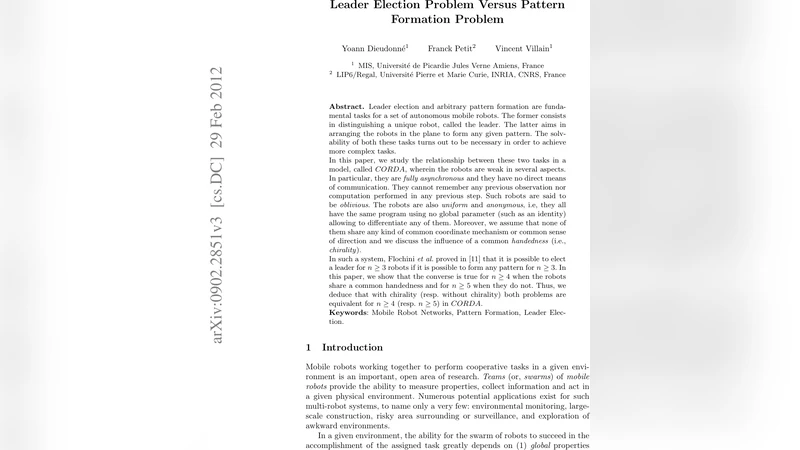
Leader election and arbitrary pattern formation are funda- mental tasks for a set of autonomous mobile robots. The former consists in distinguishing a unique robot, called the leader. The latter aims in arranging the robots in the plane to form any given pattern. The solv- ability of both these tasks turns out to be necessary in order to achieve more complex tasks. In this paper, we study the relationship between these two tasks in a model, called CORDA, wherein the robots are weak in several aspects. In particular, they are fully asynchronous and they have no direct means of communication. They cannot remember any previous observation nor computation performed in any previous step. Such robots are said to be oblivious. The robots are also uniform and anonymous, i.e, they all have the same program using no global parameter (such as an identity) allowing to differentiate any of them. Moreover, we assume that none of them share any kind of common coordinate mechanism or common sense of direction and we discuss the influence of a common handedness (i.e., chirality). In such a system, Flochini et al. proved in [11] that it is possible to elect a leader for n \geq 3 robots if it is possible to form any pattern for n \geq 3. In this paper, we show that the converse is true for n \geq 4 when the robots share a common handedness and for n \geq 5 when they do not. Thus, we deduce that with chirality (resp. without chirality) both problems are equivalent for n \geq 4 (resp. n \geq 5) in CORDA.
💡 Research Summary
**
The paper investigates the precise relationship between two fundamental tasks for a set of autonomous mobile robots—Leader Election (LE) and Arbitrary Pattern Formation (APF)—within the CORDA model. In CORDA, robots are fully asynchronous, have no direct communication, are oblivious (they cannot remember past observations or computations), and are uniform and anonymous (all run the same program and have no identifiers). Moreover, they share no global coordinate system or common sense of direction; the only possible shared geometric feature is a common handedness (chirality), i.e., a shared notion of clockwise versus counter‑clockwise.
Previous work by Flochini et al. (2015) proved a one‑way implication: if the robots can form any pattern for n ≥ 3, then they can also elect a unique leader. Their construction simply extracts a unique robot from the final pattern (for example, the robot occupying the left‑most and bottom‑most position) and declares it the leader. However, the converse—whether the ability to elect a leader implies the ability to form any pattern—remained open.
The authors answer this question by providing two complementary reductions, each depending on the presence or absence of chirality:
-
With common handedness (chirality) and n ≥ 4
Assuming a leader can be elected, the leader is fixed at a unique position and never moves. Because all robots agree on clockwise orientation, the leader together with any other robot can be used to define a global coordinate system: the leader becomes the origin, the line from the leader to the chosen robot defines the positive X‑axis, and the handedness determines the direction of the Y‑axis. Each robot, using only its current snapshot, computes the target location of its corresponding point in the desired pattern expressed in this coordinate system. The robots then move within a “safe zone” that guarantees no collisions even under the fully asynchronous scheduler. The algorithm requires O(n) observation‑compute‑move cycles per robot, matching the complexity of known APF algorithms. Hence, LE ⇒ APF for n ≥ 4 when chirality is available. -
Without common handedness (no chirality) and n ≥ 5
In the absence of a shared clockwise notion, the leader alone cannot define an orientation. The authors show that with at least five robots, the leader together with the two closest robots can be arranged into a non‑isosceles triangle, which provides a “virtual handedness”. The triangle’s vertices are used to fix an orientation: the ordered triple (leader, nearest robot, second‑nearest robot) defines a clockwise order, thereby establishing a coordinate system analogous to the chirality case. The same safe‑zone movement strategy is then applied to map each robot to its target pattern point. The extra robot is essential; with only four robots, any configuration that yields a unique leader is still symmetric enough to prevent the creation of a consistent orientation, and the reduction fails. Consequently, LE ⇒ APF holds for n ≥ 5 when chirality is absent.
Correctness arguments
- Leader immobility ensures the reference point never changes, preserving the coordinate system throughout the execution.
- Symmetry breaking is guaranteed either by the shared handedness (chirality) or by constructing a non‑symmetric triangle when handedness is missing.
- Safe‑zone movement limits each robot’s step to at most half the minimum distance to any other robot observed in the current snapshot, preventing collisions and ensuring progress even under the worst asynchronous interleavings.
Impossibility boundaries
The paper also proves that for n ≤ 3, LE itself is impossible under the CORDA assumptions, and for n = 4 without chirality the reduction cannot succeed because a unique leader cannot generate a consistent orientation. These lower bounds are tight, establishing that the thresholds n ≥ 4 (with chirality) and n ≥ 5 (without chirality) are optimal.
Implications
By establishing the bidirectional equivalence of LE and APF under the stated conditions, the work shows that solving either problem automatically solves the other. This equivalence simplifies the design of higher‑level cooperative algorithms: researchers can focus on the problem that is easier to address in a given context, knowing that the other follows. Moreover, the analysis highlights the critical role of chirality in breaking symmetry, offering a clear quantitative measure of how much additional “geometric information” is needed to compensate for the severe limitations of oblivious, asynchronous robots.
In summary, the paper demonstrates that in the CORDA model, leader election and arbitrary pattern formation are computationally equivalent for n ≥ 4 when robots share a common handedness, and for n ≥ 5 when they do not. This result completes the logical picture of these two cornerstone tasks and provides a solid foundation for future work on more complex coordinated behaviors in weak robot networks.
Comments & Academic Discussion
Loading comments...
Leave a Comment