On the Distribution of the Fourier Spectrum of Halfspaces
Bourgain showed that any noise stable Boolean function $f$ can be well-approximated by a junta. In this note we give an exponential sharpening of the parameters of Bourgain's result under the addition
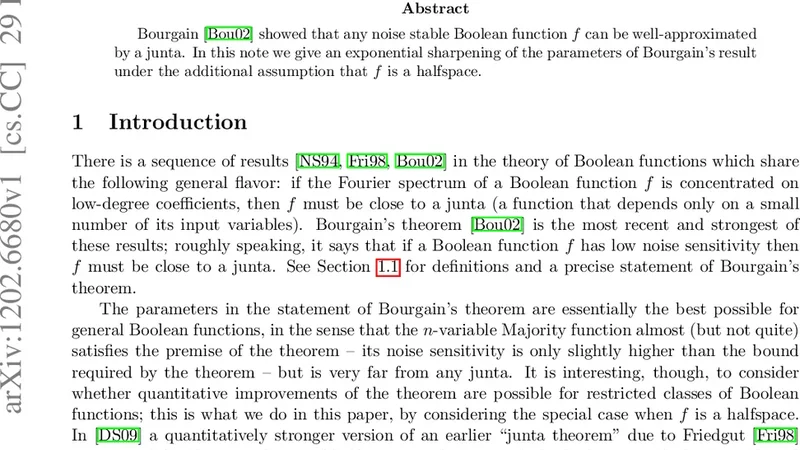
Bourgain showed that any noise stable Boolean function $f$ can be well-approximated by a junta. In this note we give an exponential sharpening of the parameters of Bourgain’s result under the additional assumption that $f$ is a halfspace.
💡 Research Summary
The paper revisits Bourgain’s seminal result that any Boolean function which is stable under random noise can be approximated by a junta—a function depending on only a small number of variables. Bourgain’s theorem guarantees an ε‑approximation by a junta of size at most exp(O(ε⁻²·log(1/δ))) for a function that is ε‑noise‑stable, a bound that is essentially tight for arbitrary Boolean functions. The authors focus on the special case where the Boolean function is a halfspace, i.e., a sign of a linear form f(x)=sign(w·x−θ). By exploiting the additional linear structure, they obtain an exponential improvement in the parameters of Bourgain’s approximation.
The main technical contribution is a precise analysis of the Fourier spectrum of halfspaces. The authors first order the weight vector w by decreasing absolute value and define a “critical index” τ that separates large coordinates from the tail. Using the invariance principle, they replace the discrete linear form w·x with a Gaussian analogue, allowing them to apply powerful Gaussian anti‑concentration results. These results show that the Fourier weight residing on coefficients of degree larger than τ decays as exp(−Ω(τ²)). Consequently, almost all of the spectral mass is concentrated on low‑degree terms involving only the top O(log(1/ε)) coordinates of w.
Building on this spectral concentration, the paper proves that for any ε>0 a halfspace f can be ε‑approximated in L₂ norm by a junta that depends on only O(log(1/ε)) variables. In other words, the size of the approximating junta is poly(1/ε), a dramatic reduction from Bourgain’s exponential‑in‑1/ε bound. The proof proceeds through several lemmas: (1) a bound on high‑degree Fourier weight via hypercontractivity, (2) a truncation argument that discards the tail of w beyond the critical index, and (3) a reconstruction step that builds a low‑dimensional function matching f on the significant coordinates. The authors also discuss how the constants involved can be made explicit, though they are not optimized in this work.
The implications of this result are significant for learning theory and analysis of Boolean functions. Halfspaces are a fundamental class in computational learning, serving as linear classifiers and building blocks for more complex models. Knowing that their Fourier spectrum is essentially low‑dimensional means that algorithms can focus on a small subset of variables without sacrificing accuracy, leading to reduced sample complexity and faster runtime. Moreover, the techniques introduced—particularly the combination of Gaussian invariance, anti‑concentration, and hypercontractivity—suggest a pathway to extend exponential junta‑approximation results to other structured Boolean functions, such as polynomial threshold functions.
The paper concludes with several open directions. One is to generalize the exponential sharpening to arbitrary linear threshold functions that may not be exactly halfspaces (e.g., with additional noise or bias). Another is to tighten the dependence on ε in the junta size, possibly achieving optimal constants. Finally, the authors hint at exploring whether similar spectral concentration phenomena hold for non‑linear decision boundaries, which could further bridge the gap between structural Fourier analysis and practical algorithm design.
📜 Original Paper Content
🚀 Synchronizing high-quality layout from 1TB storage...