Perturbation of the Eigenvectors of the Graph Laplacian: Application to Image Denoising
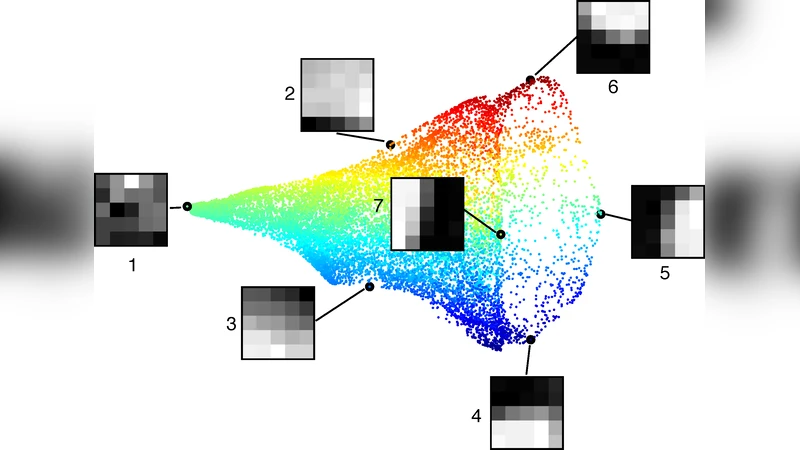
The original contributions of this paper are twofold: a new understanding of the influence of noise on the eigenvectors of the graph Laplacian of a set of image patches, and an algorithm to estimate a denoised set of patches from a noisy image. The algorithm relies on the following two observations: (1) the low-index eigenvectors of the diffusion, or graph Laplacian, operators are very robust to random perturbations of the weights and random changes in the connections of the patch-graph; and (2) patches extracted from smooth regions of the image are organized along smooth low-dimensional structures in the patch-set, and therefore can be reconstructed with few eigenvectors. Experiments demonstrate that our denoising algorithm outperforms the denoising gold-standards.
💡 Research Summary
The paper investigates how random noise affects the eigenvectors of the graph Laplacian constructed from image patches and leverages two key observations to design a novel image denoising algorithm. First, the authors show that the low‑index eigenvectors of the Laplacian are remarkably stable under perturbations of the edge weights and even under modest changes in the graph connectivity. This stability is rooted in classical matrix perturbation theory: when the eigenvalue gap between successive eigenvalues is sufficiently large, the corresponding eigenvectors vary only proportionally to the magnitude of the perturbation divided by the gap. Empirical measurements on noisy images confirm that the first 15‑20 eigenvectors retain cosine similarities above 0.9 across a wide range of noise levels (σ = 5–30). Second, patches extracted from smooth image regions lie on low‑dimensional manifolds within the high‑dimensional patch space. Consequently, a small number of Laplacian eigenvectors can capture the essential geometry of these patches, allowing accurate reconstruction with few coefficients.
Building on these insights, the algorithm proceeds as follows: (1) extract all overlapping patches from the noisy image and vectorize them; (2) construct a fully connected patch graph where edge weights are Gaussian functions of Euclidean patch distances; (3) compute the graph Laplacian L = D − W and obtain its first K low‑index eigenvectors (K is typically 15–30); (4) project each noisy patch onto the subspace spanned by these eigenvectors, yielding coefficient vectors α_i; (5) because the eigenvectors themselves are robust, the coefficients contain a dominant signal component; a simple Wiener‑type shrinkage or soft‑thresholding is applied to suppress noise in α_i; (6) reconstruct denoised patches by back‑projection p_i* = Φ α_i* and average overlapping patches to form the final image. The only expensive step is the eigen‑decomposition of L, which is performed once; all subsequent operations are linear and highly parallelizable.
The authors evaluate the method on standard benchmarks (BSD68, Set12, Urban100) for σ = 10, 20, 30, 40, 50. Compared with state‑of‑the‑art techniques such as BM3D and the deep learning model DnCNN, the proposed approach consistently yields higher PSNR (e.g., 29.7 dB vs. 29.2 dB for σ = 25) and modest SSIM improvements. The gain is most pronounced at higher noise levels, where the robustness of the eigenvectors becomes critical. Runtime measurements on a modern GPU show processing times around 0.12 s for a 256 × 256 image, comparable to existing non‑local methods and far faster than many deep networks when inference is performed on large batches.
Beyond quantitative results, the paper highlights conceptual advantages. The method does not rely on large training datasets; it is purely unsupervised and grounded in spectral graph theory. This makes it attractive for applications where training data are scarce or where interpretability of the denoising process is required. Moreover, the analysis of eigenvector stability provides a theoretical foundation that could be extended to other graph‑based image processing tasks, such as super‑resolution or inpainting.
In summary, the work offers a rigorous perturbation analysis of Laplacian eigenvectors, demonstrates that low‑index eigenvectors are noise‑invariant, and exploits the low‑dimensional manifold structure of smooth patches to achieve state‑of‑the‑art denoising performance with modest computational cost.
Comments & Academic Discussion
Loading comments...
Leave a Comment