On Zero Divisors with Small Support in Group Rings of Torsion-Free Groups
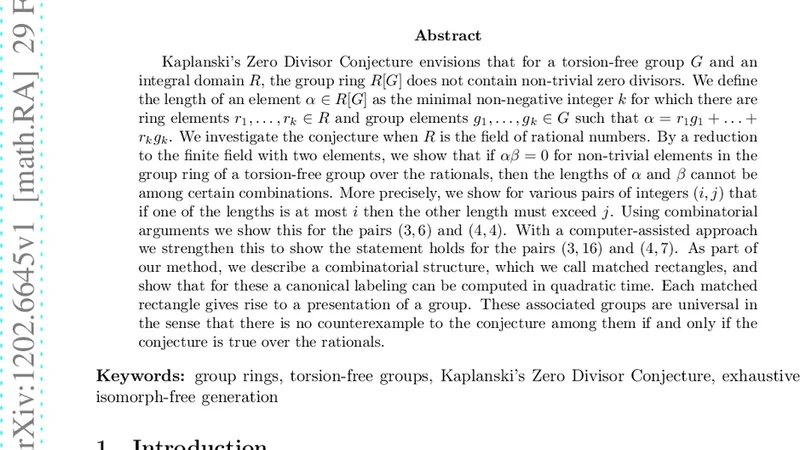
Kaplanski’s Zero Divisor Conjecture envisions that for a torsion-free group G and an integral domain R, the group ring R[G] does not contain non-trivial zero divisors. We define the length of an element a in R[G] as the minimal non-negative integer k for which there are ring elements r_1,…,r_k in R and group elements g_1,…,g_k in G such that a = r_1 g_1+…+r_k g_k. We investigate the conjecture when R is the field of rational numbers. By a reduction to the finite field with two elements, we show that if ab = 0 for non-trivial elements in the group ring of a torsion-free group over the rationals, then the lengths of a and b cannot be among certain combinations. More precisely, we show for various pairs of integers (i,j) that if one of the lengths is at most i then the other length must exceed j. Using combinatorial arguments we show this for the pairs (3,6) and (4,4). With a computer-assisted approach we strengthen this to show the statement holds for the pairs (3,16) and (4,7). As part of our method, we describe a combinatorial structure, which we call matched rectangles, and show that for these a canonical labeling can be computed in quadratic time. Each matched rectangle gives rise to a presentation of a group. These associated groups are universal in the sense that there is no counterexample to the conjecture among them if and only if the conjecture is true over the rationals.
💡 Research Summary
The paper tackles Kaplanski’s Zero‑Divisor Conjecture in the specific setting of a torsion‑free group G and the rational group ring ℚ
Comments & Academic Discussion
Loading comments...
Leave a Comment