Aspects of SOA: An Entry Point for Starters
Because Service-Oriented Architecture (SOA) is one of the hottest topics that is currently gaining momentum, and the number of its adopters (both business and IT executives) is increasing in a tremendous manner, it is really a must to enlist important aspects related to it in order to allow these adopters to better understand the role that it can play in both software and business markets. These aspects varies from the definition of SOA and key components of it, different forms of support given by elite software vendors to it, its evolution history, the relationship between it and web services, the future expectations about its uses and benefits in different organizations, the relationship between SOA and Enterprise Application Integration (EAI), and various applications that can use it to overcome limitations related to other traditional methods. Moreover, challenges that face SOA in software market should be addressed and discussed in order to be able to see the big picture and to look for better solutions for them.
💡 Research Summary
Service‑Oriented Architecture (SOA) has become a buzzword in both business and IT circles, yet many newcomers struggle to grasp its full implications. This paper offers a comprehensive, entry‑level guide that walks readers through the essential concepts, historical evolution, vendor ecosystems, practical applications, and the challenges that still impede widespread adoption.
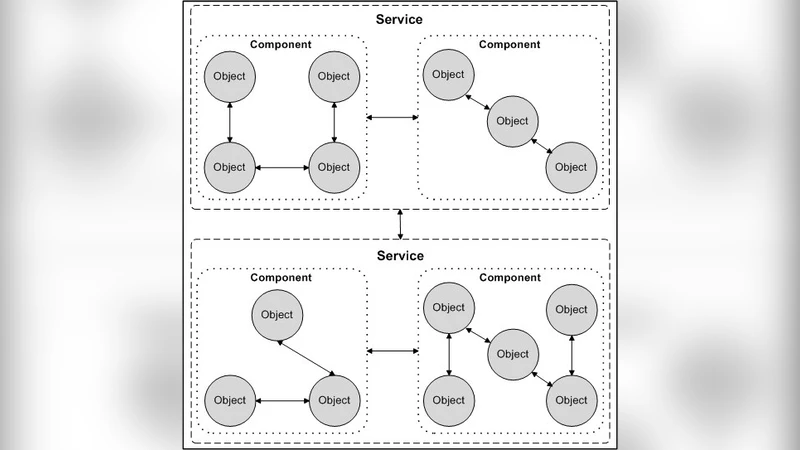
The authors begin by defining SOA as an architectural style that encapsulates discrete business functionality into reusable, contract‑driven services. Core building blocks are identified: the service itself (the encapsulated logic), the service contract (typically expressed in WSDL, OpenAPI, or similar specifications), a service registry for discovery, an enterprise service bus (ESB) that mediates communication across heterogeneous protocols, and orchestration/composition engines that coordinate multiple services into higher‑level business processes. By decoupling implementation from interface, SOA promises lower coupling, higher agility, and the ability to reuse services across applications, departments, and even external partners.
Next, the paper surveys the major vendor offerings that have turned SOA from a theoretical concept into a practical reality. IBM’s WebSphere suite, together with its Integration Bus and BPM tools, provides a heavyweight, enterprise‑grade platform emphasizing governance and monitoring. Microsoft leverages the .NET framework, Windows Communication Foundation (WCF), and Azure Service Bus to deliver a cloud‑friendly, developer‑centric stack, complemented by Azure API Management for policy enforcement. Oracle’s SOA Suite integrates tightly with its database and middleware stack, offering a unified approach to service registration, security, and lifecycle management. The authors also mention other players such as SAP, TIBCO, MuleSoft, and open‑source projects (e.g., Apache ServiceMix), highlighting the breadth of choices available to organizations.
The historical perspective traces SOA’s roots back to early distributed object technologies (CORBA, DCOM) and shows how the rise of web services in the early 2000s—SOAP, WSDL, and UDDI—provided the first standardized means of exposing services over HTTP. While SOAP offered strong typing and formal contracts, its verbosity and complexity spurred the later adoption of lighter RESTful APIs and JSON payloads. The paper argues that modern SOA is no longer synonymous with “SOAP‑based web services”; instead, it embraces a spectrum of implementation styles, including REST, event‑driven messaging, and micro‑services packaged in containers (Docker, Kubernetes). This evolution aligns SOA with cloud computing, DevOps pipelines, and continuous delivery, enabling rapid scaling and automated observability.
A dedicated section clarifies the relationship between SOA and Enterprise Application Integration (EAI). EAI traditionally focuses on moving data between legacy systems using point‑to‑point adapters or hub‑and‑spoke architectures. SOA, by contrast, abstracts functionality as services, allowing not only data exchange but also business‑level reuse and composition. The authors propose a hybrid model: legacy applications are wrapped as services (often called “service façade” patterns), then integrated via an ESB. This approach preserves existing investments while gaining the orchestration, governance, and monitoring capabilities that SOA provides.
Practical use cases illustrate the tangible benefits of adopting SOA. In the banking sector, account‑opening, transaction validation, and fraud‑detection logic have been exposed as services, enabling mobile, web, and ATM channels to share a single, consistent implementation and reducing error rates. Manufacturing firms have decomposed supply‑chain functions (order entry, inventory management, shipping) into micro‑services, orchestrated through a BPM engine, and exposed them via an API gateway to partners, achieving real‑time visibility and faster onboarding of new suppliers. Government agencies have built citizen‑centric portals where authentication, payment, and document‑retrieval services are centrally managed, facilitating cross‑department data sharing while respecting privacy regulations. SaaS providers have leveraged SOA to create plug‑and‑play integrations between CRM, ERP, and analytics platforms, offering customers customizable workflows without custom code. Across these examples, the paper emphasizes how SOA overcomes the rigidity of batch‑oriented or monolithic integration approaches, delivering measurable improvements in time‑to‑market, operational cost, and service‑level compliance.
The final and perhaps most critical portion of the paper addresses the persistent challenges that prevent SOA from becoming a universal solution. Governance emerges as a top concern: without a robust service catalog, version‑control policies, and lifecycle management, organizations risk service duplication, contract drift, and “service sprawl.” Security is another major hurdle; exposing services across network boundaries necessitates standardized authentication (OAuth, JWT), message‑level encryption (WS‑Security), and fine‑grained authorization policies, often enforced at the API‑gateway layer. Performance and latency can degrade when deep orchestration chains introduce multiple network hops; the authors recommend caching strategies, asynchronous messaging (e.g., AMQP, Kafka), and lightweight protocols to mitigate these effects. Cultural and skill‑set issues are highlighted as well—successful SOA initiatives require close collaboration between business analysts and developers, as well as training programs that teach service‑design principles, contract‑first development, and DevOps practices. Finally, cost management is discussed: as the number of services grows, operational overhead (monitoring, logging, scaling) can balloon, so automated telemetry, predictive scaling, and cost‑aware service design become essential.
To address these obstacles, the paper proposes a comprehensive SOA adoption roadmap: (1) establish a governance framework that defines service standards, ownership, and lifecycle processes; (2) implement an ESB or lightweight API‑gateway that supports both synchronous and asynchronous patterns; (3) adopt a contract‑first development methodology, using tools such as Swagger/OpenAPI for REST or WSDL for SOAP; (4) integrate CI/CD pipelines with automated testing, security scanning, and container orchestration; (5) deploy centralized monitoring (e.g., Prometheus, ELK stack) and analytics to enforce SLA compliance; and (6) invest in continuous education and change‑management programs to align organizational culture with service‑centric thinking.
In summary, the paper delivers a well‑structured, beginner‑friendly yet technically rigorous overview of SOA. By covering definition, key components, vendor ecosystems, historical context, relationship to web services and EAI, real‑world applications, and the gamut of challenges and mitigation strategies, it equips newcomers with the knowledge needed to evaluate, design, and implement SOA solutions that can drive business agility and integration efficiency in today’s rapidly evolving IT landscape.
Comments & Academic Discussion
Loading comments...
Leave a Comment