Estimating turbulent velocities in the elliptical galaxies NGC 5044 and NGC 5813
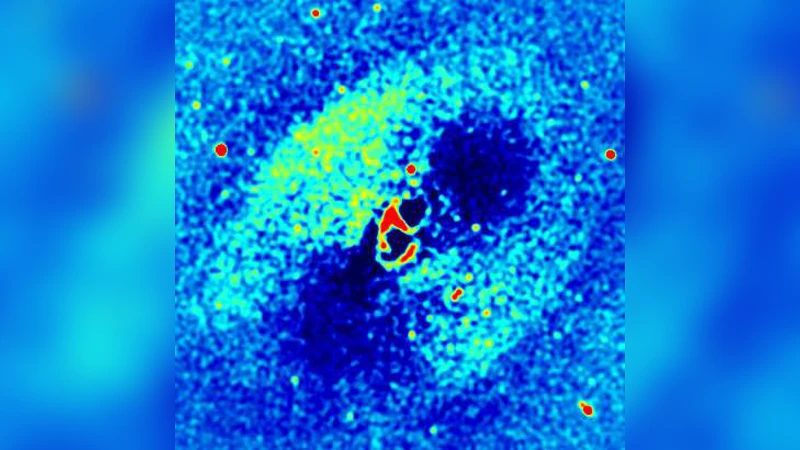
The interstellar and intra-cluster medium in giant elliptical galaxies and clusters of galaxies is often assumed to be in hydrostatic equilibrium. Numerical simulations, however, show that about 5-30% of the pressure in a cluster is provided by turbulence induced by, for example, the central AGN and merger activity. We aim to put constraints on the turbulent velocities and turbulent pressure in the ICM of the giant elliptical galaxies NGC 5044 and NGC 5813 using XMM-Newton RGS observations. The magnitude of the turbulence is estimated using the Fe XVII lines at 15.01 A, 17.05 A, and 17.10 A in the RGS spectra. At low turbulent velocities, the gas becomes optically thick in the 15.01 A line due to resonant scattering, while the 17 A lines remain optically thin. By comparing the (I(17.05)+I(17.10))/I(15.01) line ratio from RGS with simulated line ratios for different Mach numbers, the level of turbulence is constrained. The measurement is limited by systematic uncertainties in the atomic data, which are at the 20-30% level. We find that the line ratio in NGC 5813 is significantly higher than in NGC 5044. This difference can be explained by a higher level of turbulence in NGC 5044. The high turbulent velocities and the fraction of the turbulent pressure support of >40% in NGC 5044, assuming isotropic turbulence, confirm that it is a highly disturbed system, probably due to an off-axis merger. The turbulent pressure support in NGC 5813 is more modest at 15-45%. The (I(17.05)+I(17.10))/I(15.01) line ratio in an optically thin plasma, calculated using AtomDB v2.0.1, is 2 sigma above the ratio measured in NGC 5044, which cannot be explained by resonant scattering. This shows that the discrepancies between theoretical, laboratory, and astrophysical data on Fe XVII lines need to be reduced to improve the accuracy of the determination of turbulent velocities using resonant scattering.
💡 Research Summary
The paper investigates the level of turbulence in the hot intra‑cluster medium (ICM) of two massive elliptical galaxies, NGC 5044 and NGC 5813, using high‑resolution X‑ray spectroscopy from XMM‑Newton’s Reflection Grating Spectrometer (RGS). The authors exploit resonant scattering of the Fe XVII 15.01 Å line, which becomes optically thick at low turbulent velocities, while the nearby 17.05 Å and 17.10 Å lines remain optically thin. In a turbulent medium the line broadening reduces the scattering efficiency, raising the observed ratio (I₁₇.₀₅+I₁₇.₁₀)/I₁₅.₀₁. By measuring this ratio in the two galaxies and comparing it with a suite of Monte‑Carlo simulations that model resonant scattering for different Mach numbers (M), the authors infer the turbulent velocity dispersion and the fraction of total pressure contributed by turbulence.
For NGC 5044 the measured ratio is significantly higher than for NGC 5813, implying a larger turbulent Mach number (M≈0.5–0.7) and a turbulent velocity of roughly 150–210 km s⁻¹. Assuming isotropic turbulence, the turbulent pressure accounts for more than 40 % of the total pressure, indicating a highly disturbed system, likely the result of an off‑axis merger. In NGC 5813 the inferred Mach number is lower (M≈0.2–0.4), corresponding to turbulent velocities of 60–120 km s⁻¹ and a turbulent pressure contribution of 15–45 %, suggesting a comparatively calmer dynamical state.
A major limitation highlighted by the study is the systematic uncertainty in the atomic data for Fe XVII. The transition probabilities and collisional excitation rates used in AtomDB v2.0.1 carry 20–30 % uncertainties, which directly affect the theoretical line ratios for an optically thin plasma. Indeed, the optically thin ratio predicted by AtomDB is about two sigma higher than the observed ratio in NGC 5044, a discrepancy that cannot be explained by resonant scattering alone. This underscores the need for improved laboratory measurements and theoretical calculations to reconcile differences between atomic databases, laboratory experiments, and astrophysical observations.
The authors also discuss the assumption of isotropic turbulence. Real ICM turbulence may be anisotropic due to AGN jets, merger‑driven bulk flows, or shock fronts, potentially leading to an over‑estimate of the turbulent pressure when isotropy is imposed. Future missions with higher spectral resolution and throughput, such as XRISM and Athena, combined with three‑dimensional hydrodynamic simulations, will enable more precise constraints on the directionality, spatial scale, and magnitude of turbulence.
In summary, the work demonstrates that resonant scattering of Fe XVII lines provides a viable diagnostic for turbulent motions in galaxy‑scale hot gas, but the accuracy of the method is presently limited by atomic physics uncertainties and simplifying assumptions about turbulence geometry. The contrasting turbulence levels in NGC 5044 and NGC 5813 illustrate how different dynamical histories—major off‑axis merger versus a more quiescent evolution—manifest in the pressure support of the ICM. The study calls for refined atomic data and next‑generation X‑ray spectroscopy to advance our understanding of turbulent pressure contributions in massive galaxies and clusters.