Constraining Galactic cosmic-ray parameters with Z<=2 nuclei
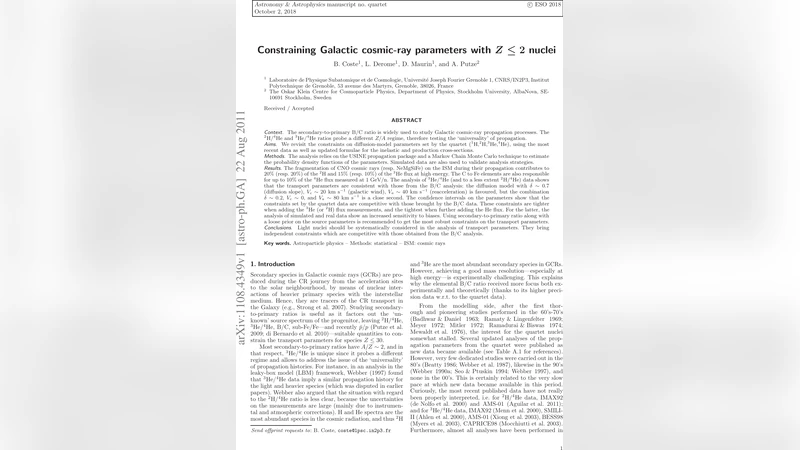
The secondary-to-primary B/C ratio is widely used to study Galactic cosmic-ray propagation processes. The 2H/4He and 3He/4He ratios probe a different Z/A regime, therefore testing the `universality’ of propagation. We revisit the constraints on diffusion-model parameters set by the quartet (1H, 2H, 3He, 4He), using the most recent data as well as updated formulae for the inelastic and production cross-sections. The analysis relies on the USINE propagation package and a Markov Chain Monte Carlo technique to estimate the probability density functions of the parameters. Simulated data are also used to validate analysis strategies. The fragmentation of CNO cosmic rays (resp. NeMgSiFe) on the ISM during their propagation contributes to 20% (resp. 20%) of the 2H and 15% (resp. 10%) of the 3He flux at high energy. The C to Fe elements are also responsible for up to 10% of the 4He flux measured at 1 GeV/n. The analysis of 3He/4He (and to a less extent 2H/4He) data shows that the transport parameters are consistent with those from the B/C analysis: the diffusion model with delta0.7 (diffusion slope), Vc20 km/s (galactic wind), Va40 km/s (reacceleration) is favoured, but the combination delta0.2, Vc0, and Va80 km/s is a close second. The confidence intervals on the parameters show that the constraints set by the quartet data are competitive with those brought by the B/C data. These constraints are tighter when adding the 3He (or 2H) flux measurements, and the tightest when further adding the He flux. For the latter, the analysis of simulated and real data show an increased sensitivity to biases. Using secondary-to-primary ratio along with a loose prior on the source parameters is recommended to get the most robust constraints on the transport parameters.
💡 Research Summary
The paper revisits the constraints on Galactic cosmic‑ray (GCR) transport parameters using the quartet of light nuclei (¹H, ²H, ³He, ⁴He). While the secondary‑to‑primary boron‑to‑carbon (B/C) ratio has long been the benchmark for diffusion‑reacceleration models, the Z/A≈2 regime probed by deuterium and helium isotopes offers an independent test of the “universality” of propagation. The authors assemble the most recent measurements of ²H/⁴He and ³He/⁴He (from IMAX‑92, AMS‑01, BESS‑98, CAPRICE‑98, etc.) and update the nuclear inelastic and production cross‑sections, including the contribution of CNO and Ne‑Mg‑Si‑Fe fragmentation to the secondary fluxes.
The propagation framework is a 1‑D thin‑disk plus halo model implemented in the semi‑analytical USINE code. The diffusion coefficient is parameterised as K(R)=K₀ β^{η_T}(R/1 GV)^δ, with free parameters K₀, δ (diffusion slope), V_c (constant vertical wind), and V_a (Alfvén speed governing stochastic re‑acceleration). The source spectrum follows Q∝β^{η_S} R^{-α}. The halo half‑height L is fixed at 4 kpc to facilitate comparison with earlier work.
A Bayesian Markov Chain Monte Carlo (MCMC) approach, based on the Metropolis‑Hastings algorithm, is used to sample the joint posterior of transport and source parameters. The authors deliberately adopt weak priors to let the data drive the inference, and they explore several fitting strategies: (i) secondary‑to‑primary ratios only, (ii) ratios plus primary fluxes, and (iii) ratios with a loose prior on source parameters.
To assess methodological robustness, artificial data sets are generated from two extreme benchmark models: (A) δ≈0.2, V_c≈0, V_a≈80 km s⁻¹ (re‑acceleration dominated) and (B) δ≈0.7, V_c≈20 km s⁻¹, V_a≈40 km s⁻¹ (diffusion‑convection‑re‑acceleration). Realistic statistical errors (10 % on ³He/⁴He, 1 % or 10 % on He flux) are applied. The MCMC reconstructions show that when only ratios are used, δ and V_a are loosely constrained, but adding a precise He flux dramatically narrows the credible intervals, especially for V_c. The artificial tests confirm that the fitting strategy can recover the input parameters within the 68 % confidence region, provided systematic uncertainties are modest.
Applying the same machinery to the actual data, the authors find that the best‑fit transport parameters are consistent with those derived from B/C analyses. The diffusion‑convection‑re‑acceleration model with δ≈0.7, V_c≈20 km s⁻¹, V_a≈40 km s⁻¹ yields χ²/d.o.f.≈0.9, while the re‑acceleration‑only model (δ≈0.2, V_c≈0, V_a≈80 km s⁻¹) gives a comparable χ²≈1.0, indicating a near‑degeneracy between the two regimes. Inclusion of the ³He/⁴He ratio together with the He flux tightens the constraints on V_c and V_a, favoring the former solution but not excluding the latter. The ²H/⁴He ratio, being less precise, contributes mainly to the determination of δ.
A key quantitative result is the assessment of secondary production from heavier primaries: fragmentation of CNO nuclei contributes ≈20 % to the high‑energy ²H flux and ≈15 % to the ³He flux; Ne‑Mg‑Si‑Fe adds a similar fraction. Moreover, up to 10 % of the measured ⁴He flux at ~1 GeV n⁻¹ originates from spallation of these heavier elements. These contributions are essential for accurate modelling of the light isotope spectra at high energies.
The authors conclude that light‑nuclei ratios provide constraints that are competitive with, and in some cases tighter than, those from B/C, especially when primary He fluxes are included. However, the analysis is more sensitive to systematic biases (e.g., cross‑section uncertainties, solar modulation modeling) than the B/C case. They recommend a strategy that combines secondary‑to‑primary ratios with a loose prior on source parameters to obtain robust transport constraints. The work highlights the importance of including light isotopes in future GCR propagation studies, particularly with upcoming high‑precision data from AMS‑02 and other missions, which will enable discrimination between diffusion‑dominated and re‑acceleration‑dominated scenarios and may reveal spatial variations in the diffusion coefficient.
Comments & Academic Discussion
Loading comments...
Leave a Comment