A Massive Progenitor of the Luminous Type IIn Supernova 2010jl
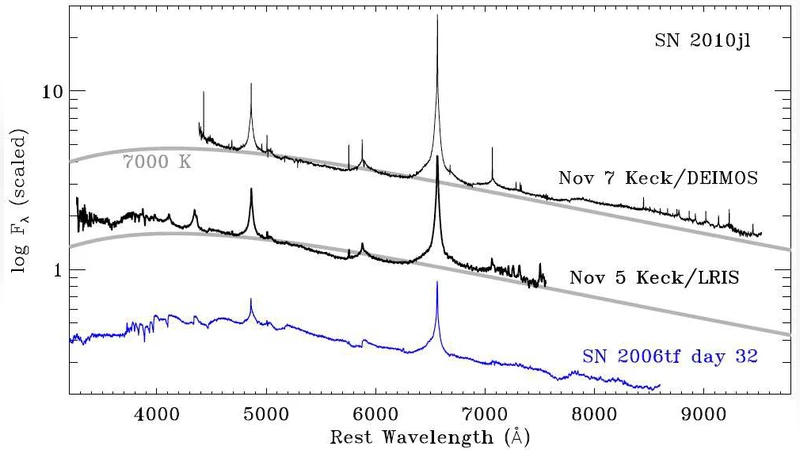
The bright, nearby, recently discovered supernova SN2010jl is a member of the rare class of relatively luminous Type~IIn events. Here we report archival HST observations of its host galaxy UGC5189A taken roughly 10yr prior to explosion, as well as early-time optical spectra of the SN. The HST images reveal a bright, blue point source at the position of the SN, with an absolute magnitude of -12.0 in the F300W filter. If it is not just a chance alignment, the source at the SN position could be (1) a massive young (less than 6 Myr) star cluster in which the SN resided, (2) a quiescent, luminous blue star with an apparent temperature around 14,000K, (3) a star caught during a bright outburst akin to those of LBVs, or (4) a combination of option 1 and options 2 or 3. Although we cannot confidently choose between these possibilities with the present data, any of them imply that the progenitor of SN2010jl had an initial mass above 30Msun. This reinforces mounting evidence that many SNe IIn result from very massive stars, that massive stars can produce visible SNe without collapsing quietly to black holes, and that massive stars can retain their H envelopes until shortly before explosion. Standard stellar evolution models fail to account for these observed properties.
💡 Research Summary
The paper presents a detailed investigation of the progenitor of the luminous Type IIn supernova SN 2010jl, combining archival Hubble Space Telescope (HST) imaging taken roughly a decade before the explosion with early‑time optical spectroscopy obtained shortly after discovery. The authors first locate a bright, blue point source at the precise SN position in the pre‑explosion HST/WFPC2 frames. Photometry in the F300W (near‑UV) and F814W (I‑band) filters yields absolute magnitudes of –12.0 mag and –10.5 mag, respectively, indicating an object far more luminous than a typical single star and possessing a distinctly blue color.
Spectroscopic data taken within about ten days of explosion reveal the hallmark features of an IIn event: an extremely broad Hα emission component (≈ 4000 km s⁻¹) together with strong He I, Fe II, and other intermediate‑width lines, signifying vigorous interaction between the supernova ejecta and a dense circumstellar medium (CSM). The presence of such a dense CSM implies that the progenitor experienced substantial mass loss shortly before core collapse.
To interpret the nature of the pre‑explosion source, the authors explore four plausible scenarios. (1) The source could be a compact, young massive star cluster (age < 6 Myr) whose integrated light produces the observed UV brightness. In this case, the cluster would need a total mass of order 10⁶ M☉ to account for the luminosity, consistent with vigorous star formation in the host galaxy UGC 5189A. (2) It could be a single, luminous blue supergiant with an effective temperature of roughly 14,000 K; fitting a black‑body model to the photometry yields a bolometric luminosity that requires an initial mass of 30–40 M☉. (3) The source might represent an eruptive outburst of a luminous blue variable (LBV) analogue, analogous to the giant eruptions observed in η Carinae, during which a massive star temporarily brightens by several magnitudes. (4) A hybrid of the above, where a massive cluster hosts a luminous blue star or an LBV undergoing an outburst, is also considered.
Regardless of which interpretation is correct, all viable models demand an initial stellar mass exceeding ~30 M☉. This conclusion challenges the conventional view that the most massive stars (> 30 M☉) end their lives by collapsing directly to black holes without a visible supernova display. Instead, SN 2010jl demonstrates that very massive stars can retain substantial hydrogen envelopes up to the moment of core collapse and can explode as bright, interaction‑dominated supernovae.
The paper’s findings reinforce a growing body of evidence that many Type IIn supernovae arise from the deaths of very massive stars, that such stars can undergo extreme pre‑explosion mass‑loss episodes, and that standard single‑star evolutionary tracks need revision to accommodate these outcomes. The authors advocate for further high‑resolution, multi‑wavelength follow‑up (e.g., infrared imaging, radio interferometry) of SN 2010jl and similar events to map the geometry and composition of the CSM, thereby refining our understanding of the final stages of massive stellar evolution.
Comments & Academic Discussion
Loading comments...
Leave a Comment