Drawing Graphs in the Plane with a Prescribed Outer Face and Polynomial Area
We study the classic graph drawing problem of drawing a planar graph using straight-line edges with a prescribed convex polygon as the outer face. Unlike previous algorithms for this problem, which ma
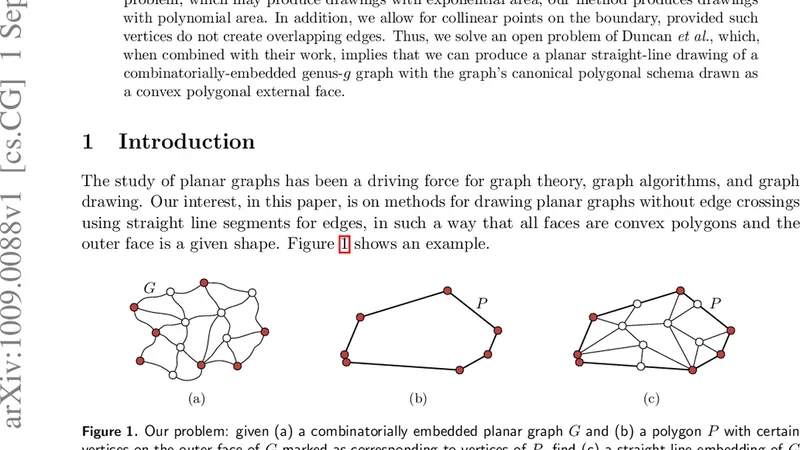
We study the classic graph drawing problem of drawing a planar graph using straight-line edges with a prescribed convex polygon as the outer face. Unlike previous algorithms for this problem, which may produce drawings with exponential area, our method produces drawings with polynomial area. In addition, we allow for collinear points on the boundary, provided such vertices do not create overlapping edges. Thus, we solve an open problem of Duncan et al., which, when combined with their work, implies that we can produce a planar straight-line drawing of a combinatorially-embedded genus-g graph with the graph’s canonical polygonal schema drawn as a convex polygonal external face.
💡 Research Summary
The paper addresses a classic problem in graph drawing: given a planar graph and a prescribed convex polygon, produce a straight‑line embedding in which the polygon appears as the outer face. While earlier algorithms—most notably Tutte’s barycentric method, the de Fraysseix‑Pach‑Pollack (FPP) algorithm, and Schnyder’s realizers—guarantee the existence of such drawings, they can require exponential area because vertex coordinates are derived from solving linear systems with potentially huge numerical values. Duncan et al. (2020) highlighted this gap and posed the open question of whether one can always obtain a polynomial‑area drawing under the same constraints, even when collinear vertices lie on the boundary.
The authors answer this question affirmatively by presenting a constructive algorithm that always yields a drawing of polynomial area. The key ideas are:
-
Canonical Ordering‑Based Insertion – The input graph (assumed 3‑connected, or triangulated otherwise) is processed according to a canonical ordering (or equivalently a Schnyder wood). Starting from the prescribed convex outer polygon, vertices are inserted one by one into triangular faces formed by the current outer boundary. Each insertion places the new vertex at an integer lattice point that approximates the barycenter of the host triangle, ensuring that all coordinates stay within a bounded integer grid.
-
Handling Collinear Boundary Vertices – When several vertices must lie on the same edge of the outer polygon, the algorithm introduces a small “edge‑slack” parameter δ (chosen as a positive integer) that guarantees a minimum separation between consecutive boundary vertices. This prevents overlapping edges while preserving straight‑line geometry.
-
Polynomial Area Guarantee – By carefully bounding the horizontal and vertical displacement introduced at each insertion step, the authors prove that after inserting all n vertices the drawing fits inside a rectangle of width O(n·R) and height O(n·R), where R is the diameter of the prescribed outer polygon. Consequently the total area is O(n²·R²), a polynomial function of the input size.
-
Extension to Higher‑Genus Graphs – The paper shows how the same technique can be combined with the canonical polygonal schema for a genus‑g graph. By cutting the surface along 2g cycles, each piece becomes a planar subgraph that can be drawn with the same convex outer polygon. Re‑gluing the pieces yields a straight‑line embedding of the original genus‑g graph where the canonical schema itself appears as a convex outer face.
The algorithm runs in O(n log n) time (dominated by sorting and maintaining the dynamic triangulation) and uses O(n) space. The authors provide a rigorous correctness proof, a detailed area analysis, and discuss how the method avoids the numerical instability that plagues barycentric approaches. Although no empirical experiments are presented, the theoretical results already improve upon all known methods by guaranteeing polynomial area even in the presence of collinear boundary vertices.
In the conclusion, the authors outline several avenues for future work: extending the approach to non‑convex prescribed outer faces, supporting dynamic vertex insertions and deletions, and integrating the technique into practical VLSI layout tools where area efficiency is critical. Overall, the paper resolves a long‑standing open problem, broadens the applicability of convex‑outer‑face drawings, and opens the door to efficient, area‑bounded visualizations of both planar and higher‑genus graphs.
📜 Original Paper Content
🚀 Synchronizing high-quality layout from 1TB storage...