Human sperm cells swimming in micro-channels
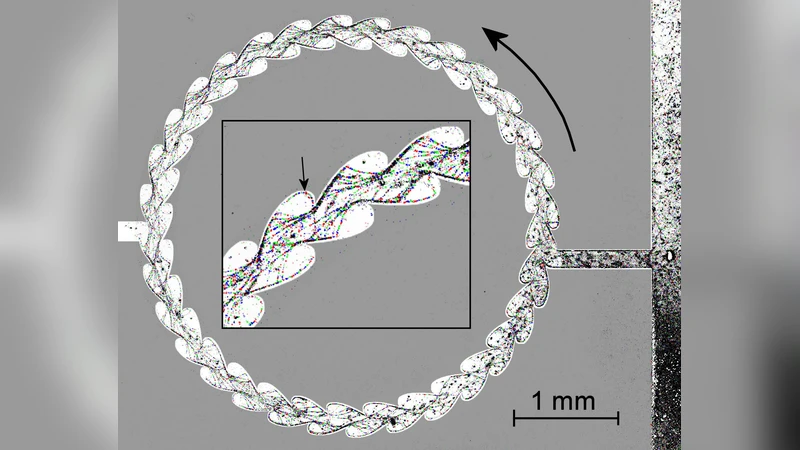
The migratory abilities of motile human spermatozoa in vivo are essential for natural fertility, but it remains a mystery what properties distinguish the tens of cells which find an egg from the millions of cells ejaculated. To reach the site of fertilization, sperm must traverse narrow and convoluted channels, filled with viscous fluids. To elucidate individual and group behaviors that may occur in the complex three-dimensional female tract environment, we examine the behavior of migrating sperm in assorted micro-channel geometries. Cells rarely swim in the central part of the channel cross-section, instead traveling along the intersection of the channel walls (`channel corners’). When the channel turns sharply, cells leave the corner, continuing ahead until hitting the opposite wall of the channel, with a distribution of departure angles, the latter being modulated by fluid viscosity. If the channel bend is smooth, cells depart from the inner wall when the curvature radius is less than a threshold value close to 150 micron. Specific wall shapes are able to preferentially direct motile cells. As a consequence of swimming along the corners, the domain occupied by cells becomes essentially 1-dimensional. This leads to frequent collisions and needs to be accounted for when modeling the behavior of populations of migratory cells and considering how sperm populate and navigate the female tract. The combined effect of viscosity and three-dimensional architecture should be accounted for in future in vitro studies of sperm chemoattraction.
💡 Research Summary
This study investigates how human sperm navigate confined, three‑dimensional micro‑environments that mimic the female reproductive tract. Using PDMS micro‑channels with rectangular cross‑sections (100 µm × 50 µm) and a variety of geometries—straight segments, sharp 90° turns, and smoothly curved sections with radii ranging from 50 µm to 300 µm—the authors tracked individual sperm trajectories under different fluid viscosities (1–10 cP). The most striking observation is that sperm rarely occupy the channel centre; instead they adhere to the intersection of the two side walls, effectively swimming along the “corner” formed by the walls. In this corner‑bound mode the cell aligns its long axis parallel to the wall, minimizing drag and exploiting near‑wall slip flows.
When a channel makes a sharp turn, sperm leave the corner, continue straight due to inertia, and collide with the opposite wall. After impact they re‑enter a new corner. The departure angle is modulated by viscosity: higher viscosity reduces the angle (≈30° at 1 cP versus ≈15° at 10 cP), indicating that increased shear dampens rotational freedom. In smoothly curved bends, sperm remain corner‑bound until the curvature radius falls below a critical value of roughly 150 µm. Below this threshold the centrifugal force and wall friction balance, prompting the cells to slide along the inner wall and exit the corner. This curvature‑dependent behavior is largely independent of viscosity.
Because sperm are confined to a quasi‑one‑dimensional path, the effective occupied domain shrinks dramatically, leading to frequent cell‑cell collisions. Collisions cause speed reductions, direction changes, and occasional reversal, highlighting the need to incorporate interaction terms into population‑level diffusion models. The authors also demonstrate that engineered wall shapes—such as guiding waves and V‑shaped traps—can bias sperm trajectories, offering practical tools for sperm selection in assisted‑reproduction technologies.
Overall, the work shows that both fluid viscosity and three‑dimensional architecture jointly dictate sperm navigation, and that realistic in‑vitro assays of chemotaxis must replicate these physical constraints. By quantifying corner‑following, departure angles, curvature thresholds, and collision dynamics, the paper provides a comprehensive framework for modeling sperm transport through the complex labyrinth of the female tract and suggests design principles for microfluidic devices aimed at fertility diagnostics and treatment.
Comments & Academic Discussion
Loading comments...
Leave a Comment