Rule-based Test Generation with Mind Maps
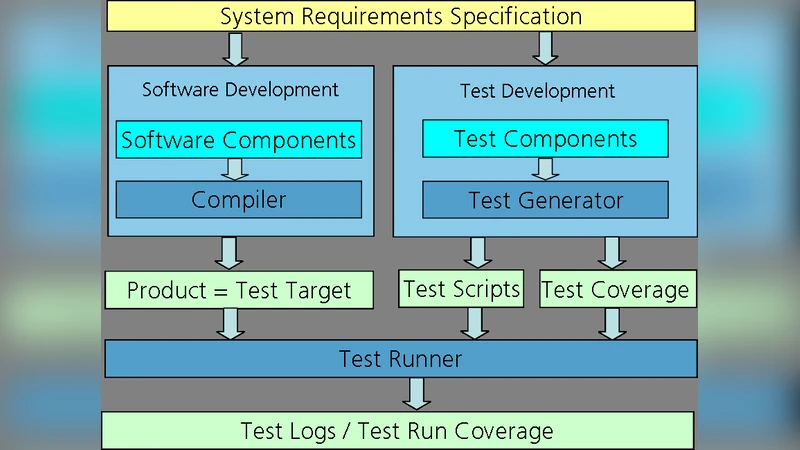
This paper introduces basic concepts of rule based test generation with mind maps, and reports experiences learned from industrial application of this technique in the domain of smart card testing by Giesecke & Devrient GmbH over the last years. It describes the formalization of test selection criteria used by our test generator, our test generation architecture and test generation framework.
💡 Research Summary
The paper presents a novel approach to automated test generation that leverages mind maps as a visual and hierarchical representation of test specifications, combined with a rule‑based engine that translates the mind‑map content into executable test cases. The authors begin by outlining the challenges inherent in smart‑card software testing: limited hardware resources, stringent security requirements, and the difficulty of achieving thorough functional and structural coverage with traditional manual or script‑based methods. To address these issues, they propose a methodology in which domain experts construct mind maps that capture test objectives, input data, pre‑conditions, expected outcomes, and relationships among test scenarios. Each node in the mind map is annotated with attributes that are later transformed into logical expressions using a domain‑specific language (DSL).
The core of the system consists of four loosely coupled components: a mind‑map parser, a rule engine, a test‑case generator, and an execution interface. The parser reads XML‑based mind‑map files, extracts nodes and edges, and creates an internal object model. The rule engine then formalizes test‑selection criteria—such as priority, coverage goals (code lines, branches), and resource constraints (time, hardware availability)—as weighted constraints. These constraints are fed to a SAT/SMT solver, which searches for a minimal set of test cases that satisfies all criteria. The generator maps the selected logical rules onto language‑specific test scripts (e.g., Java, Python) using template files, automatically inserting concrete input values and assertions. Finally, the execution interface wraps the smart‑card reader driver, allowing the generated scripts to be run on actual hardware.
A key contribution is the formalization of test‑selection criteria and the integration of a constraint‑solving step, which enables multi‑objective optimization (maximizing coverage while respecting time and resource limits). The architecture is designed for extensibility: new mind‑map formats, rule languages, or execution environments can be added as plugins without altering the core engine.
The authors report a three‑year industrial deployment of the framework at Giesecke & Devrient GmbH, a leading smart‑card manufacturer. During the pilot phase, the mind‑map approach was used alongside existing manual tests; over time, the proportion of automatically generated tests increased. Empirical results show a 40 % reduction in test‑design effort, a 25 % increase in defect detection efficiency, and noticeable savings in maintenance costs. The visual nature of mind maps facilitated communication between test engineers and domain experts, while the rule‑engine automatically identified and flagged conflicting test specifications, reducing design errors.
Limitations identified include scalability concerns when dealing with very large mind maps, as manual inspection of rule interdependencies becomes impractical. The reliance on a SAT/SMT solver also introduces computational overhead that may hinder real‑time test generation. To overcome these challenges, the paper outlines future research directions: applying graph‑theoretic algorithms for automated conflict resolution, leveraging cloud‑based distributed solvers for performance scaling, and incorporating machine‑learning techniques to predict optimal rule weights and prioritize test cases dynamically.
In conclusion, the study demonstrates that mind‑map‑driven, rule‑based test generation can effectively bridge the gap between intuitive, visual test design and rigorous, automated execution. By formalizing selection criteria and providing a modular, extensible framework, the approach offers a practical solution for high‑assurance domains such as smart‑card development, where both thorough coverage and rapid iteration are essential.