Heterogeneity shapes groups growth in social online communities
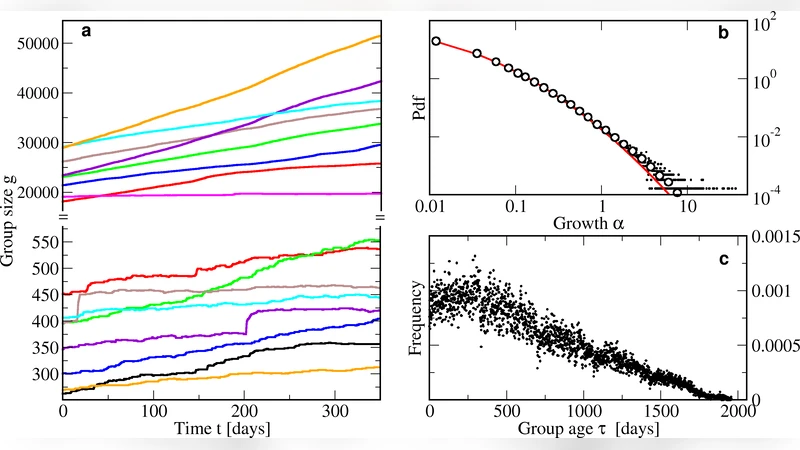
Many complex systems are characterized by broad distributions capturing, for example, the size of firms, the population of cities or the degree distribution of complex networks. Typically this feature is explained by means of a preferential growth mechanism. Although heterogeneity is expected to play a role in the evolution it is usually not considered in the modeling probably due to a lack of empirical evidence on how it is distributed. We characterize the intrinsic heterogeneity of groups in an online community and then show that together with a simple linear growth and an inhomogeneous birth rate it explains the broad distribution of group members.
💡 Research Summary
The paper investigates why online social groups exhibit heavy‑tailed size distributions and apparent “rich‑gets‑richer” growth, using data from the photo‑sharing site Flickr. Two complementary datasets were assembled: (i) a high‑resolution time series of 9,503 groups tracked daily over 350 days, and (ii) a large‑scale snapshot of more than 260,000 public groups with membership counts and estimated birth dates (the date of the first photo posted).
Empirical analysis shows that most groups grow approximately linearly in time. For each group the size can be written as g(t)=1+α·(t−t₀), where α is a per‑day growth rate and t₀ the birth date. The growth rates, measured as the average daily increase over six weeks, follow a log‑normal distribution (μ≈−3.62, σ≈1.57). Moreover, the number of newly created groups increases roughly linearly with calendar time, indicating a non‑stationary birth process.
Based on these observations the authors propose a minimal “heterogeneous linear growth model”. At each discrete time step (one day) a number of new groups proportional to the current time is introduced; each new group starts with one member and receives a growth rate α drawn independently from the empirical log‑normal distribution. All existing groups then increase their size by their own α. Simulating this process for 1,959 days (the period covered by the data) reproduces the observed complementary cumulative distribution of group sizes with high fidelity; only the very largest groups are slightly over‑predicted, an effect attributed to the occasional abrupt jumps seen in small groups that inflate the estimated α.
A key result is that the model naturally yields an average growth conditional on size, ⟨α|g⟩∝g, i.e., Gibrat’s law, even though the microscopic rule contains no preferential attachment. The apparent proportionality arises because groups of the same size can have very different ages and intrinsic growth rates: older, slow‑growing groups coexist with younger, fast‑growing ones, and the mixture produces a linear ⟨α|g⟩ relationship. Analytically, the authors derive expressions for ⟨α|g⟩ and the size distribution p(g) by assuming independence between α and age τ and integrating over their joint probability. Substituting the empirical log‑normal p(α) and a linear age distribution yields numerical solutions that match both simulations and data, confirming the validity of the independence assumption.
To contrast the heterogeneity‑driven mechanism with classic preferential growth, the authors adapt Simon’s model (originally for word frequencies) to the same setting. In Simon’s formulation, each new member either creates a new group (probability q) or joins an existing group chosen proportionally to its current size. When calibrated to the same total number of groups and members and forced to have a linearly increasing birth rate, Simon’s model produces a strong correlation between a group’s initial size (measured a year earlier) and its final size, and a tight age‑size relationship. By contrast, the real Flickr data and the heterogeneous linear growth model display only a weak age‑size correlation and a broad spread of final sizes for groups of the same age. This demonstrates that the heavy‑tailed size distribution and the apparent “rich‑gets‑richer” effect can emerge without any explicit preferential attachment; they are instead a statistical consequence of heterogeneous growth potentials combined with an inhomogeneous birth process.
In the discussion the authors emphasize that many complex systems—cities, firms, scientific collaborations—show similar heavy‑tailed distributions, yet the underlying cause may often be intrinsic heterogeneity rather than cumulative advantage. Their simple framework suggests that measuring and modeling the distribution of “fitness” or growth propensity is crucial for understanding the dynamics of such systems. While the model does not explain why certain groups have higher α (e.g., thematic relevance, leader activity, external promotion), it shows that once such heterogeneity exists, preferential‑attachment‑like signatures can arise automatically. The paper thus contributes a parsimonious, empirically grounded alternative to classic preferential‑attachment models and opens avenues for future work to identify the determinants of growth heterogeneity across online and offline social systems.
Comments & Academic Discussion
Loading comments...
Leave a Comment